 Powered by SlotsReach.com
Sugar Rush pays 150x at most, and everything above that comes off the board
Pragmatic’s June 2022 candy slot keeps almost none of its money in the symbols. Fifteen pink lollipops on a grid that only holds forty-nine cells pay 150x, yet the game advertises a 5,000x maximum win. Every one of those missing multiples has to come from multipliers the grid collects while you play, which makes the reels a delivery system for board state rather than a direct source of cash. The math runs at 96.50%, the volatility is high, and that 5,000x is a hard cap rather than a big number somebody once hit.
Wins land in clusters when five or more matching sweets touch up, down, left, or right anywhere on the 7×7 board. There are no lines, no ways, and genuinely no wild anywhere in the game, which is an odd choice for a Pragmatic cluster title. This is the original release of the Sugar Rush line, establishing the mechanic the studio has been rebuilding sequels around ever since.
How the multiplier spots work
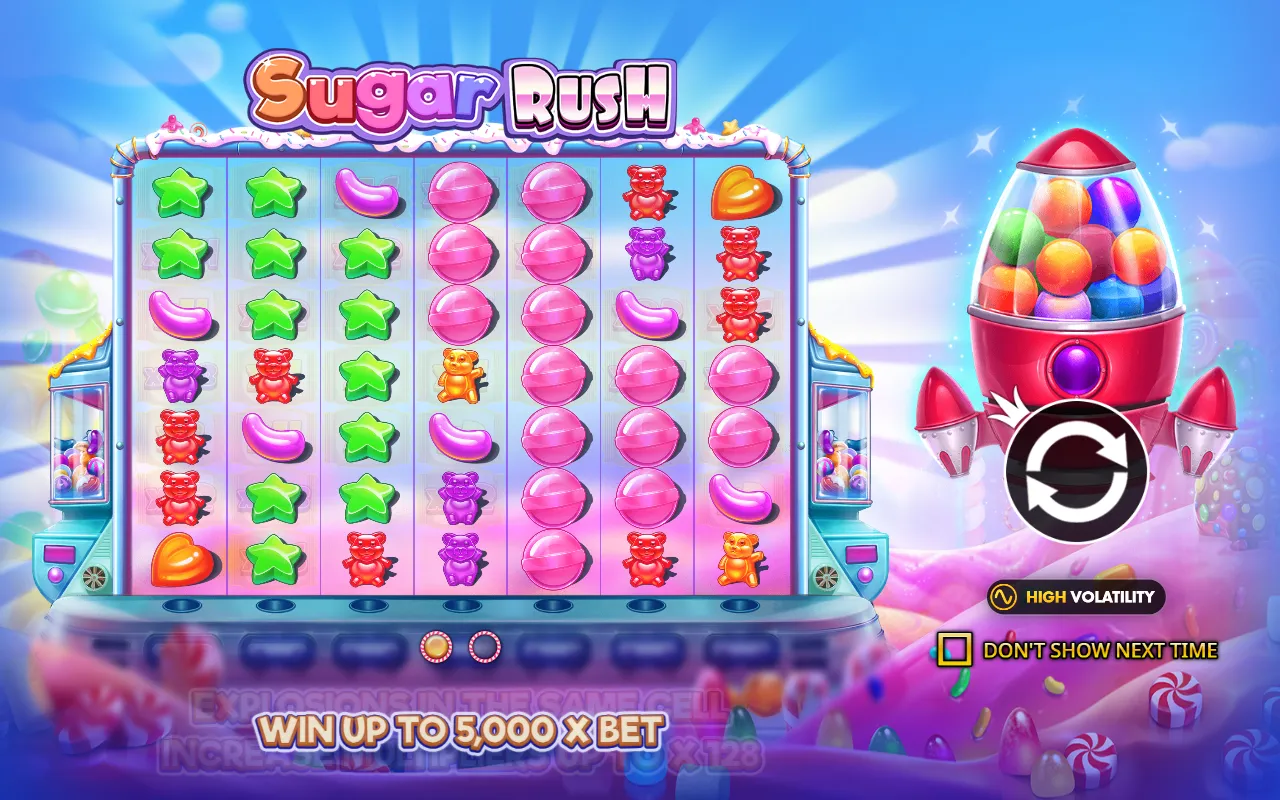
Every symbol that explodes marks the cell it was sitting in, though nothing happens the first time. The second time a symbol explodes on that same cell, the spot picks up a x2 multiplier, and every explosion after that doubles it to x4, x8, and x16, all the way up to a ceiling of x128 per cell.
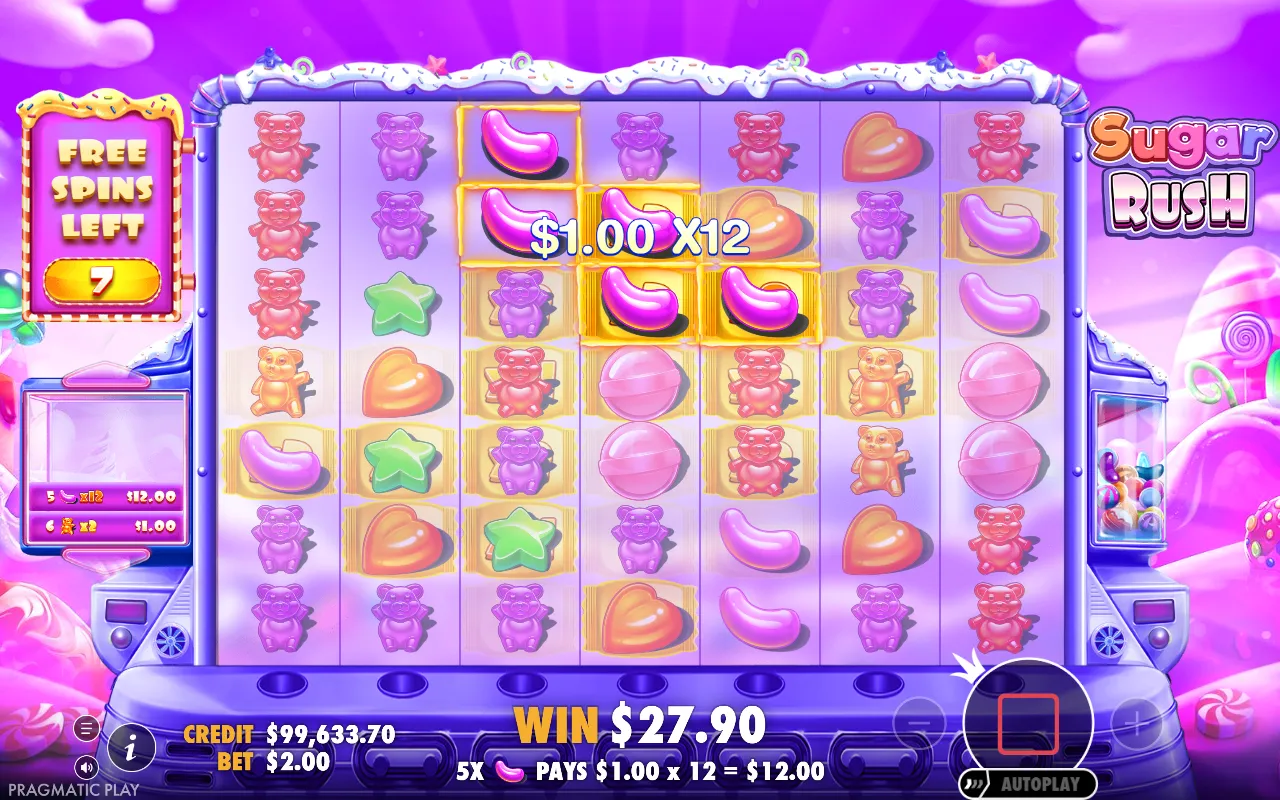
The part that decides how the game pays is what happens when several marked cells land inside one winning cluster. They add rather than compound, so a cluster covering five cells that each read x8 is paid at x40 rather than x8 raised to a power. The big win here is always a wide cluster landing on well-chewed ground rather than a small one on a single monstrous cell, and the game shows the sum as it pays, which is a nice touch on a mechanic that could easily have been opaque.
What separates the base game from the bonus is that the marks only survive until the tumbling stops. One spin can tumble three or four times to build a little multiplier state, and then it all wipes. We watched three cells reach x2 in a base spin and vanish a second later, leaving you playing a cluster slot with a paytable that tops out at 150x. It feels exactly like that, especially when a 1 in 2.9 hit rate delivers cheap hits worth less than the stake. Twelve base spins gave us two wins of $2.10 and $1.40, and the other ten paid nothing at all.
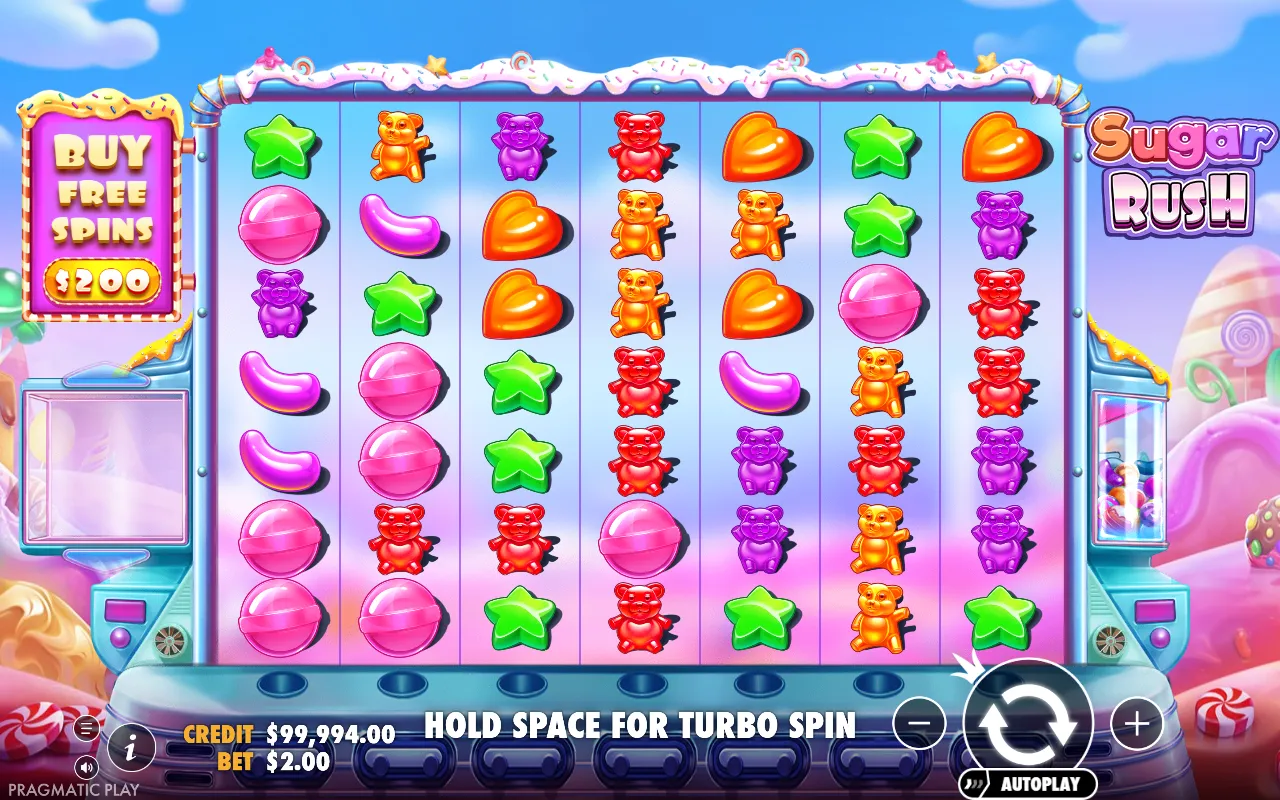
The free spins, and what $200 bought
Three to seven candy-machine scatters in a single tumble sequence open the round for 10, 12, 15, 20, or 30 free spins, and the same counts can retrigger it from inside. Nothing about the reels changes except that the marked spots and their multipliers stop being wiped. They hold for the entire round and keep doubling across all the spins, meaning the board can only ever get better. That single difference is the whole product, making this a bonus that is a genuinely different game rather than just the base game with the price removed.
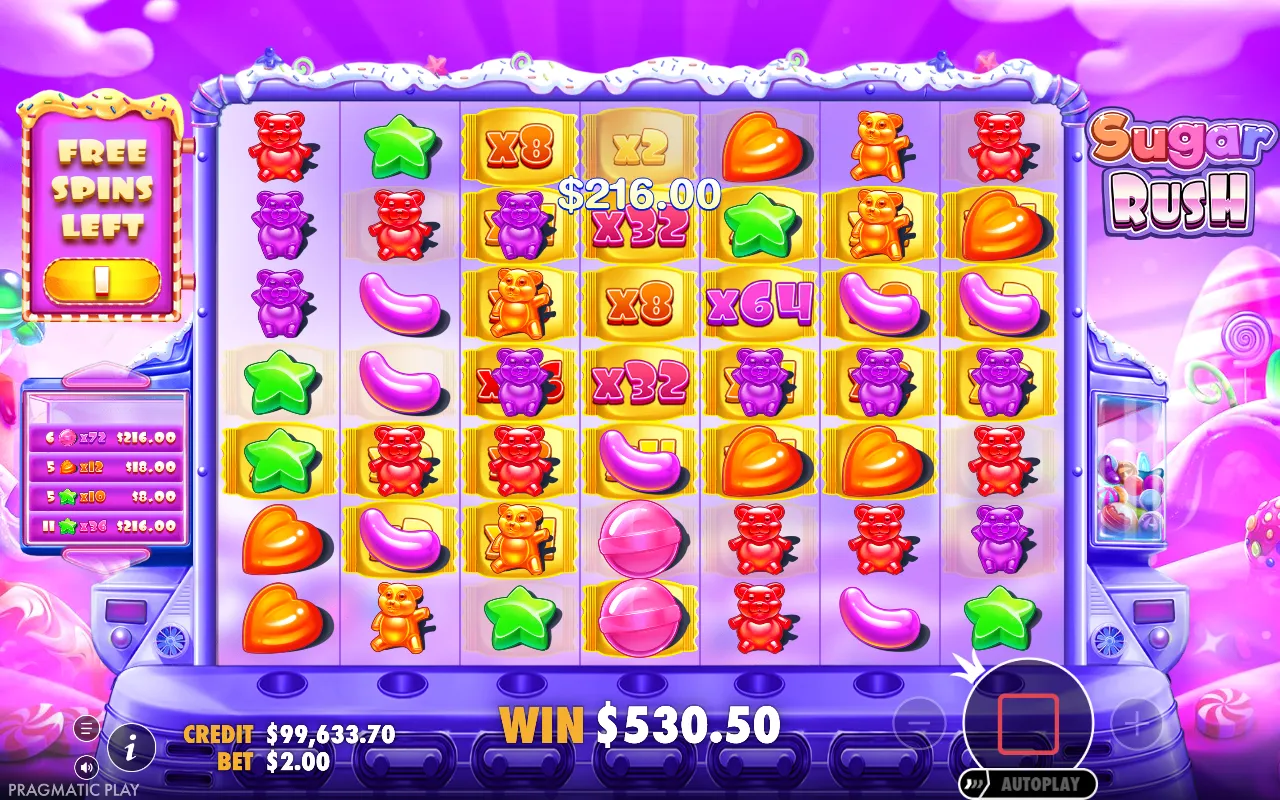
The buy costs 100x the total bet, which was $200 against the $2.00 we were playing, and the return is 96.50% either way. That parity is worth knowing because a bought round usually returns less than the base game does. What the purchase does not buy is the size of the award, since the scatter count is drawn at random. You can pay 100x and get the ten-spin version, which is exactly what happened when we bought twice and got ten spins both times.
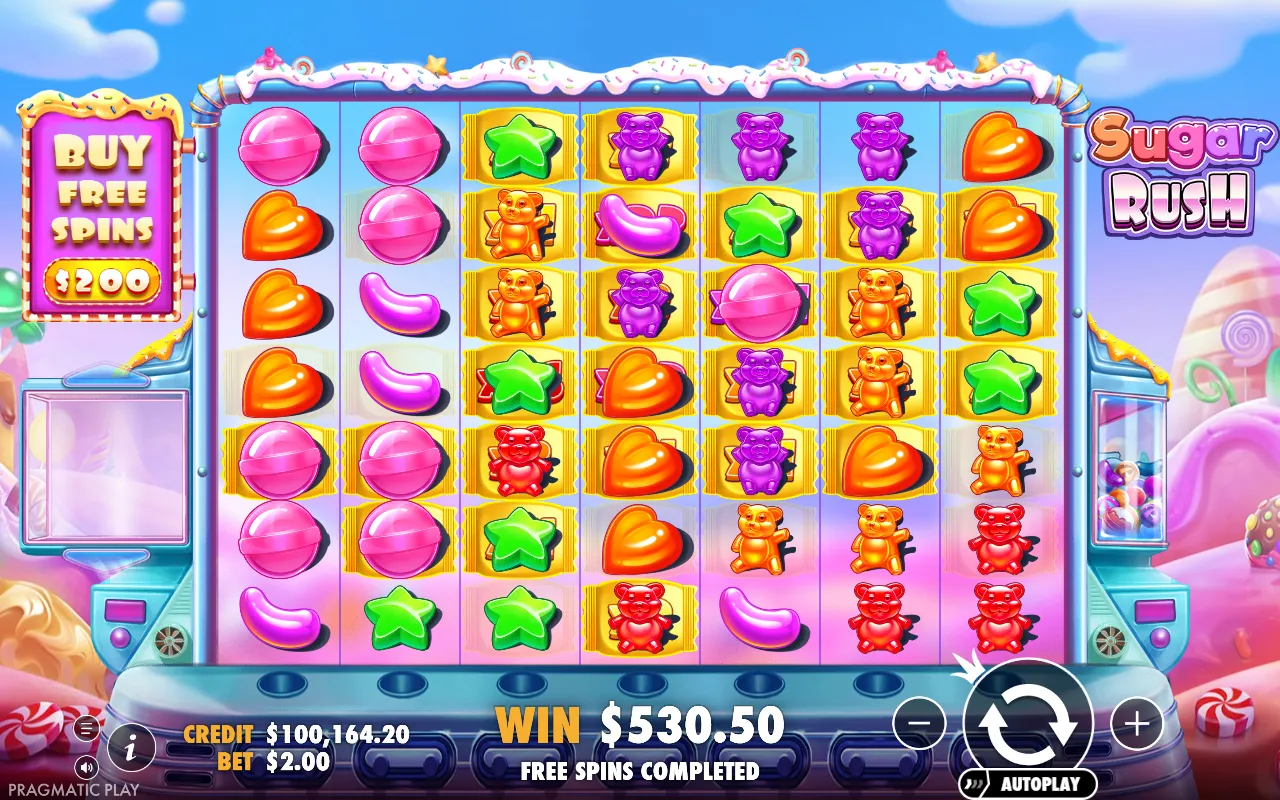
Those two rounds cost the same and could not have gone more differently. The first came back at $54.20, about a quarter of its price. The second opened just as slowly, with spins five through eight paying nothing while the board quietly filled up to twenty marked cells, then paid $33.00 on spin nine and detonated on spin ten. Eleven green stars at a summed x36 paid $216.00, followed by two smaller clusters, and then six pink lollipops at a summed x72 for another $216.00 to finish out a $530.50 round.
The sweets and what they pay
The paytable puts a pink lollipop at the top, followed by an orange heart, a pink jelly bean, a green star, and gummy bears in red, purple, and orange at the bottom. Five lollipops return your stake exactly, nine of them pay two and a half times it, and only at fifteen does the ladder jump to 150x. The worst symbol runs from 0.2x to 20x. Read across that table and the design is obvious: the symbols are there to trigger explosions, and the explosions are where the money is.
The ceiling has teeth, too. Hitting 5,000x does not merely cap what you are paid, it ends the free spins round on the spot and forfeits whatever spins are left. Land it on spin two of thirty and twenty-eight awarded spins go with it. The chance of getting there is 1 in 2,340,000, which is a long way out even by the standards of a 5,000x game. Fruit Party and Fruit Party 2 carry the same headline ceiling at 1 in 95,891 and 1 in 495,050.
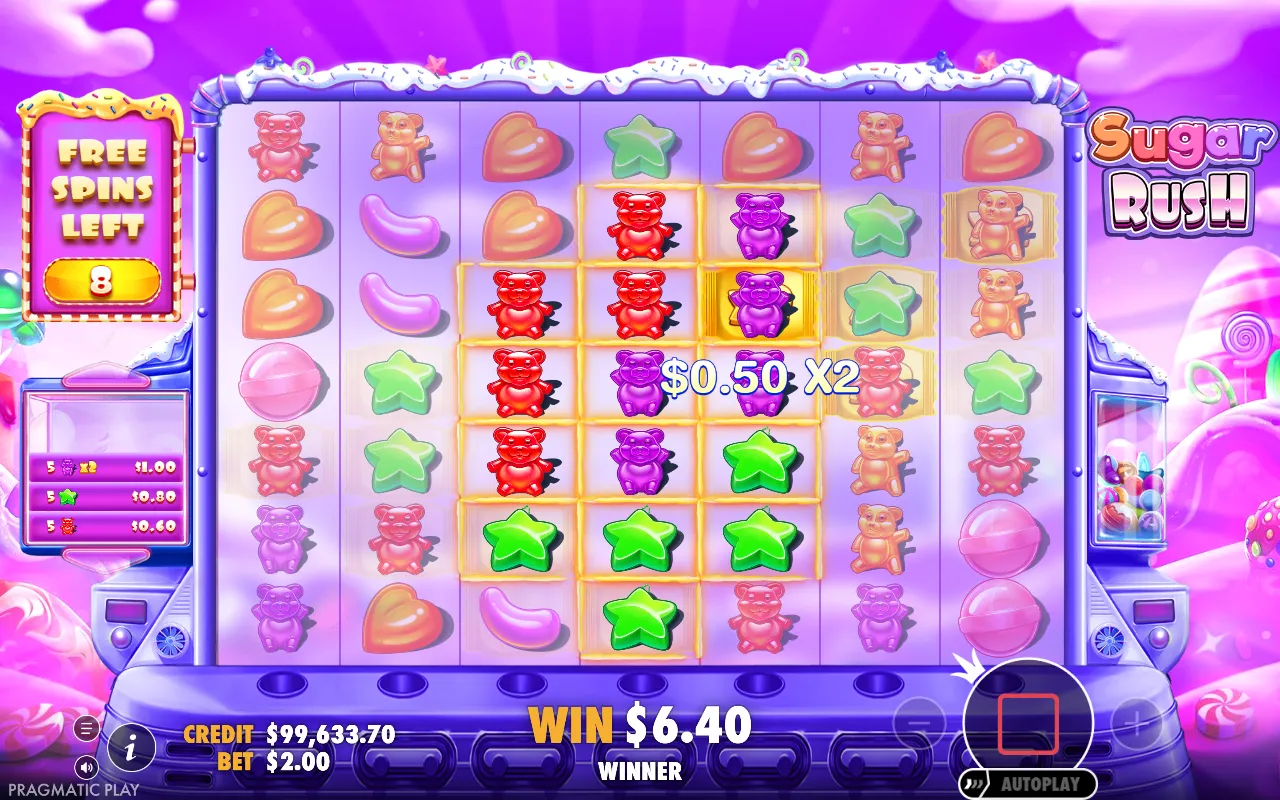
Visually it is Pragmatic’s house candyland with the saturation pushed all the way up, jelly sweets shot like product photography over hills of ice cream. There is no story, no character, and no joke, and after an hour it is exactly as sweet as it was in the first minute. What the art does earn its keep on is legibility. A cell carrying a multiplier turns gold with its value printed on it, so ten spins into a good bonus you can read the state of the whole round off the grid without needing a meter or a counter anywhere.
The series, and the other Sugar Rush
Pragmatic has built the line out steadily since this original release. Sugar Rush 1000 raised the ceiling to 25,000x in 2024, Sugar Rush Xmas reskinned it, and Sugar Rush Super Scatter went to 50,000x in January 2026. The multiplier spots even crossed over into other games like Sweet Rush Bonanza, which welds them onto the pays-anywhere engine from Sweet Bonanza. This game is simply where the mechanic starts.
One warning is worth having. Pragmatic released a completely different game called Sugar Rush back in 2015, featuring a 5×3 board, twenty paylines, 95.245% return, and medium volatility. It has nothing in common with this one beyond the name, so if a casino lobby serves you a five-reel game with paylines, you are on the older one.
Pros and cons
Good
- The bonus is mechanically a different game, not just free spins, because the multiplier board persists for the whole round
- The buy runs at the same 96.50% as the base game, where most buys return less
- The mechanic is completely readable on screen, with gold tiles and numbers telling you how the round is going at a glance
- Wide clusters adding their multipliers together makes for genuinely explosive single spins, like the $216.00 twice on one spin we saw
Bad
- The base game wipes its multipliers between spins, leaving most of your session feeling like a cluster slot with a 150x paytable
- There is no wild at all, which leaves nothing to rescue a board that lands badly
- Hitting the 5,000x cap ends the round immediately and forfeits every remaining free spin
- The buy is a lottery on award size, meaning you can pay 100x and get the smallest of the five, as we did twice
Verdict
Two $200 purchases returning $54.20 and $530.50 from the identical ten spins is the honest shape of this game rather than bad luck on one of them. The base game is thin on purpose and the free spins are where all the math lives, so the 100x buy is not really an optional shortcut here, it is the game being sold separately. At 96.50% on both sides it is at least an honest price, and the round is fun to watch in a way the base game never is, with the board turning gold cell by cell while you count spins. Anyone playing Sugar Rush 1000 or Super Scatter for their bigger ceilings is playing a version of this, as the multiplier spots were invented here and every sequel since has been the same board with a taller number bolted on top.