 Powered by SlotsReach.com
Gates of Olympus 2500 finally changes a rule
Pragmatic Play has spent five years re-selling Gates of Olympus with bigger numbers on the logo. Gates of Olympus 2500, due 28 September 2026, is a different kind of sequel. Where Gates of Olympus 1000 widened the multiplier range and left the game alone, this one rewrites a clause in the free spins, and it happens to be the clause players have complained about since 2021. Multipliers that land on losing spins can now count. Not everywhere, the option only exists in two of the game’s four bonus types, but it is the first thing in this family that isn’t just inflation.
The rest of the math reads exactly as expected. The RTP is 96.52%, the volatility is high, and every win is capped at 25,000x the bet. One thing to get straight before the name misleads you: the 2500 on the logo is the biggest value a multiplier orb can carry, not the ceiling. The ceiling is ten times that.
Pays anywhere, tumbles, and no wild
The machine underneath hasn’t moved. Land eight or more of the same symbol anywhere on the 6×5 board and it pays; the winners vanish, everything drops down, and new symbols fall in until the board stops producing. Chains have no cap, and our longest ran five boards.
Multiplier orbs are the other half of the engine. Winged spheres carrying anything from 2x to 2,500x can drop on any spin or any tumble, base game included. When the tumbling stops, every orb still on screen adds its value into one total, and that total multiplies everything the sequence paid. Added is the operative word here, two 50x orbs make 100x, not 2,500x. An orb on a losing board does nothing at all, because there’s nothing for it to multiply.
There’s no wild in the game. The Zeus scatter does double duty instead, and it’s quietly the second-best payer on the reels: six or more of them pay 100x, while twelve-plus crowns, the best regular symbol, pay 50x. The gems at the bottom of the table are just filler. Nine green ones landed for us and paid $0.80 on a $2.00 bet.
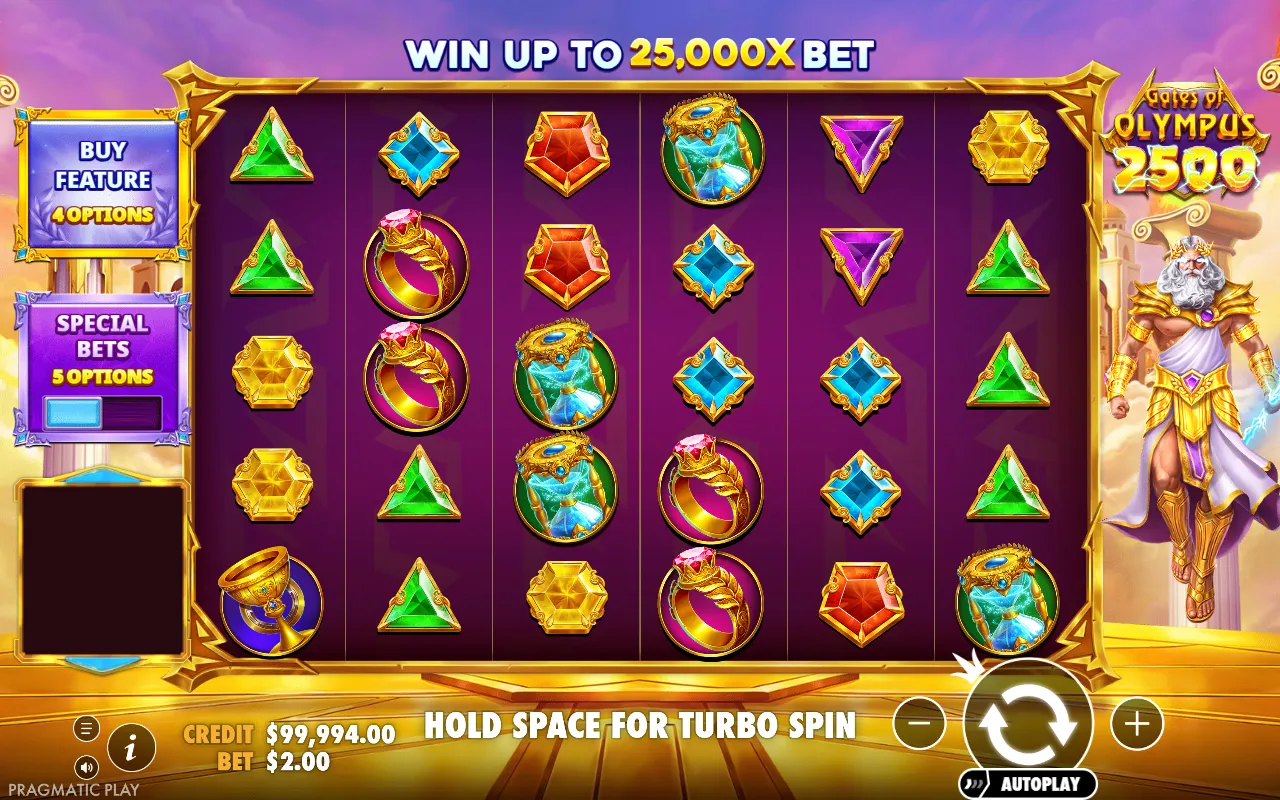
Between those moments, the base game is patient work. Roughly one spin in three or four pays anything, and three of our five opening spins ended on the first board with absolutely nothing.
Four bonuses behind one wheel
Four or more scatters open the round, and the count only changes the cash attached: four pay 3x, five pay 5x, and six or more pay a startling 100x. The spins themselves are fixed at fifteen no matter how many scatters triggered them. Left to land on its own, the trigger shows up about once every 443 spins.
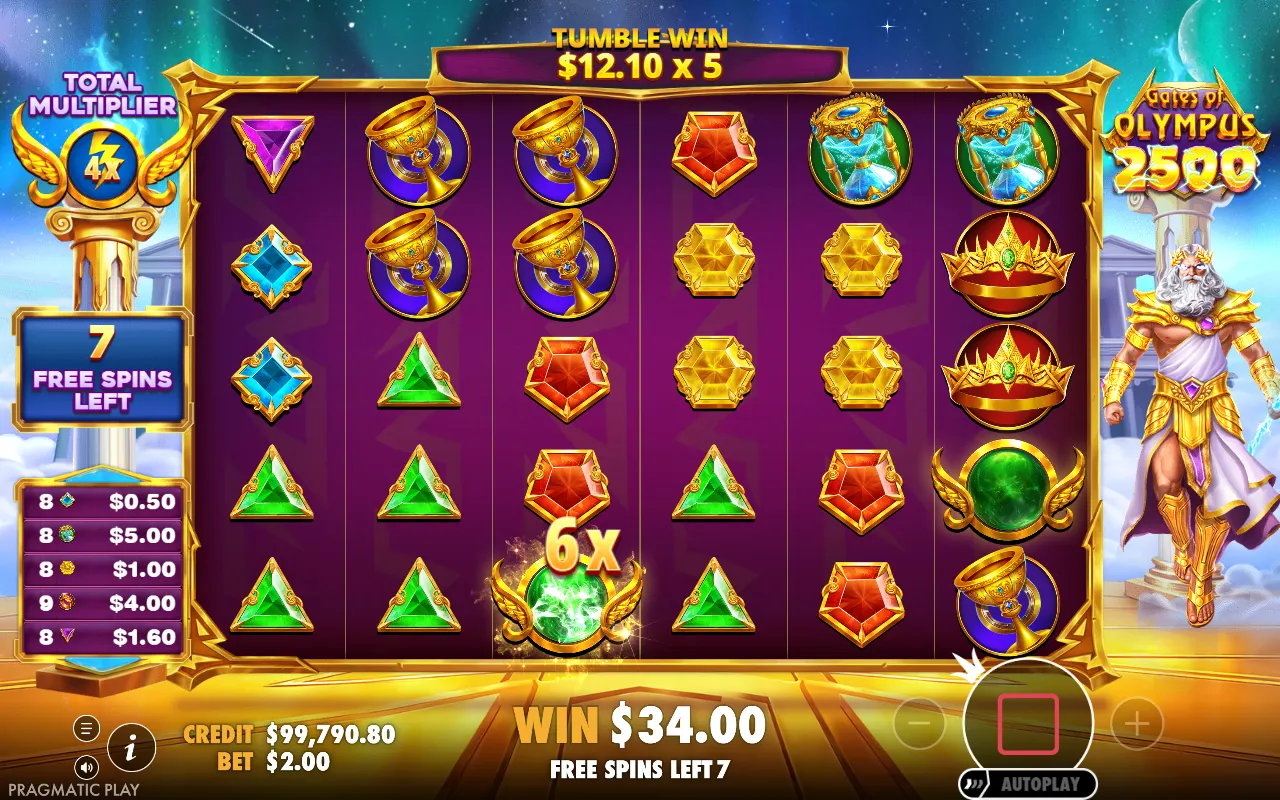
Before the round starts, a wheel spins to pick one of four free spins types. Don’t lean in too closely: the game’s own small print admits the wheel is just an animation for entertainment, and the type is already decided when it starts turning. All four types share the same core, which is a total multiplier that builds for the whole round. Qualifying orbs add their values to a running pillar, and the pillar multiplies wins from then on.
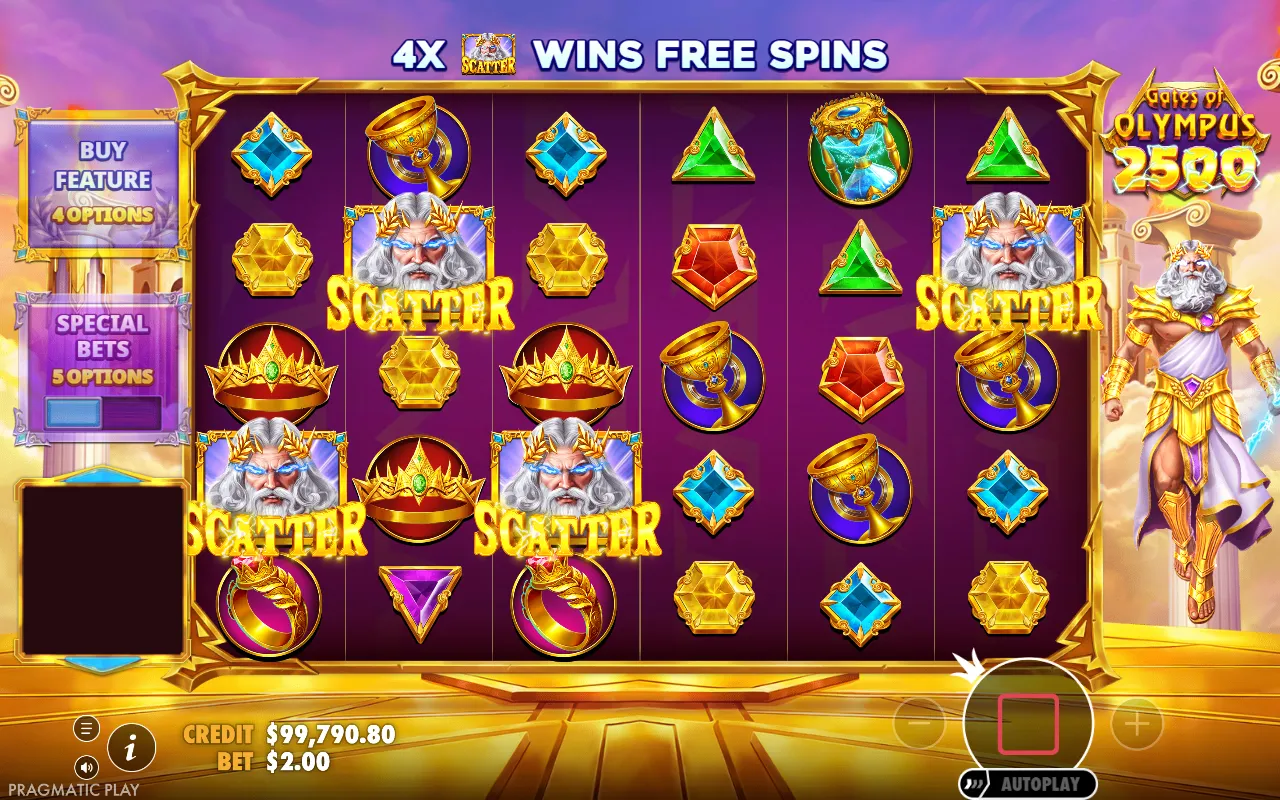
What separates the types is one clause each. In Free Spins 1, an orb only counts if it lands on a spin that wins, which is the original game’s rule. Free Spins 2 deletes that condition, meaning every orb that lands goes into the total, winning spin or not. The two Super versions repeat the pair with a floor of 10x on every orb.
Retriggers have a sharp edge worth knowing. Three scatters do nothing whatsoever in the base game, no consolation, no meter, but the same three landing inside any bonus type add five spins. It’s an identical board with completely different value, and nothing on screen marks the difference.
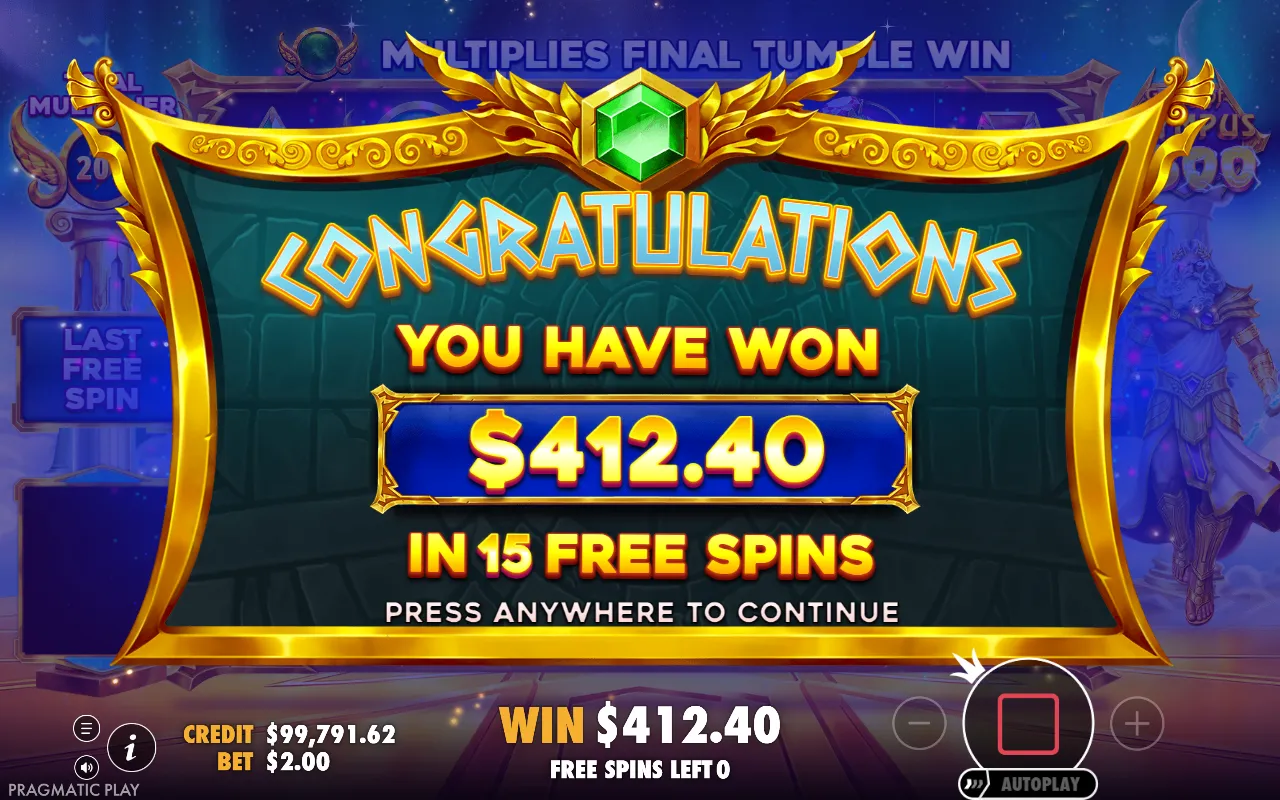
We bought Free Spins 1 for $200.00 at a $2.00 bet and got the whole character of the feature in one round. The trigger board paid its $6.00, and then almost nothing happened. Eleven spins in, the multiplier pillar was still empty and the round held just $7.50. The last four spins did everything. Orbs finally hit winning boards, the pillar closed at 20x, and the round finished at $412.40. Getting just over double the price delivered almost entirely in the final quarter proves that high volatility isn’t a badge here; it’s the schedule.
The buy menu and the five special bets
The buy menu sells all four types directly, which is also the only way to choose one: 100x the bet for Free Spins 1, 250x for Free Spins 2, then 500x and 1,250x for the Super pair. At our $2.00 stake, that ran from $200.00 to $2,500.00. The pricing tells you exactly where the designers think the value sits, as the every-orb-counts rule alone costs two and a half times the standard round. One genuinely good detail is that all four buys return 96.50% against 96.52% for normal play, meaning a buy costs a rounding error rather than a visible slice of RTP.
The special bets are a separate menu of five, and they can’t be combined with buys. Three ante levels raise the trigger odds: 1.25x the bet for double the chance of free spins, 2.75x for eight times the chance, and 5.5x for the same eight times plus a better spread of round types. Read that pricing twice. Ante Bet 3 doubles Ante Bet 2’s cost without improving the trigger rate at all; the extra money buys only the distribution.
Then come the two Super Spins, which are really a different game wearing the same robes. Super Spin 1 costs 20x the bet and guarantees a multiplier orb on every spin. Super Spin 2 costs 250x and guarantees it at 25x minimum. Both switch free spins off completely. The win cap heavily punishes the big one because the 25,000x ceiling is fixed against the normal bet rather than what a spin actually costs, which leaves Super Spin 2 able to return at most 100x its own stake. A mode priced at 250x a spin, with the bonus disabled and a 100x ceiling, is a hard thing to recommend to anybody.
The series, and what’s actually new
The original Gates of Olympus arrived in February 2021 and became one of the most imitated slots of its generation. Pragmatic has kept the family busy ever since with Super Scatter, POP, Dice, and a Christmas edition. Gates of Olympus 1000 in late 2023 raised the top orb to 1,000x, lifted the cap to 15,000x, and changed nothing else about how the game behaves. 2500 raises the numbers again, but the Free Spins 2 rule is the part that would still matter if the numbers had stayed put.
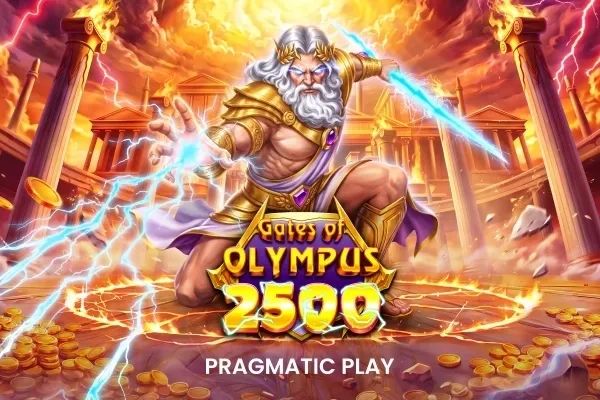
Visually, you’d need the logo to tell this apart from its siblings: same clouds, columns and golden platform, same gems and regalia on the reels, same giant Zeus looming beside them. The one new set piece is the bonus scene, which moves everything to a night sky with a temple and a steady rain of gold coins. It’s a handsome game in exactly the way the last four were, and that’s a choice, not an accident.
Pros and Cons
What works
- Free Spins 2 keeps every multiplier orb that lands, a real rule change in a series that usually just inflates numbers.
- All four buys run at 96.50%, barely under the base game’s 96.52%.
- A natural trigger can land any of the four round types, including the one priced at 1,250x, so patience is a real alternative to paying.
- Six or more scatters pay 100x, which is more than any regular symbol on the reels manages.
What doesn’t
- The base game is long stretches of dead boards; three of our five opening spins paid nothing.
- The type-selection wheel is pure theatre, and the game admits it.
- Super Spin 2 charges 250x the bet per spin with free spins disabled and a 100x ceiling.
- Art direction is on autopilot, giving us the exact same scene for the fifth entry running.
Verdict
Our $200.00 Free Spins 1 buy came back $412.40, and eleven of its fifteen spins contributed just $7.50 of that. That is this game in one round: a bonus that does nothing until it does everything, sitting on a base game that mostly watches gems fall. Whether you enjoy it comes down to whether fifteen minutes of nothing feels like tension or like waiting.
The reason to pick it over the original, or over 1000, is concrete rather than cosmetic. Free Spins 2 and its Super twin keep every orb, and that single deletion turns the round from a string of near-misses into a machine that only accumulates. The player this was built for is the one who watched a 100x orb land on a dead spin in the original and swore at the screen. Here, $500.00 on a $2.00 bet buys the round where that orb would have actually counted.