 Powered by SlotsReach.com
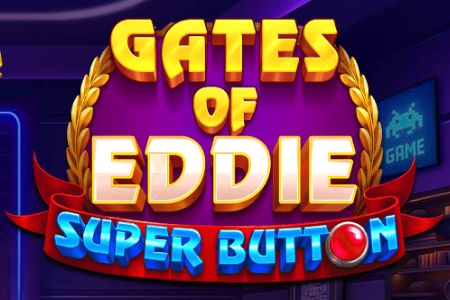
Gates of Eddie Super Button hides its top prize from its own bonus
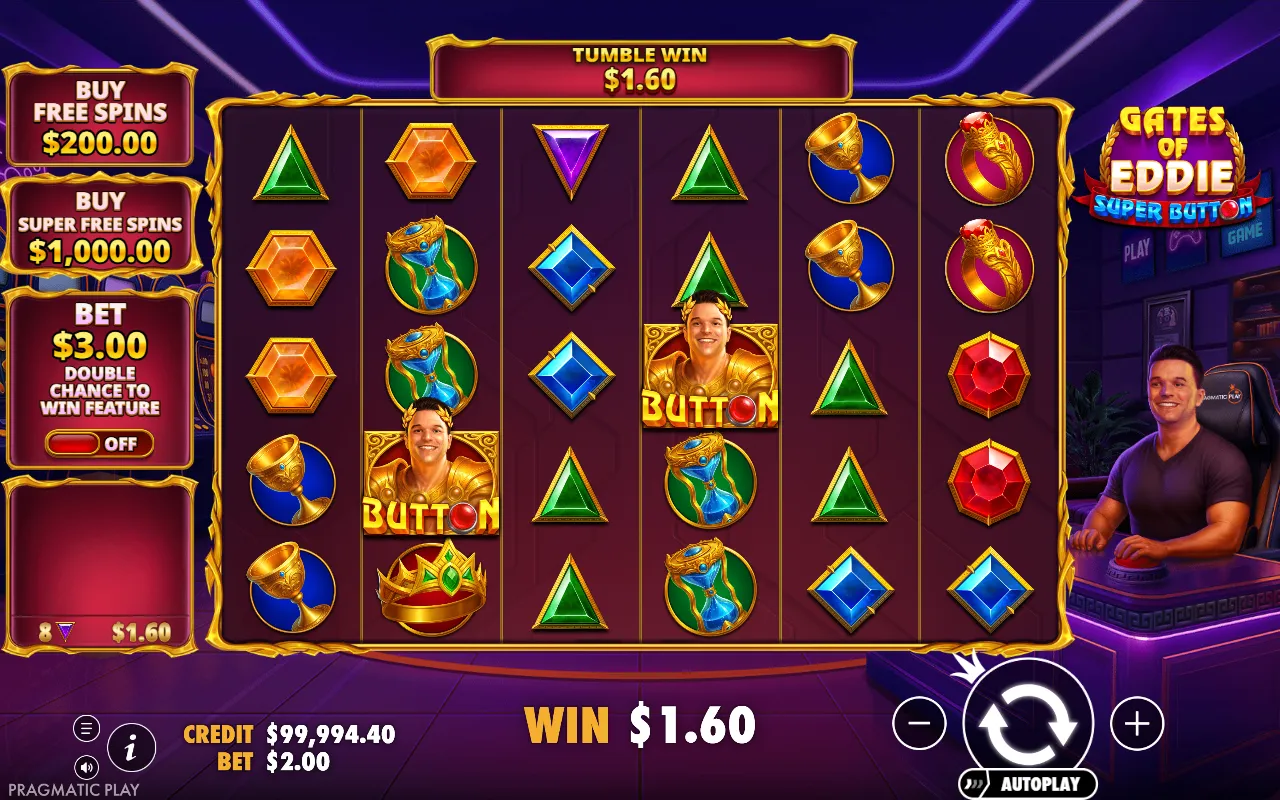
Pragmatic Play has rebuilt the Gates of Olympus engine something like two dozen times. This time, they’ve thrown out Zeus in favor of a cheerful man in a gaming chair with an oversized red button in front of him. The man is Ed Craven, co-founder of Stake, which is also the only place this game lives, it launched on 28 November 2025 as a true Stake exclusive. Underneath the personalized portrait, the engine is completely unchanged. You get a 6×5 board that pays for eight or more matching symbols anywhere in view, tumbling wins, and random multiplier orbs worth up to 500x.
The math profile brings a 96.50% RTP and a massive ceiling of 50,000x your stake. Curiously, the game labels its own volatility as medium, a rather peculiar badge to hang on a 50,000x slot. But what makes this title worth more than a passing shrug is where that 50,000x actually sits. It isn’t waiting for you in the bonus round, and neither of the game’s buy buttons can get you anywhere near it.
The Super Button and where the 50,000x lives
The ordinary scatter is Eddie’s face on a red panel with BUTTON written beneath it, and landing four or more anywhere will kick off the free spins. Sitting alongside it is a second scatter, the Super Button, featuring the same man redrawn as a bearded gold deity. It conveniently counts toward that four-scatter trigger requirement as well.
However, the Super Button doesn’t pay out based on its sheer count on the board. It pays based on how many of them are included inside a qualifying combination of four or more scatters. One Super Button in that combination pays 100x your total bet, two pay 500x, three pay 5,000x, and four hand over the full 50,000x. This means the absolute top prize in the game is awarded on the spot during a single base spin, with no feature played at all. Almost every other Pragmatic slot with a ceiling this high forces you to grind through a bonus round to reach it.
This quirk entirely reframes the game because the Super Button simply does not appear during free spins. It’s completely off the reels for the entire round. Both buy buttons sell you free spins, which means neither of them can ever reach the 50,000x cap. If you spend 500x your stake on the premium bonus, you are mechanically further away from the game’s ceiling than someone spinning flat at 20 cents.
Eight of anything, anywhere on the board
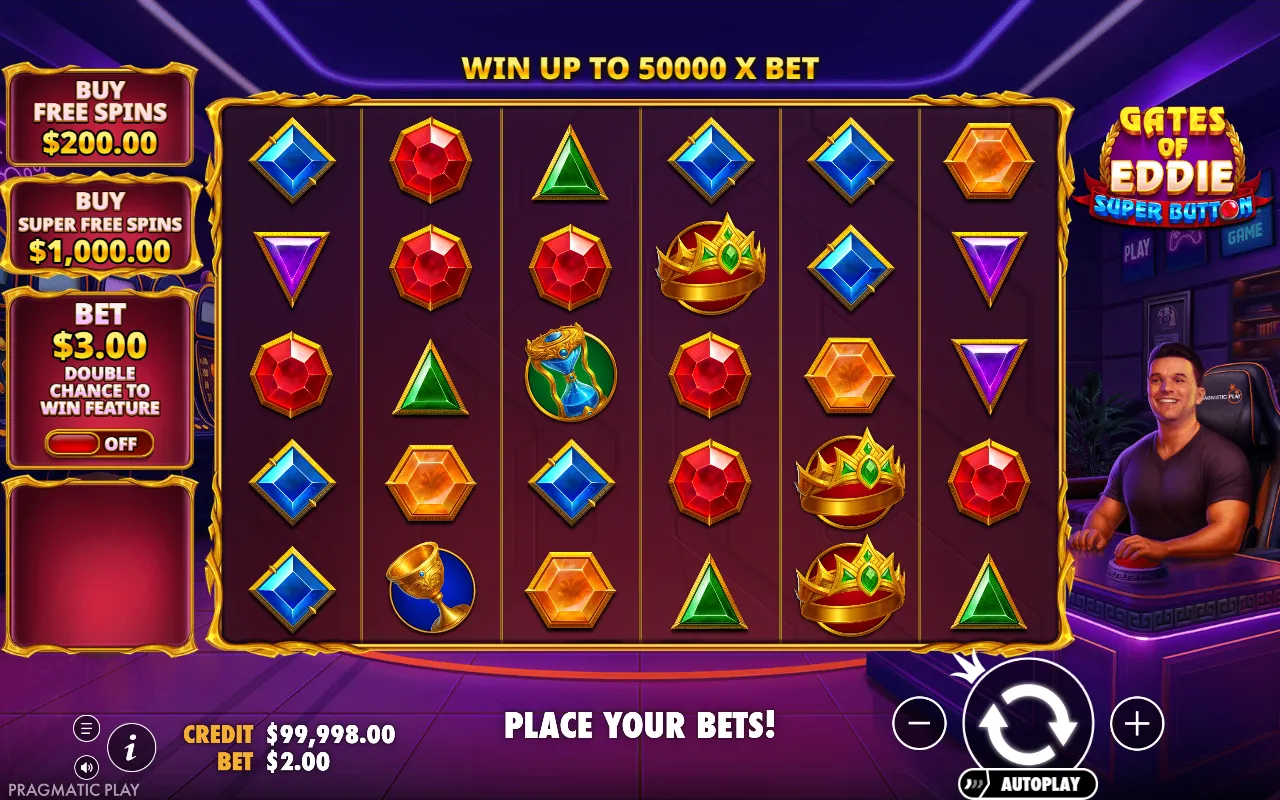
Wins here are counted, not lined up. Eight or more of the same symbol anywhere across the thirty cells will pay out, and their exact positions are totally irrelevant. Winning symbols disappear, everything above drops down, and fresh symbols fill the gaps. The sequence runs until a drop produces a dead board, though in our time with the game, the tumbles rarely chained past three.
The threshold is unforgiving in a way that’s easy to underestimate on a grid of this size. Seven of a symbol pays absolutely nothing, no matter what else is happening on the screen. The pay tiers group into 8-9, 10-11, and 12-30. That 12-symbol mark is exactly where the ladder stops climbing, meaning thirty crowns pay exactly what twelve crowns pay. Once a symbol is running, eighteen of those thirty cells are just decoration.
The multiplier orbs land at random on any spin or tumble, taking a value somewhere between 2x and 500x. When the tumbling stops, all the values on screen are added together and applied to that sequence. They are added, not multiplied by each other. Crucially, an orb that lands on a board that doesn’t pay is completely inert. It isn’t held, banked, or carried into the next spin. It just sits there.
The free spins and what the two buys gave back
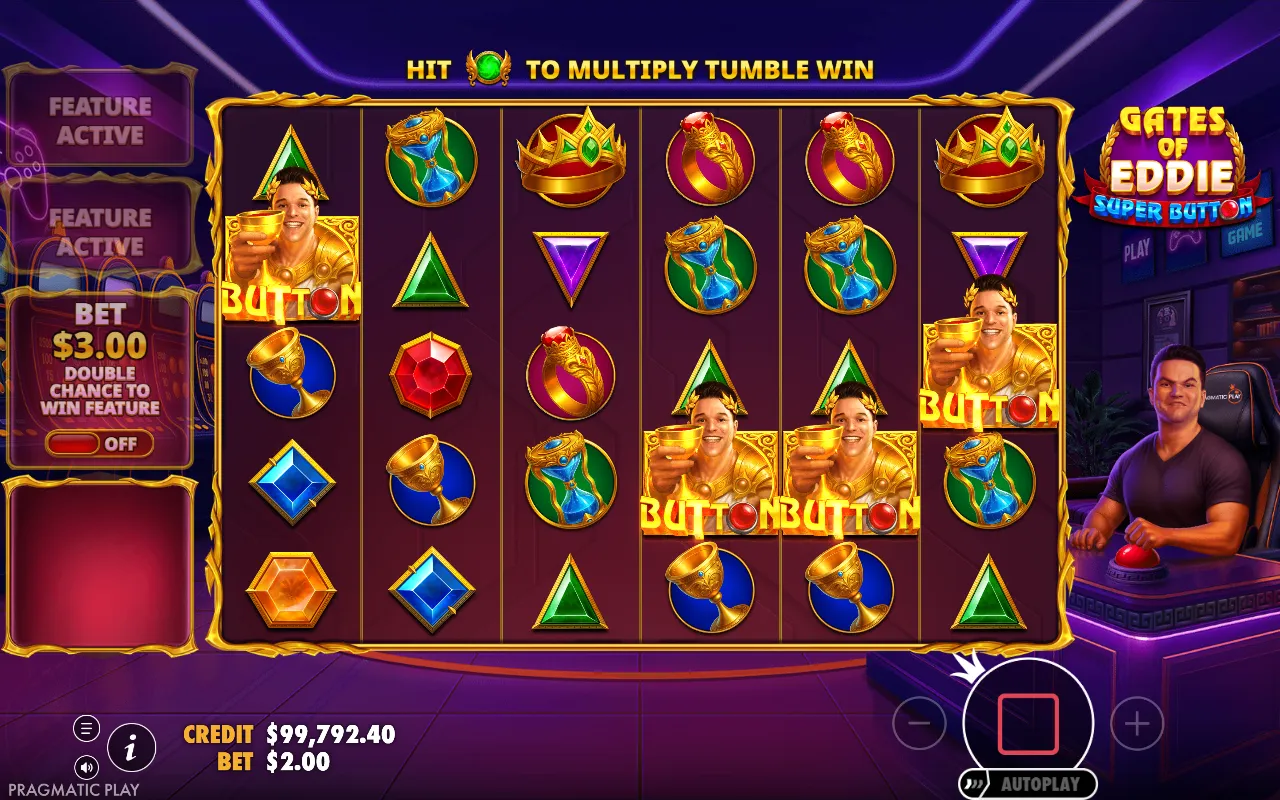
The bonus round is always 15 spins, regardless of whether four scatters triggered it or six. Extra scatters pay more upfront on the triggering spin, but they don’t buy you more time. Landing three or more scatters during the feature adds five spins, meaning the symbol that needed four to matter in the base game suddenly only needs three.
The one thing that does accumulate is the total multiplier in the top-left corner. Every orb that lands on a winning spin adds its value to that meter, which holds its ground for the whole round and never drops. The catch is that the spin has to actually pay. A meter standing at 49x hovering over a board that produces nothing is worth nothing, and realistically, that is the state of most spins in the round.
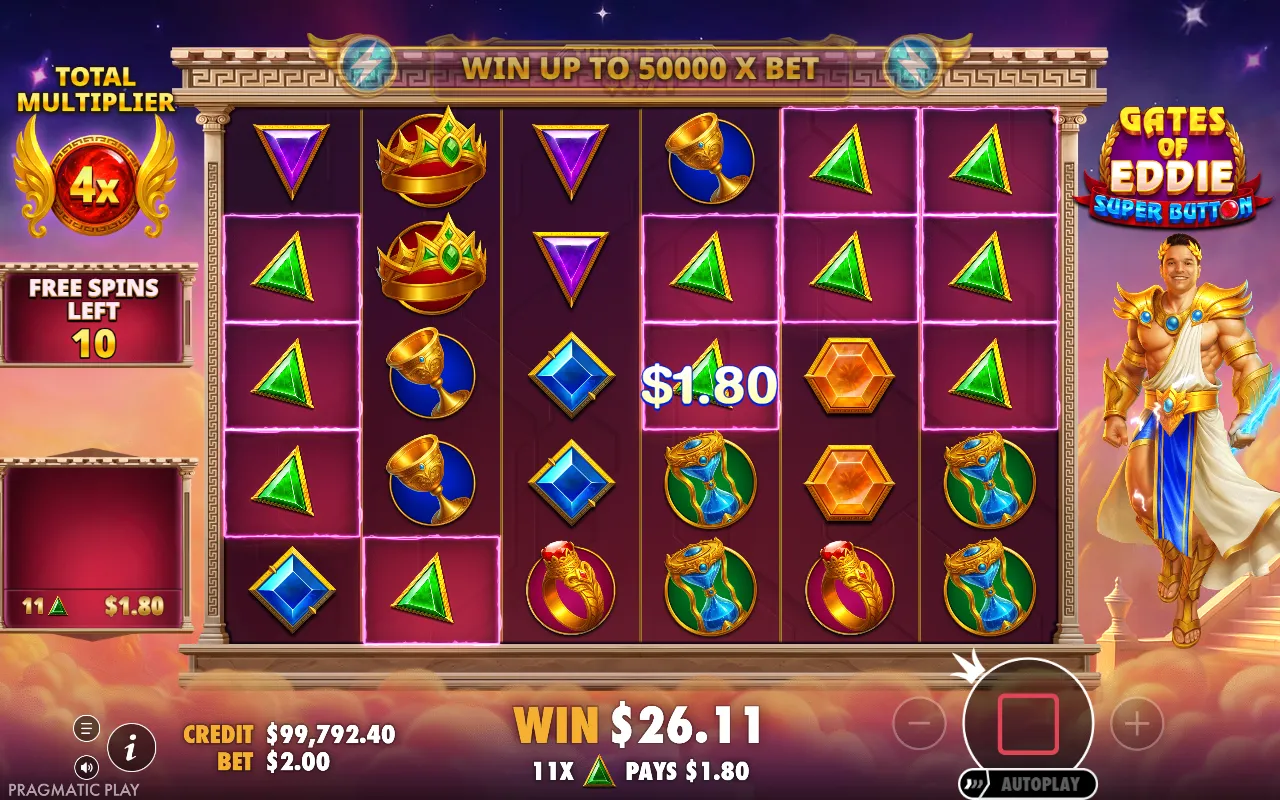
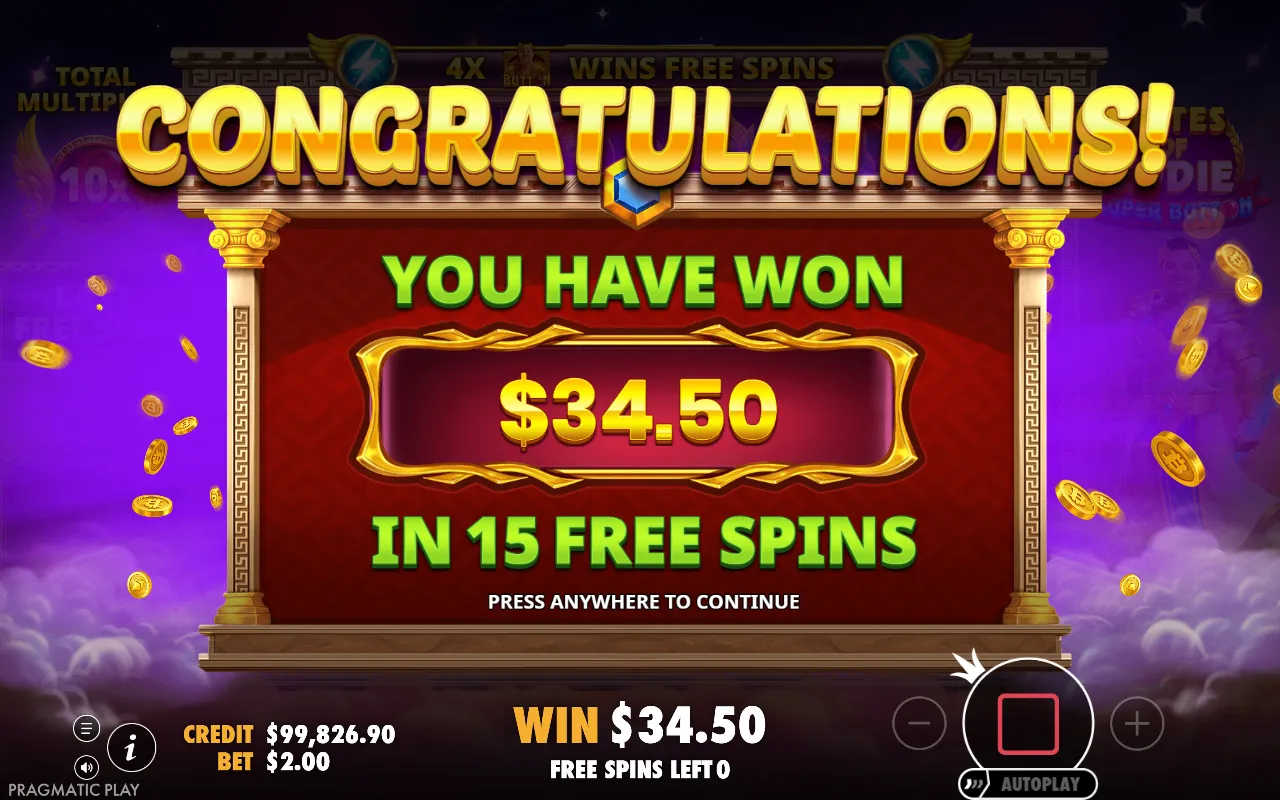
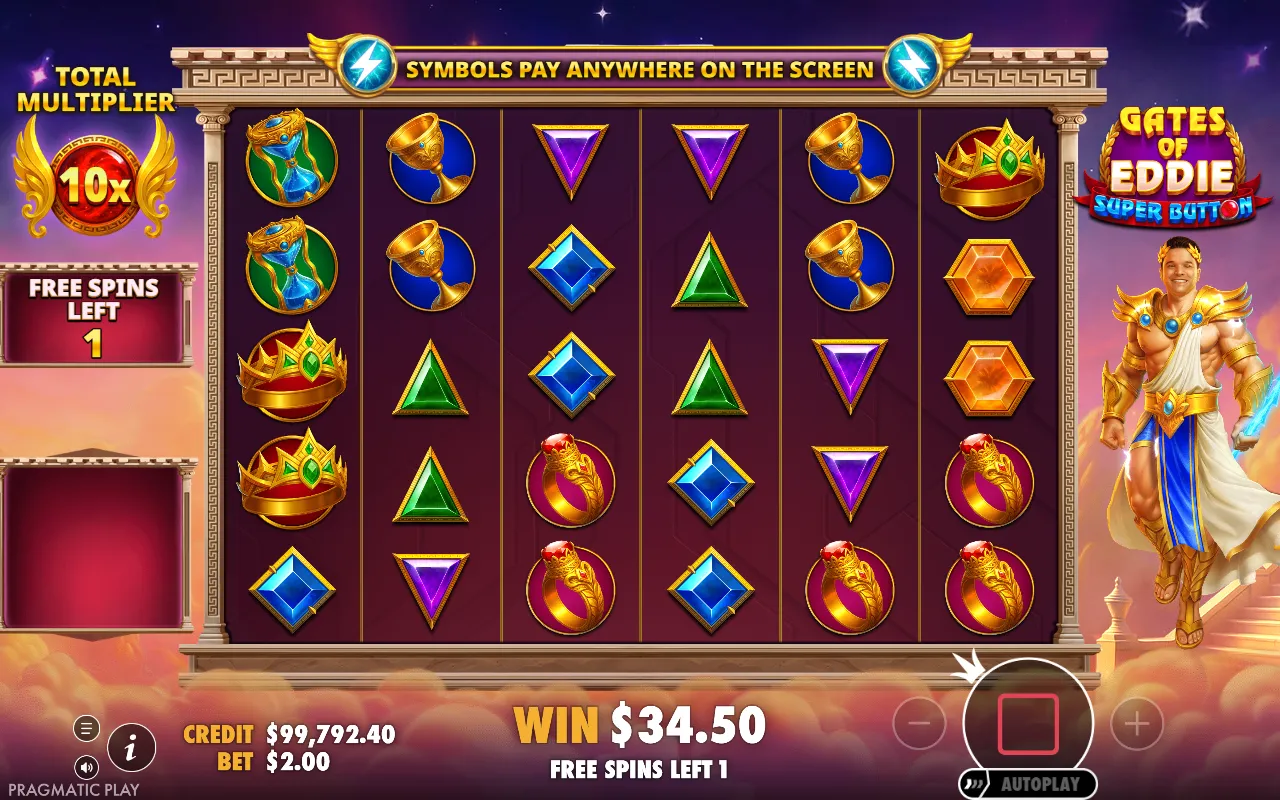
We took both bonus rounds for a spin at a $2.00 stake to see how they felt. The cheaper option, BUY FREE SPINS at 100x, cost $200.00. The triggering spin landed four buttons and paid $6.00 by itself, which acts as a small lottery inside the purchase, four scatters pay 3x, but six pay 100x, so that initial spin could technically hand back half the price of admission.
What followed was undeniably flat. Without a retrigger, the meter crawled to a meager 10x, and the round shut down at a disappointing $34.50.
The premium option, BUY SUPER FREE SPINS, costs 500x, bringing the price tag to $1,000.00 at the same stake. It changes exactly one thing: the multiplier orbs cannot roll below 10x. That sounds like a minor tweak, but it absolutely is not. Every orb in our premium round came in at 12x, 15x, 20x, or 25x. The meter climbed rapidly, hitting 34x, then 49x, then 81x, and the round ultimately returned $1,067.90. It was the exact same fifteen spins with the same symbols and rules. The floor under the orbs made the entire difference.
The pricing does carry a small sting. The expensive buy runs at a slightly lower return than the cheap one, 96.49% against 96.50%, while the base game also sits at 96.50%. Paying five times the price buys you a better-shaped round, but not a better mathematical deal.
The ante bet turns the buy buttons off
The left column features a toggle labelled BET $3.00 / DOUBLE CHANCE TO WIN FEATURE. Activating it raises your stake by half, throws more scatters and Super Buttons onto the reels, and pays the highest return in the game at 96.55%. It also disables both buy buttons outright. The two routes into the bonus are mutually exclusive, forcing you to choose your strategy at the start of a session rather than switching between them on the fly. Either way, the round remains 15 spins.
The symbols and two completely different sets
There are nine paying symbols, all essentially the Olympus grammar redrawn with harder edges: a blue diamond, green triangle, purple triangle, orange hexagon, and red gem at the bottom. The premiums are a chalice, ring, hourglass, and crown. The top-tier crown tops out at 50x for twelve or more. On a game advertising a 50,000x ceiling, a 50x top symbol tells you plainly that the standard symbols are not where the heavy lifting happens.
The art direction is where the game finally stops feeling like a direct copy. The base game is set in a purple-lit private gaming den, complete with neon ceiling strips, a glowing arcade cabinet, a potted plant, and Eddie in a black t-shirt resting one hand on the button. Trigger the bonus, and that entire set is thrown away for Mount Olympus. Suddenly, you have marble columns, an orange sunset, and the same man standing barefoot in gold armour with a lightning bolt in his fist. Buy the Super round, and he ages into a white-bearded elder. It’s an escalating progression of three versions of one person, even if the game never once bothers to explain who he is or why the red button is there.
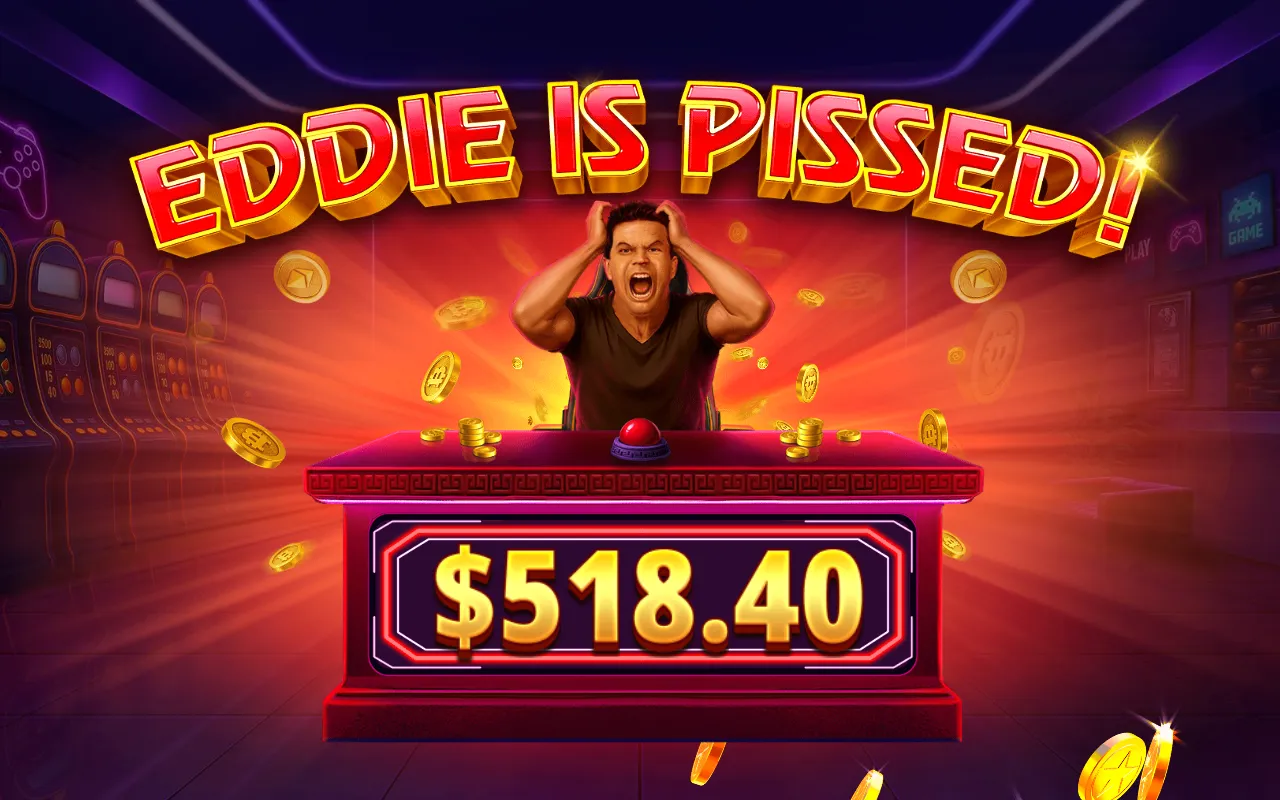
The visual joke that really lands is the celebration screen. Instead of a generic big win graphic, the screen proudly declares EDDIE IS PISSED!, showing him with his head in his hands while the payout counter climbs.
The twenty-fourth Gates
This is one of a dozen operator-branded Gates reskins. Its nearest relative isn’t actually the original, but Gates of Olympus Super Scatter, which carries the exact same Super Scatter ladder, 50,000x cap, and 96.50% RTP. If you have played that, you have played this math model already. What you are paying for here is the atmosphere, the button, and a big-win card with a swear word on it.
What works and what does not
Pros
- The Super Button ladder puts a 50,000x prize inside a single base spin, bypassing the bonus round entirely. That is incredibly unusual at this ceiling.
- The return holds steady when you buy: 96.50% flat, 96.50% on the cheap buy, and 96.49% on the expensive one.
- The 10x floor on the orbs in Super Free Spins is a real, tangible mechanical difference that drastically changes the momentum of the multiplier meter.
- Providing two full art sets and three versions of the same character shows a lot more effort than a standard reskin usually gets.
Cons
- The symbol that carries the game’s ceiling is banned from the free spins, meaning the round both buy buttons sell you physically cannot reach the top prize.
- The ante bet switches the buys off, preventing you from combining the two feature-chasing routes.
- Twelve of a symbol pays the same as thirty, which quietly wastes the majority of a thirty-cell board on a good drop.
- A medium volatility label feels completely out of place on a game packing a 50,000x cap and 500x multiplier orbs.
- Underneath the personalized portrait, it is undeniably a Gates of Olympus reskin and doesn’t pretend otherwise.
Verdict
Dropping $1,000.00 on the super buy returned $1,067.90 during our session, while the standard $200.00 buy barely managed a $34.50 return. The only mechanical difference between those two experiences was the 10x floor under the multiplier orbs. That is a highly impactful design decision and the primary reason to spend the extra money, if you are going to buy a feature at all. The rest of the game is Gates of Olympus with the lights changed, executed well enough that the dual environments and the EDDIE IS PISSED! card carry far more character than the last five reskins put together.
But ultimately, the structure works against itself. A player actively chasing that massive 50,000x payout should never touch either buy button, because the very symbol that pays it is taken off the reels the moment the free spins begin.