
 Powered by SlotsReach.com
Cash Fortress keeps all its money in the coins
Rare Stone has taken the oldest reel set in the business, sevens, bells, diamonds, BARs, and a fruit bowl, and marched it straight through a street carnival. Set to release on 17 September 2026, Cash Fortress is a 5×3 slot with 20 fixed lines from Playtech’s Rare Stone studio. Behind all the festive bunting, however, it is a coin game through and through. The standard paylines offer little more than pocket change; everything actually worth having arrives via gold coins and the giant golden vault door parked to the left of the reels.
The base game runs on a 95.90% RTP, with wins capping out at 2,600.5x the bet, a nice little notch above the 2,000x Grand prize that headlines the screen. The main event here is a hold-and-win feature that the vault can multiply into two, three, or even four boards running simultaneously. I decided to buy my way straight into the four-board version and quickly learned something the sales pitch skips: the bought round does not play itself.
What the coins lead to
The coins in this game carry printed values ranging from 0.5x up to 50x the bet, alongside three named prizes: a Mini at 20x, a Minor at 100x, and a Major at 500x. Landing six coins in a single spin triggers the Cash Fortress feature. But every coin that lands, even a lone one, gives that golden vault a chance to swing open, and that is by far the better outcome. When it opens, a reel spins inside the vault to award one of four things: the 2,000x Grand outright, or the Double, Triple, or Quad versions of the feature, which run the hold-and-win mechanic on two, three, or four boards at once.
Hovering above the reels are four jackpot plaques that look suspiciously like progressive pots. They aren’t. The Grand, Major, Minor, and Mini are strictly fixed top prizes wearing jackpot badges. If you play at a €50 bet, the plaques read €100,000 down to €1,000, precisely ten times their €5 values. It’s a fixed multiplier ladder of 2,000x, 500x, 100x, and 20x, scaling exactly with your stake. The game even admits in its rules that the flashy animation of coins flying into the vault is purely for visual entertainment and decides nothing. I have to give them credit for the honesty, even if it does drain a bit of drama from the base game’s flashiest moment.
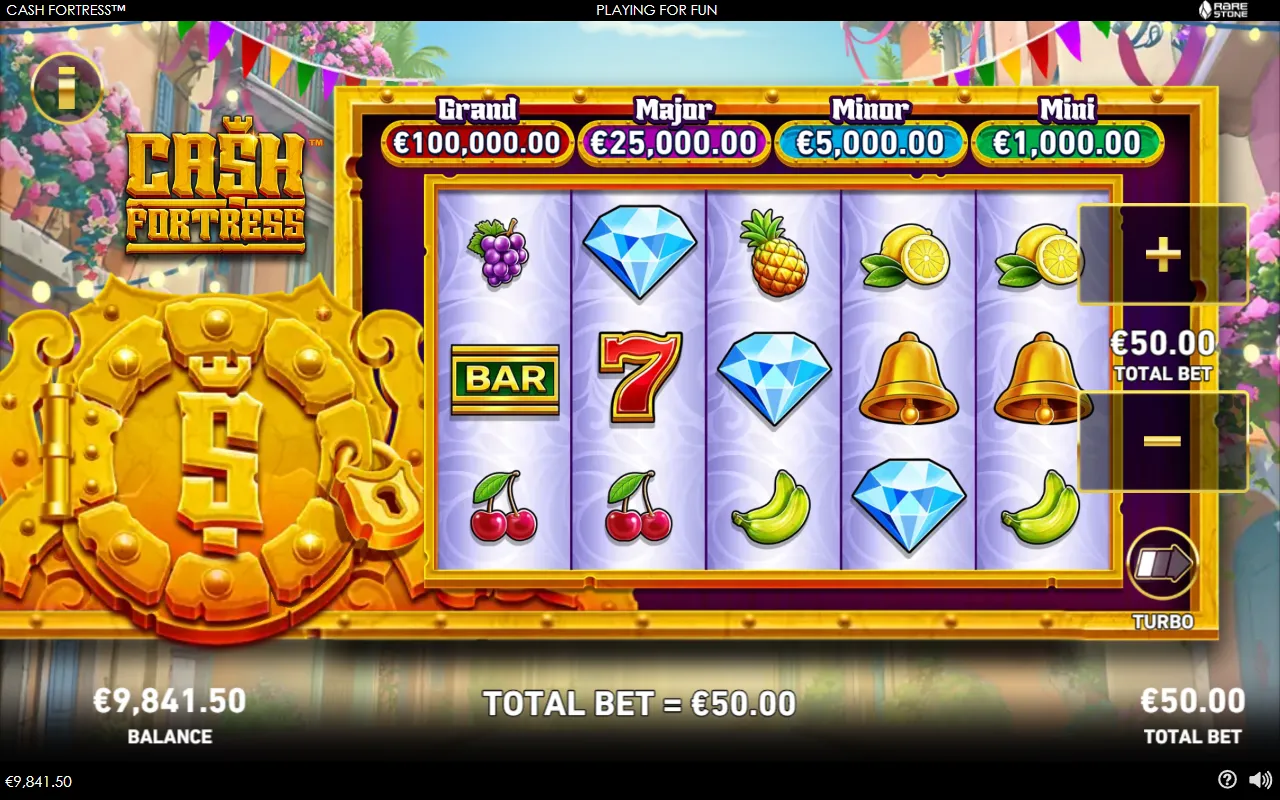
During my session, the coins fell frequently enough, though I never quite managed to land the required six at once, and the vault stayed stubbornly shut. Since it opens entirely on chance rather than filling a meter, there is nothing to build toward between spins, you just have to hope for a lucky break.
The feature and the Quad round we bought
The Cash Fortress feature itself is about as plain a hold-and-win as you can get. Triggering coins lock in place, you get three respins, and any new coin locks and resets the count to three. When the respins finally run dry, the coin values are simply added up and paid out. There are no multipliers, no collector symbols, and no upgrades. If you manage to fill all 15 positions on a board, the Grand pays out on the spot.
The vault versions run that exact same game on independent boards, each keeping its own respin count on three little lights under the grid. A board that burns through three respins without landing a coin goes dark while its neighbors carry on, and nothing passes between them. It is genuinely the most distinctive sight in the game: four grids filling up at four completely different speeds.
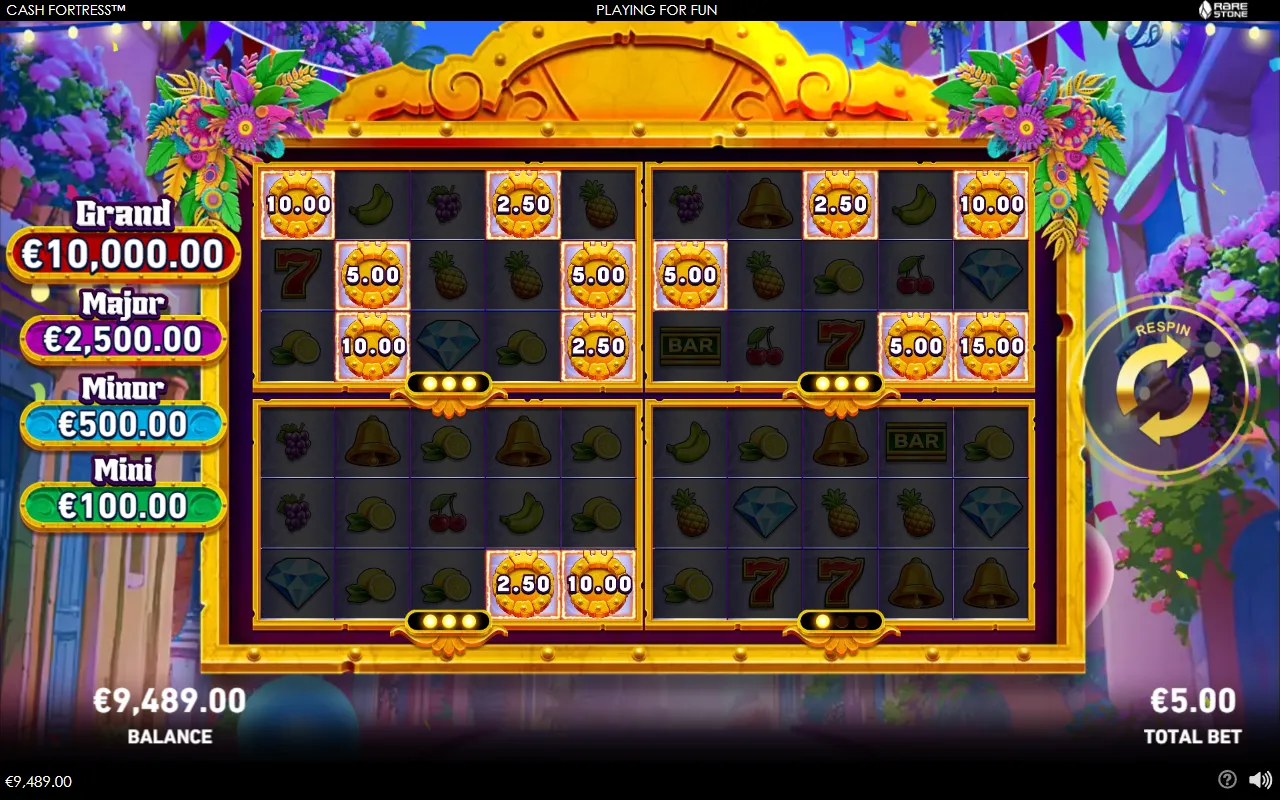
The buy menu sells exactly one thing, the Quad round, straight in, for 100x the bet. Unusually, buying the feature costs no RTP. The bought mode runs at 95.91% against the base game’s 95.90%, whereas a feature buy normally shaves something off. I paid €500 at a €5 stake to test it out, and ran into the catch nobody advertises: every single respin on every board required a manual button press. It took seventeen taps of the respin button to see the round through. Autoplay does not reach into the feature, so if you buy it, you are going to have to work for it.
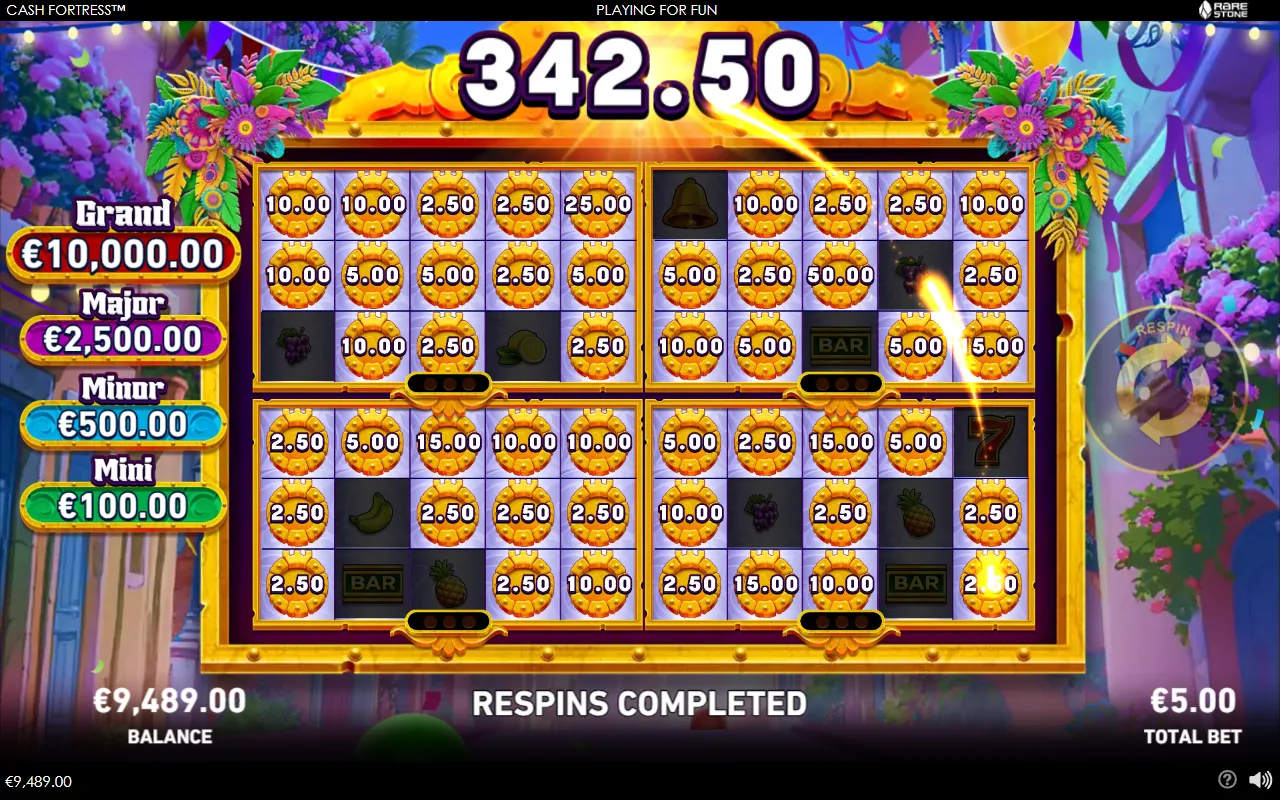
My bought round filled generously but paid modestly. More than forty coins locked across the four boards, bringing the total to €352.50. The catch? Nearly everything that stuck was the 2.50 minimum coin. The single biggest coin across the entire round was one 50.00, and none of the four named prizes showed up at all.
Free games on the Mega reel
Landing three fiesta buses anywhere on the reels pays 1x the bet on the spot and triggers six free spins. Hitting four or five buses raises that instant payment to 10x or 30x, but the spin count stays locked at six regardless.
The free games rely on one central idea: on every spin, a Mega reel drops over three adjacent reels, and whatever single symbol lands on it counts as all nine positions at once. A bus on the Mega reel adds three spins, while a giant coin opens the Cash Fortress feature. The catch is printed right in the paytable, the free-game symbols pay exactly half their base rates, with the top-paying red seven dropping from 10x to 5x for a full line. The giant reel is effectively funded by halving the paytable, and the game puts both tables side by side rather than trying to hide it. The round never landed during my spins, so I can only tell you what it promises on paper, not how it actually feels in action.
Symbols and artwork
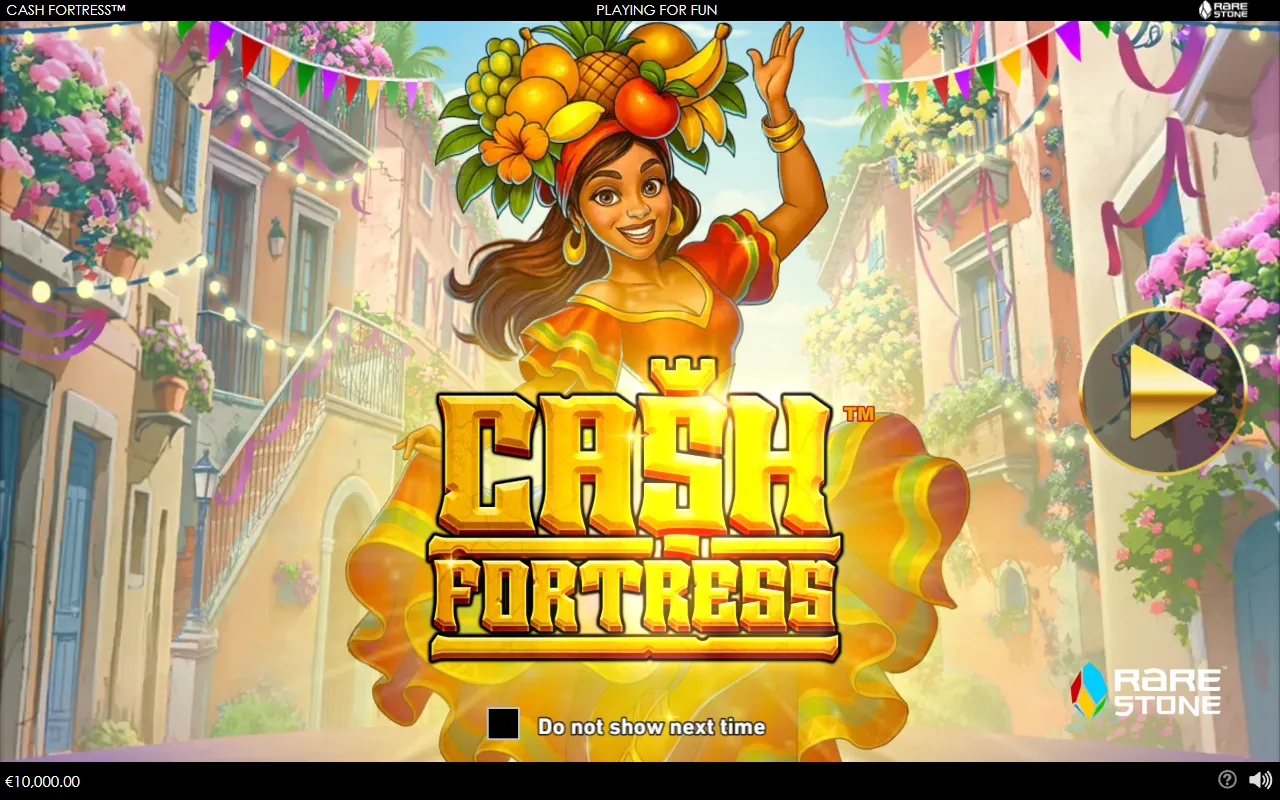
Visually, Cash Fortress looks like a classic fruit machine that got invited to a garden party in Havana. It is set against a pastel street filled with flower garlands and confetti, while the reels feature the glossiest possible versions of casino classics. The red seven sits on top, followed by a diamond, bell, and BAR, with pineapples, lemons, bananas, cherries, and grapes filling out the low end. The wild symbol is a fruit-hatted dancer, and when she completes a win, she stretches to cover her entire reel. But the game spells out the condition clearly: no line win, no expansion. A lone dancer just stands there.
Underneath all that colorful gloss, the paytable is purposefully thin. Three sevens pay just 0.8x the bet, meaning a winning line actually loses you money, and every three-of-a-kind in the game pays under the spin cost. Only the scatter clears 1x from a three-symbol hit. The lines simply exist to pass the time between coin drops, and the game makes no real effort to pretend otherwise.
Pros & Cons
What works
- The Quad round is proper theatre, four boards, respins resetting board by board, and forty-plus coins on screen at once.
- Buying the feature costs no RTP: it plays at 95.91% bought against the 95.90% base.
- The prizes are honest fixed multipliers ranging from 20x to 2,000x, scaling exactly with the bet.
What doesn’t
- The 95.90% base RTP is on the thin side of today’s standard.
- Line wins are purely decorative, as every three-of-a-kind pays less than the spin cost.
- The bought feature is entirely manual; my session took seventeen presses of the respin button.
- Strip off the carnival paint, and this is a hold-and-win that a dozen other studios already ship.
Verdict
My €500 Quad buy came back at €352.50, and across four boards and more than forty locked coins, I never saw a single one of the four named prizes. That perfectly encapsulates the game in one round: it is generous with small coins, stingy with the jackpot plaques it hangs over the reels, and built so that the base game functions as little more than a waiting room for the vault.
It is a tidy, well-drawn version of a very familiar machine. The one thing here you cannot get from the usual coin-respin crowd is the vault ladder into two, three, or four simultaneous boards, and it is genuinely fun to watch them fill at different speeds. If four hold-and-win boards running at once sounds like your kind of evening, 100x the stake buys the best version of it here, just remember to bring a spare finger for the respin button.