
 Powered by SlotsReach.com
Games Global has built a cricket slot for the Indian season, and its line game is close to decorative. Cricket Century Kings is a 5×4 slot with 40 fixed lines, but the traditional reels aren’t going to get you very far. With a maximum win capped at 10,000x, the standard symbols are surprisingly light, and the best five-of-a-kind on the board returns just 8x your stake. Instead, everything revolves around the gold coins that constantly drop onto the grid. Land six of them, and you are whisked away to a taller board for a hold-and-win round featuring a four-rung prize ladder.
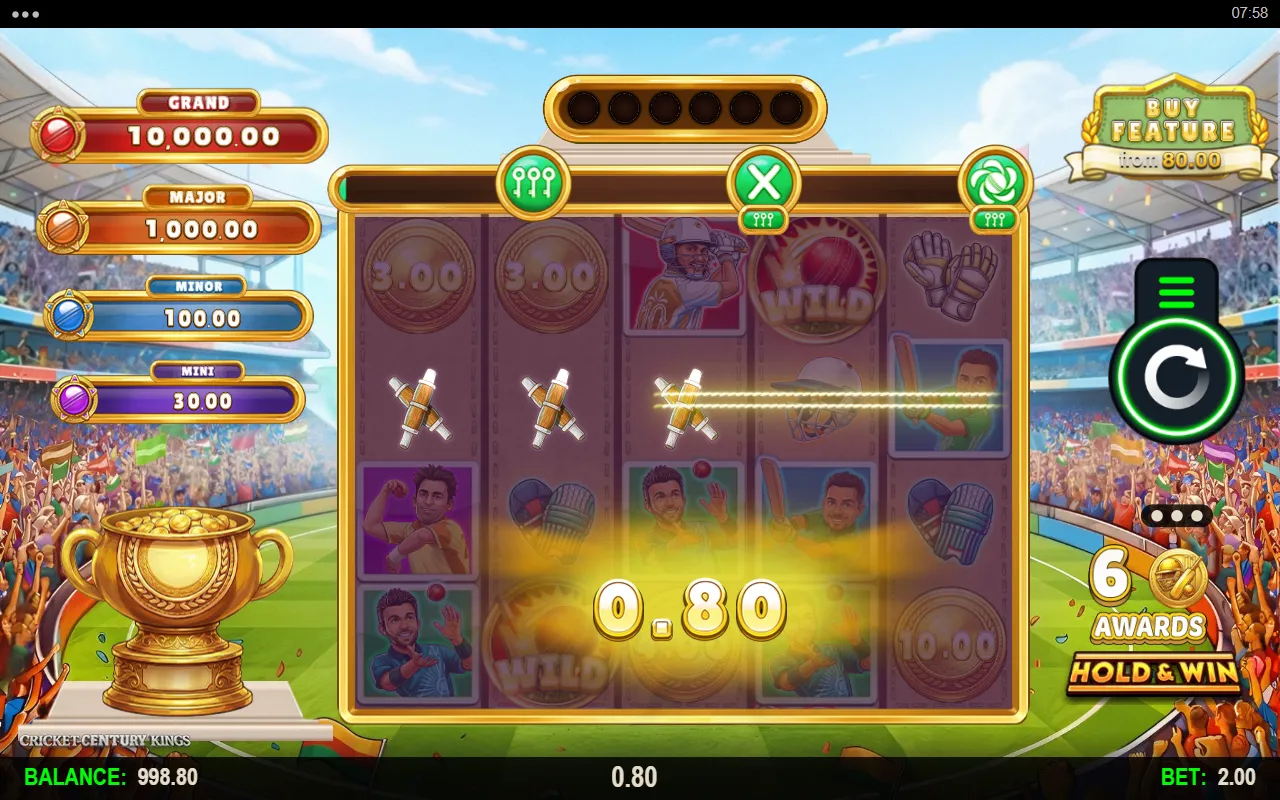
The line game barely pays
Forty lines run left to right from the first reel, and only the highest win counts on each. Five painted cricketers make up the premium symbols, with the top player paying that modest 8x for a full line. The wild is a red ball on a gold banner, paying 10x and substituting for everything except scatters and coins. The bottom of the paytable is filled out by four pieces of cricket kit, stumps, gloves, a helmet, and pads, which pay between 0.4x and 2x for a set of five.
These numbers are intentionally small on a game capable of paying 10,000x. The sole exception is the scatter, a gold medallion stamped with a helmet and crossed bat. Landing five of those anywhere pays 100x, making it more than ten times the best line in the game and the only base-game outcome with any real weight.
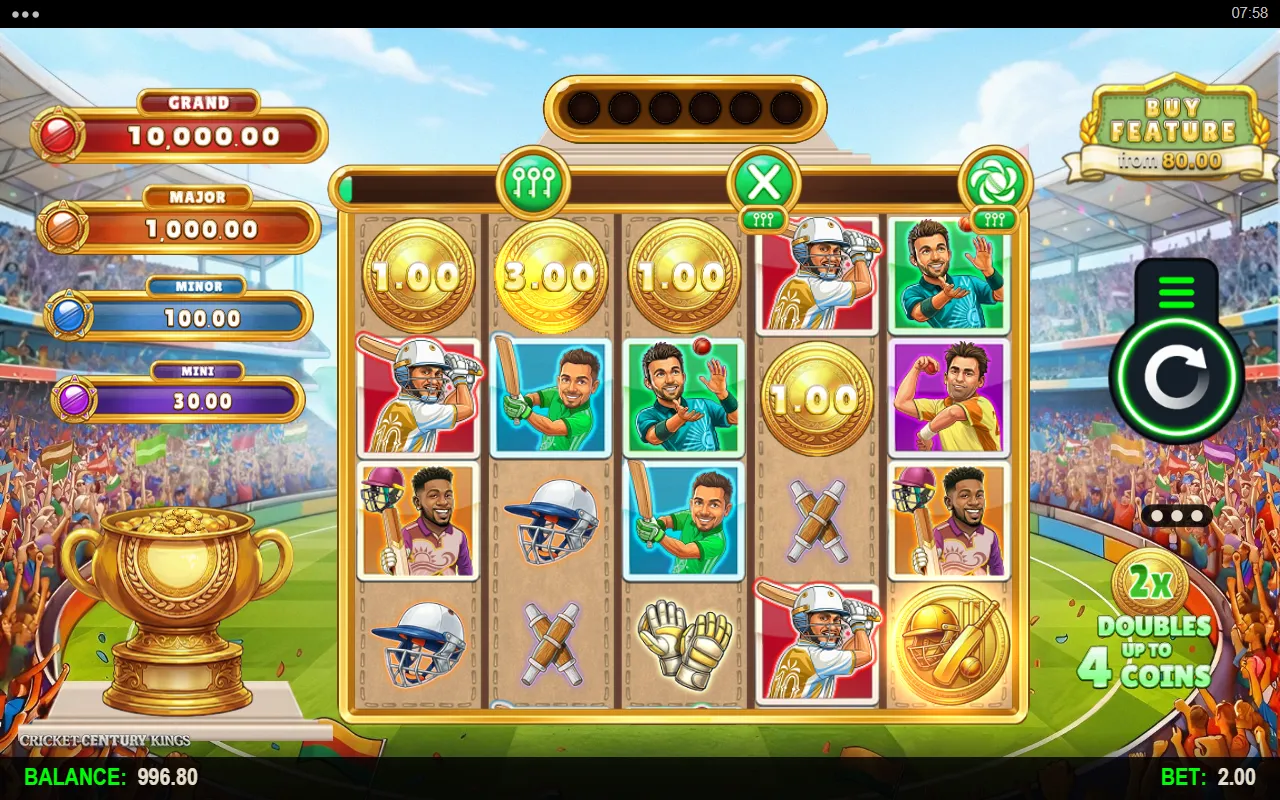
The coins never pay on their own
Each gold coin prints a cash value drawn from a fixed ladder ranging from 0.5x to 12x your stake. When playing at a 2.00 bet, you will spend the base game watching numbers like 3.00 and 10.00 tease you from the reels. But none of it is active money. A coin never pays in the base game, regardless of the number printed on its face. It only counts.
You need six coins on a single spin to trigger the hold-and-win. Landing four or five feeds a meter that upgrades the bonus round for the next time you trigger it, the game’s way of paying you in future equity rather than immediate cash. Meanwhile, a match coin on the fifth reel feeds the gold trophy standing next to the grid. That 10.00 coin isn’t a missed win; it is just a tally mark, though the game is careful never to say so.
The hold and win round
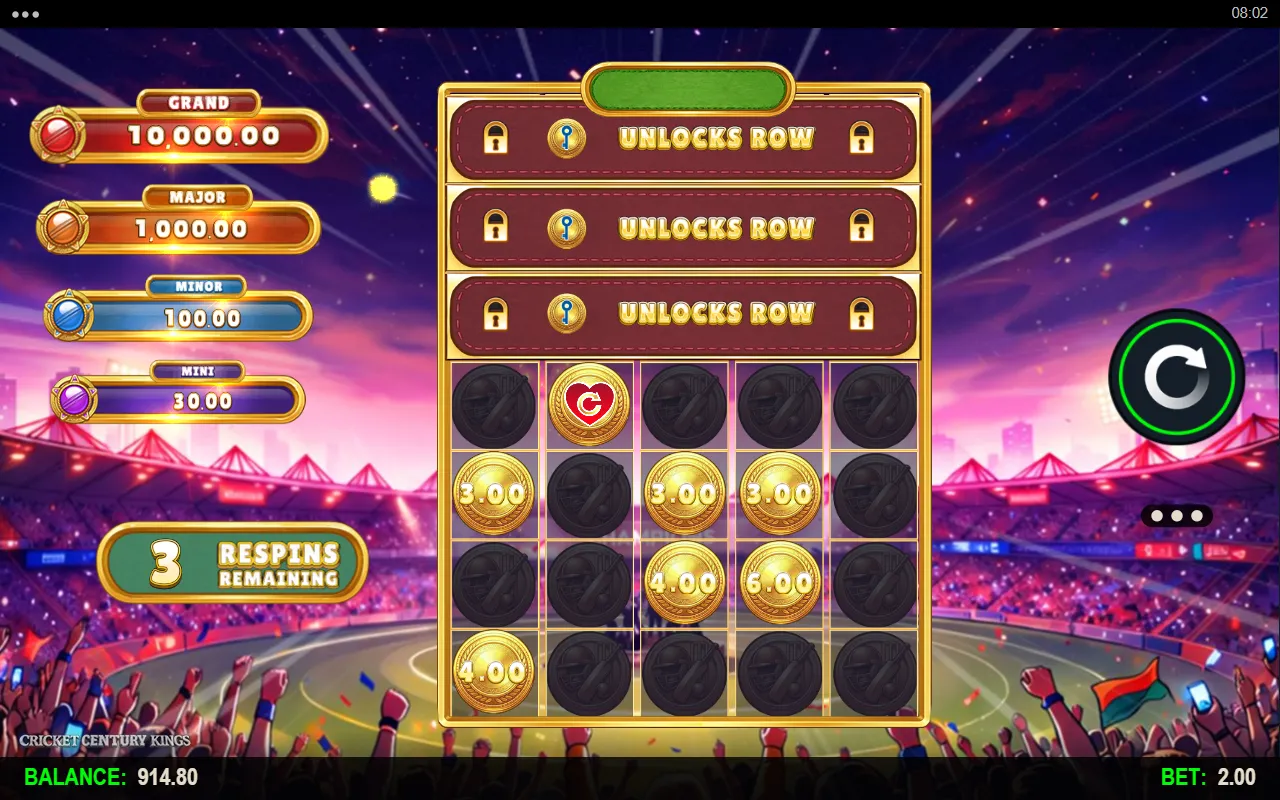
Anyone familiar with Games Global’s hold-and-win features will recognize the foundation here. Six coins trigger the feature, locking in place while granting three respins. Any fresh coin that lands also locks and resets the counter to three. When the round finally ends, the cash coins are tallied up and paid out.
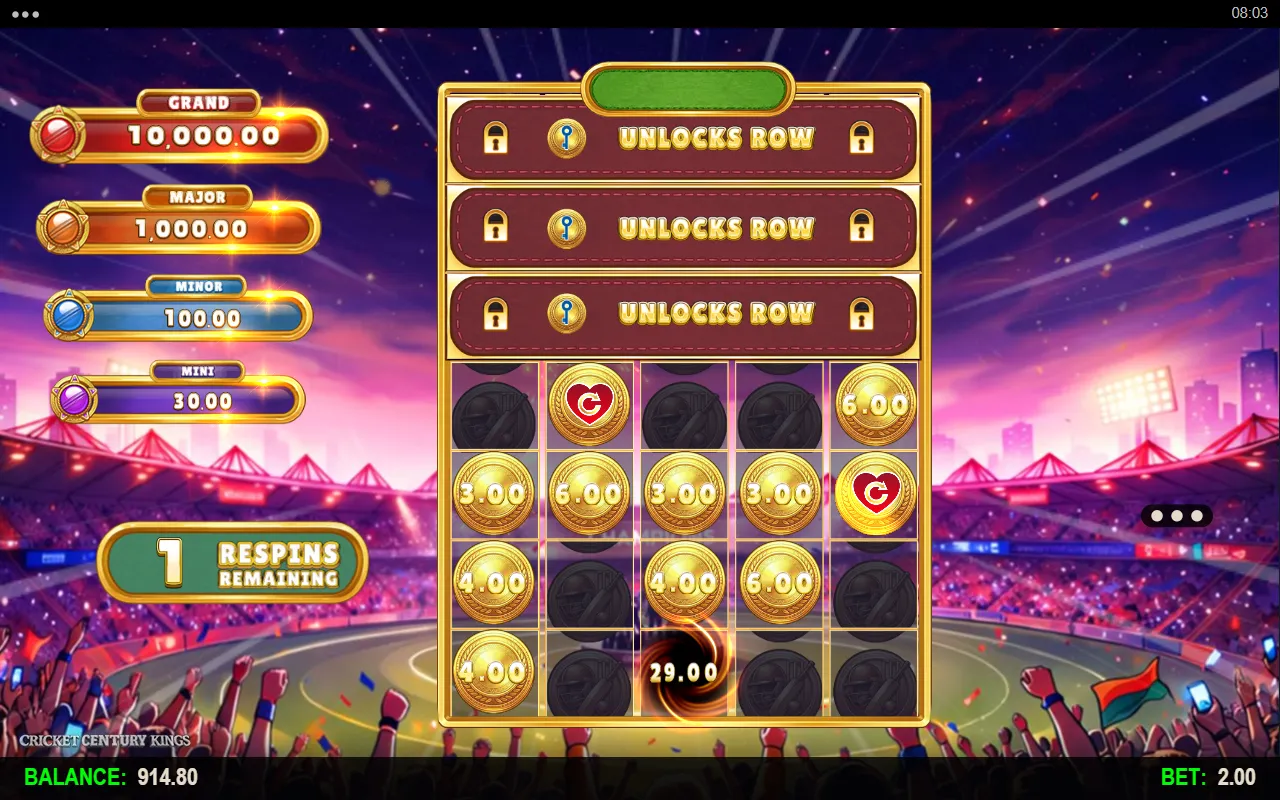
However, two major elements set this version apart. First, the action moves to a 5×7 board rather than the 5×4 grid of the base game. The catch is that three of those seven rows are shut behind UNLOCKS ROW banners. You need a specific unlock coin to open them, one row per coin. If none land, you spend the entire round filling twenty positions while fifteen more sit visible but completely unusable above your head.
The second twist involves the prize coins. The MINI, MINOR, MAJOR, and GRAND prizes are worth 15x, 50x, 500x, and 5,000x, but they do not pay out simply by landing. Instead, each one counts down by one on every respin. They only pay if the countdown reaches zero before the round finishes. A GRAND needs twelve more respins to mature, while a MAJOR needs ten. Since respins only continue when new coins land, hitting the top prize isn’t just about a GRAND coin showing up, it has to show up early, in a round that simply refuses to stop.
The feature is rounded out by six kinds of booster coins that perform familiar tasks: collecting the cash on the board into one total, doubling up to four coins, opening a row, or adding a respin. Two of these boosters stick around for the whole round rather than firing once, and those are exactly what the upgrade modes guarantee you.
There is one glaring irritation that lasts the entire round: it doesn’t run itself. Every single respin requires a manual press of the spin button. Between presses, the screen just sits there looking like a finished round rather than one waiting for your input. Our bonus went fifteen respins deep off an opening three, which meant fifteen manual clicks just to keep the game moving.
What the four prices buy
The buy menu offers four entries, giving you plenty of options. The plain round costs 40x. Max Mode at 80x starts with all three extra rows already open. Multiplier Mode at 110x opens the rows and guarantees a booster that doubles up to four coins on every respin. Collect Mode at 165x opens the rows and guarantees the collect booster instead. At a 2.00 stake, those options cost 80.00, 160.00, 220.00, and 330.00.
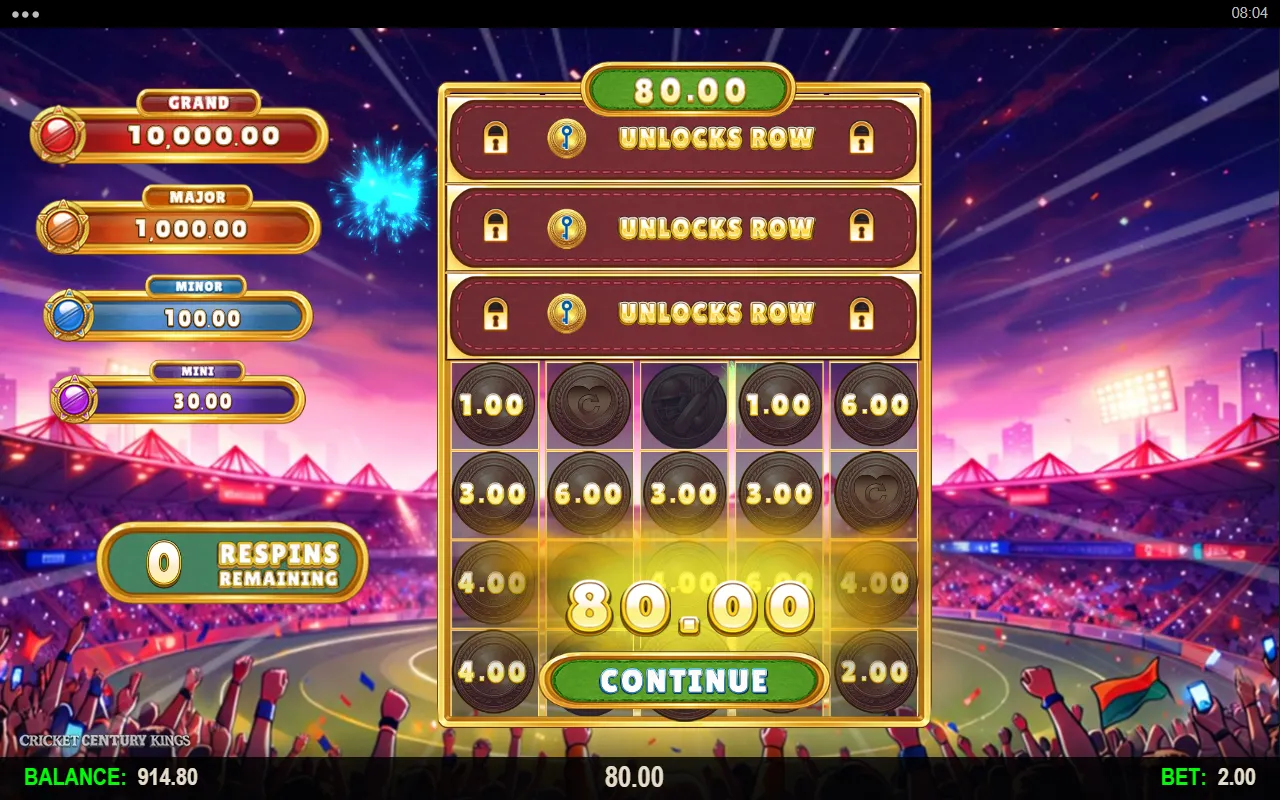
We opted for the cheapest entry, and it effectively made the argument against itself. Seventeen coins landed over those fifteen respins, leaving only three empty spots on the active board. Crucially, not a single one of those seventeen coins was an unlock, so the top three rows never opened. The round paid exactly 80.00, which was precisely what it cost to buy in.
The two rounds we did not see
Landing three scatters awards ten free spins. During every spin, either wilds or coins get power stacked across all five reels. That is the entire point of the feature: stacked coins mean hitting six on a spin becomes a realistic expectation rather than a fluke. The free spins are essentially a delivery route into the hold-and-win rather than a round designed to pay out heavily on its own.
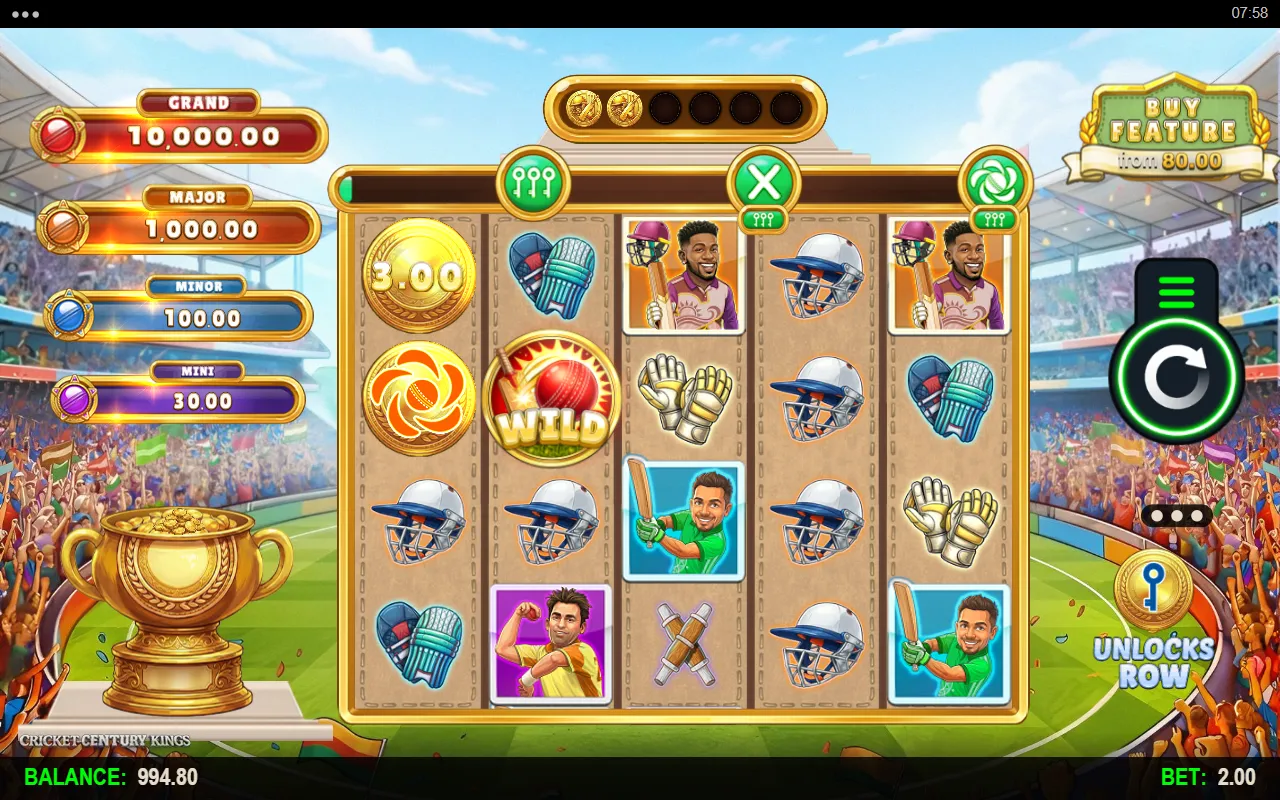
There is also the Collection Pot, represented by the gold trophy beside the grid. Match coins on the fifth reel fill it, and eventually, it grants a wheel spin for one of the four prizes, from the MINI up to the GRAND. It never triggered for us during our session, and there is no way to buy directly into it.
How it looks
The game leans heavily into bright cartoon poster art, and it commits fully to the aesthetic. The background is a packed daytime cricket ground with flags waving in the stands and confetti drifting across the outfield. The grid itself is framed in tan leather, stitched like the seam of a cricket ball. The high symbols are painted cricketer portraits on colored cards, designed with enough character that you can instantly tell the bowler from the keeper, a detail most sports slots fail to manage.
The smartest design choice is the environmental switch. Trigger the bonus round, and the entire scene shifts to a purple night ground under glaring floodlights, letting you know exactly which game mode you are in without having to read a single word. The weakest visual element is the kit at the bottom of the paytable. The helmet, gloves, pads, and stumps are rendered as flat icons, and since these are the symbols that land most often, you spend a lot of time looking at the dullest part of the art.
Pros and cons
What works
- The prize ladder uses fixed multiples of your own bet, from 15x through 5,000x, rather than a shared progressive, meaning it holds the exact same proportional value at 0.20 as it does at 20.00.
- The respin reset proves generous in practice, easily extending an initial three respins into a much longer streak.
- Having four buy prices instead of the usual one or two provides genuine variety, as the gaps between them purchase tangibly different rounds.
- The artwork is well-crafted, and the day-to-night transition serves as excellent visual signposting.
What does not
- The line game feels close to worthless. Getting just 8x your stake for five of the best symbol feels remarkably low on a game capped at 10,000x.
- Coins print cash values but pay nothing in the base game, creating a repetitive tease on almost every spin.
- Every respin in the bonus round requires a manual press, and the screen offers no clear indication that it is waiting for you.
- The 40x bonus buy leaves fifteen of the thirty-five positions locked, making the cheapest option the one most likely to disappoint.
Verdict
Our 40x bonus buy returned exactly the 80.00 it cost, and the three locked rows were entirely to blame. That specific round perfectly encapsulates the whole game in miniature: the coins do all the heavy lifting, the reels underneath them are just there to pass the time, and the difference between a great session and a flat one comes down to whether you are filling the small board or the fully unlocked grid. The prize-coin countdown is the cleverest mechanic here, but also the quietest, since a GRAND that needs twelve more respins is often a prize you simply watch expire.
If you are reaching for the buy menu, you should probably skip the 40x option entirely and start at 80x. It is the cheapest of the four tiers that opens all thirty-five positions, saving you from the frustration of having twenty usable spots while the rest of the board mocks you from above.