
 Powered by SlotsReach.com
Whale Rush pays its biggest prize before the bonus starts
Most cluster slots keep their headline payouts locked away deep inside the free spins round. Whale Rush takes a completely different approach, dropping its 10,000x maximum win right on the way in, before a single bonus spin has even started.
Developed by Microgaming and landing on 26 August 2026, this 7×7 grid slot relies on familiar cascading mechanics paired with a steep mathematical curve. Wins trigger when five or more matching symbols touch edge to edge. The winning clusters clear away, fresh symbols drop into the gaps, and the emptied cells slowly turn into multipliers that double every time you clear them again. The RTP sits at 96.04% and the volatility is very high. You can feel that mathematical weight right away, landing five of the best symbol in the game merely pays your bet back and nothing else.
Where the 10,000x sits
The path to the game’s ceiling depends on two different scatter symbols. The silver chest is a standard Scatter that only awards free spins. Landing three gives you ten free spins, four gives twelve, five gives fifteen, six gives twenty, and seven or more gives thirty.
The gold chest is a Super Scatter, and it is the key to the game’s best moments. It counts toward triggering the bonus exactly like a silver chest, but it also pays out a cash prize based on how many gold chests land in that triggering group. One gold chest is worth 100x your bet. Two are worth 500x. Three jump to 5,000x. Catch four or more, and you hit the 10,000x ceiling of the entire game.
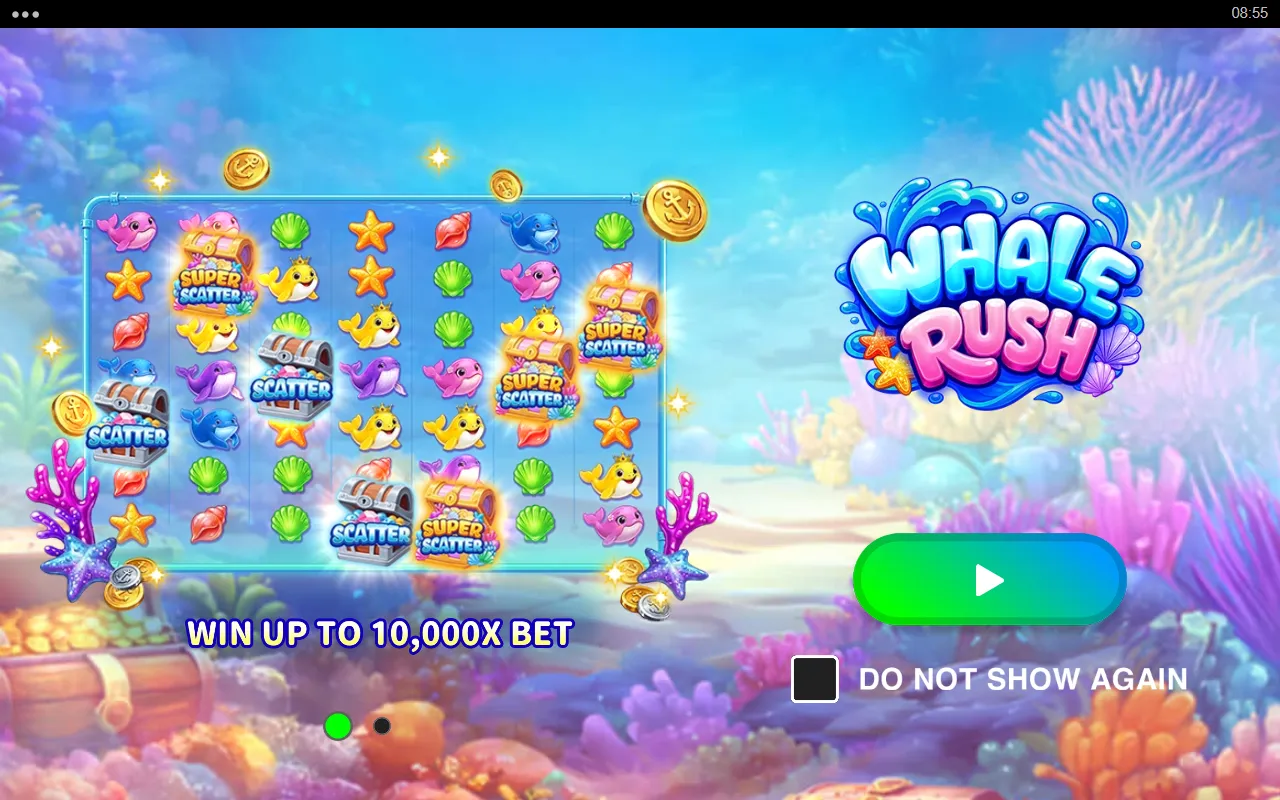
Because of this setup, the maximum win does not actually come from the bonus round itself. It lands on the triggering spin. By the time you are watching the free spins counter tick down, the most lucrative event possible has either happened or it hasn’t. The alternative route to a big payout is much slower: building up multiplier cells during the free spins and hoping a massive cluster lands perfectly on top of them.
Marks, then multipliers
Understanding how the grid builds its potential is crucial, because a cleared cell does not immediately become a multiplier. When you win a cluster, the symbols vanish and those grid positions are simply marked. If a winning symbol is later removed from one of those marked positions, the cell upgrades to x2. Clear it a third time and it hits x4, then x8, climbing a ladder that tops out at x1024. Every multiplier requires two clears of the exact same cell before it is worth a penny.
When a cluster covers multiple multiplier cells, their values are added together rather than multiplied. Two x8 cells under one winning cluster combine to make x16. Because of this addition rule, the multiplier ladder really needs to climb toward that x1024 limit to make a significant impact.
The base game and free spins handle these marks differently. During the base game, marks and multipliers only last for the current spin. Whatever you build during a run of cascades is wiped clean the moment you hit the spin button again. In the free spins, however, they stay in place for the entire round.
The free spins round
A standard three-chest trigger gives you ten free spins, with retriggers possible along the way. What makes this round far more valuable than ten base game spins is the persistence. Cells cleared on your second spin are still marked on your ninth, meaning late cascades land on ground prepared by the early ones.
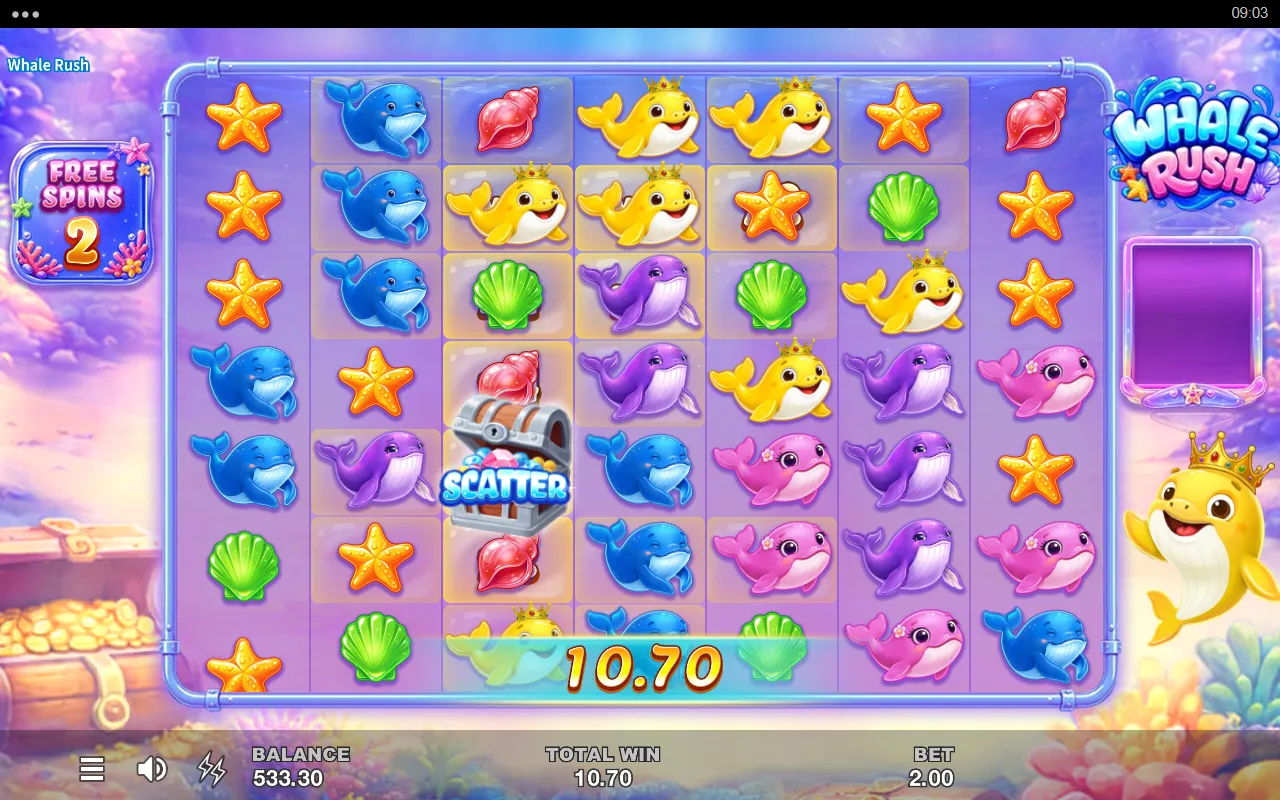
Buying the standard bonus for 200.00 at a 2.00 bet shows just how slowly the momentum builds. In one round, with just two spins left, the board was covered in marks with barely a multiplier in sight, and the payout sat at just 10.70.
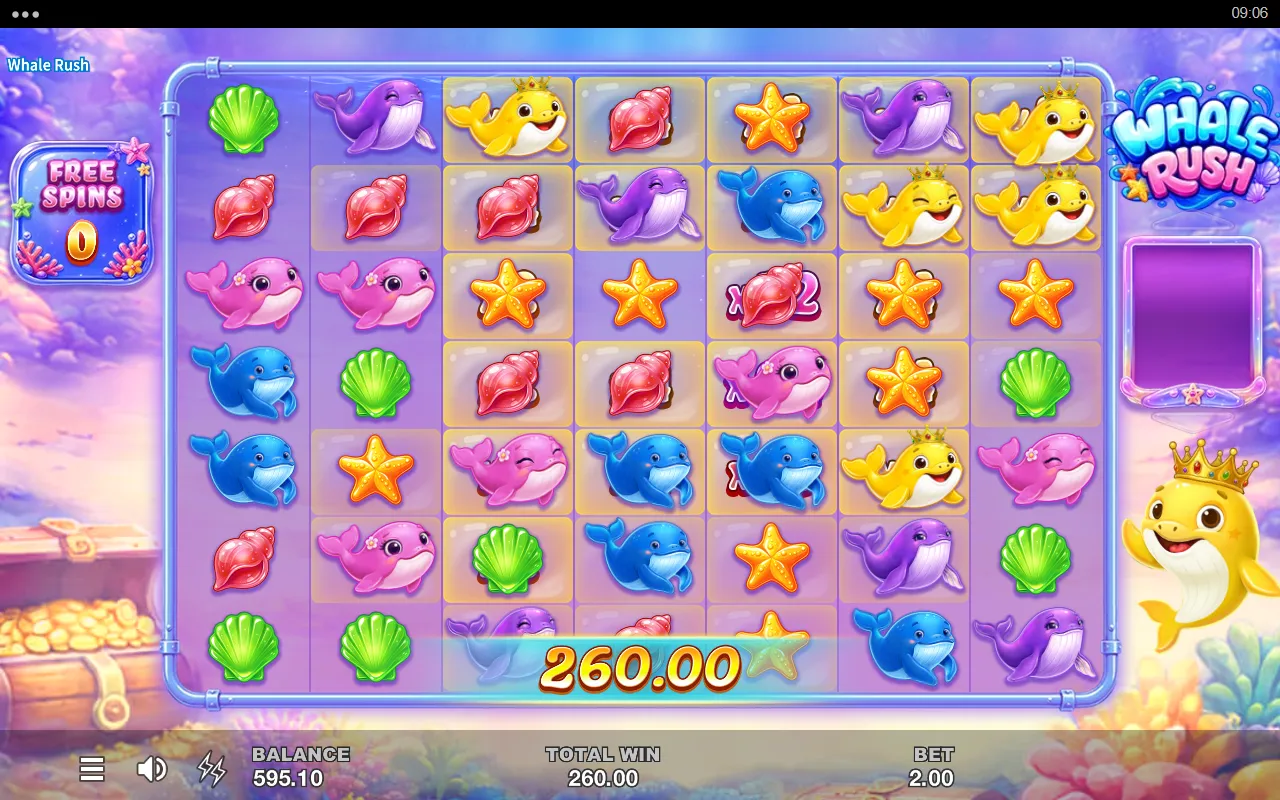
However, the back end of the round is where the math finally catches up. That same session finished at 260.00, with almost all the returns arriving in the closing spins alongside a single x2 cell. Ten spins of accumulation on a 49-cell grid buys plenty of marks, but securing that crucial second clear takes time.
There is also an expensive buy option called Super Free Spins, which changes the dynamic entirely. It starts every one of the 49 cells at x2 instead of blank, cleverly skipping the two initial clears the normal round requires before a cell counts for anything.
Two buys and three boosts
Whale Rush offers five priced ways to alter the game, and the pricing structure reveals a lot about the math. Buying the standard free-spins round costs 100x your bet, while the Super Free Spins round costs 500x.
Beyond the buys, there are three ante options that increase your stake on every spin. Paying 5x the base bet gives a tenfold better chance of triggering free spins. Paying 10x drops random starting multipliers around the grid. Finally, paying 250x activates Super Spin 2, dropping an x32 multiplier on all 49 positions from the very first spin.
That last option deserves a long look. Super Spin 2 charges 250x for a single spin. The standard free-spins round, which gives you ten spins with full persistence, costs 100x. Paying more than double for one spin only makes sense if starting the ladder at x32 everywhere is worth more to you than ten spins of building it yourself. It is worth noting that these boosts switch off the moment you buy a feature, so you cannot stack them together.
Seven symbols and no wild
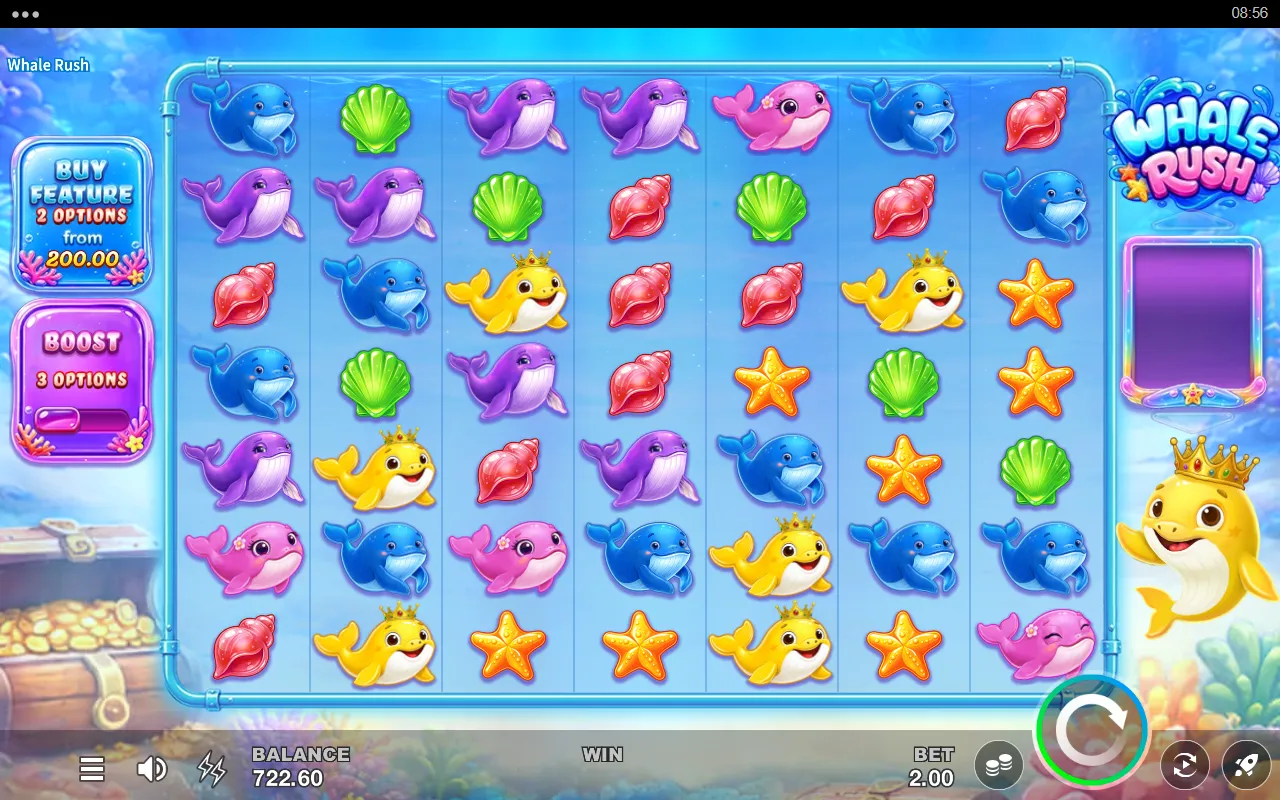
The paytable consists of four cartoon whales in yellow, pink, purple, and blue, alongside three pieces of seabed clutter: a red conch, a green scallop, and an orange starfish. There is no wild symbol in this game at all. On a cluster grid, this means every single win requires five of the exact same symbol touching edge to edge.
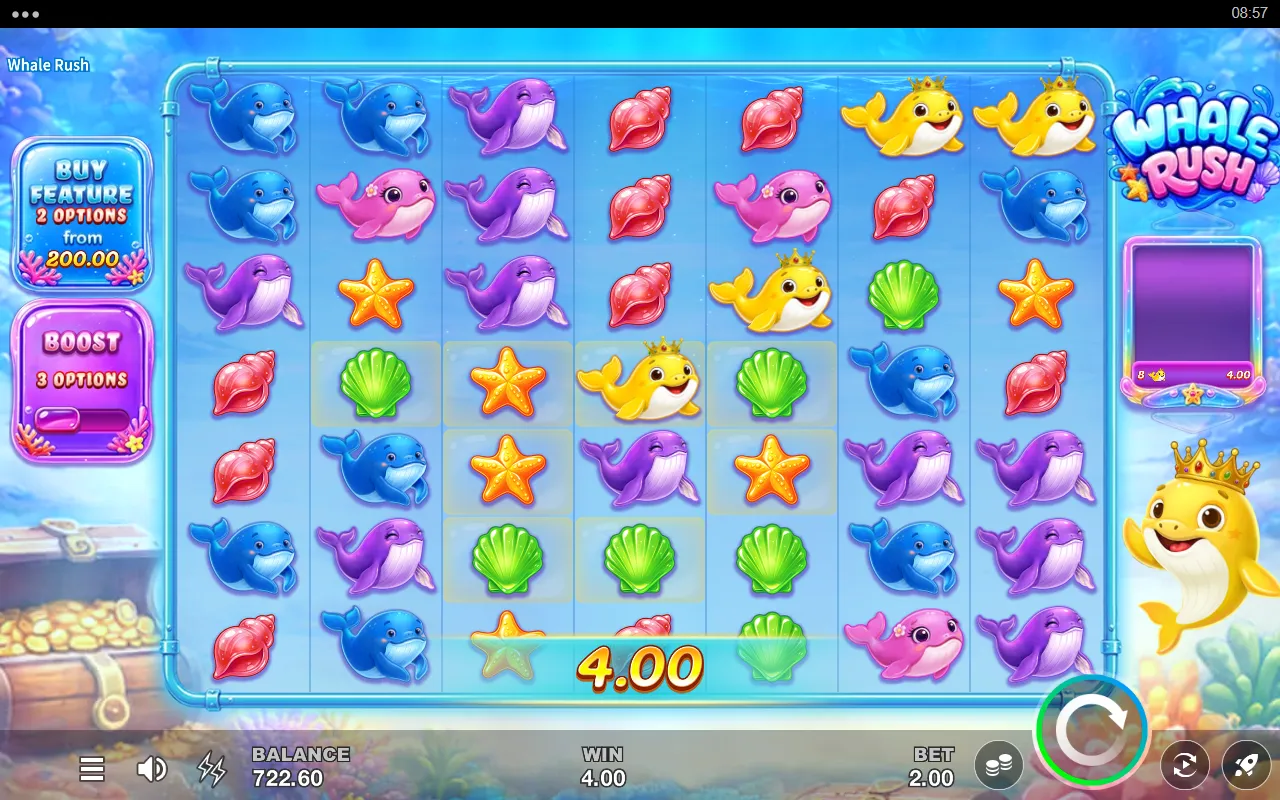
The top of the paytable is remarkably flat, which sets expectations early. Five crowned whales, the highest-paying symbol, pay 1x. Landing eight of them pays just 4.00 against a 2.00 bet. Ten pay 5x. You need thirteen before the payout looks like anything substantial at 35x, and a massive cluster of fifteen or more pays 150x. On a board of 49 cells, those are rare events. Any payout of consequence has to arrive through a multiplier cell or a gold chest, with the symbols acting merely as the vehicle.
The artwork sharply contrasts with the brutal math. It features bright turquoise water, coral in pink and orange, and a crowned yellow whale grinning at the side of the screen like a cereal box mascot. It is drawn like a picture book for a five-year-old and is completely unembarrassed about it. The free spins swap the bright water for a lilac dusk, providing the only tonal shift in the game. It looks lovely, even if it is selling a base game that mostly just refreshes the screen.
Pros and cons
Pros
- The maximum win does not need the bonus. Four gold chests in one triggering group pays 10,000x outright, which very few cluster games allow.
- Multiplier grids persisting through free spins gives the round a real shape. It builds, and the last spins are genuinely worth more than the first.
- The buy is cheap by current standards. 100x for ten spins with full persistence is on the low side of the market.
- Clean, warm, well-drawn artwork, and a rebuy button one click away when a round ends.
Cons
- The base game is thin. Marks reset every spin, so unless one spin cascades repeatedly over the same cells, nothing you build survives to the next.
- No wild anywhere, and a top symbol that pays 1x for five, which adds up to long stretches of nothing happening.
- Super Spin 2 at 250x a spin is priced for a player who barely exists.
- Ten spins is a short round for a mechanic that needs repetition on the same cells to pay.
Verdict
In our experience, buying the standard bonus for 200.00 returned 260.00, but it took until the final moments of the ten spins to get there. That perfectly captures the shape of Whale Rush: base spins that mostly reshuffle the screen, a bonus round that only starts paying once the marks have had time to double, and a headline 10,000x that four gold chests settle on a single trigger. The standout mechanic is the cell that must be cleared twice before it counts, a much stricter version of the sticky multiplier every cluster game now ships with. Ultimately, someone who buys in at 100x, hits rebuy when the counter reaches zero, and never spins the base game at all is getting the only version of Whale Rush that plays well.