 Powered by SlotsReach.com
Neptune’s Citadel promises 2000x, but the paytable stops at 30x
Playing Neptune’s Citadel is a lesson in managing expectations. Released by Genii in 2026, this 6×6 cluster game is built around a simple reality: almost every win you hit will be smaller than the cost of the spin that bought it. You need five matching symbols touching side to side or top to bottom to trigger a payout. When they do, the winners burst, new symbols drop into the empty spaces, and a scallop clam resting on the seabed feeds multipliers into a meter beside the reels. The game boasts a ceiling of 2000x the bet, but nothing on the standard paytable comes anywhere near that. It leaves the eleven-spin bonus round as the only part of the game where that headline number is even theoretically in play.
Clusters, cascades, and chasing the drops
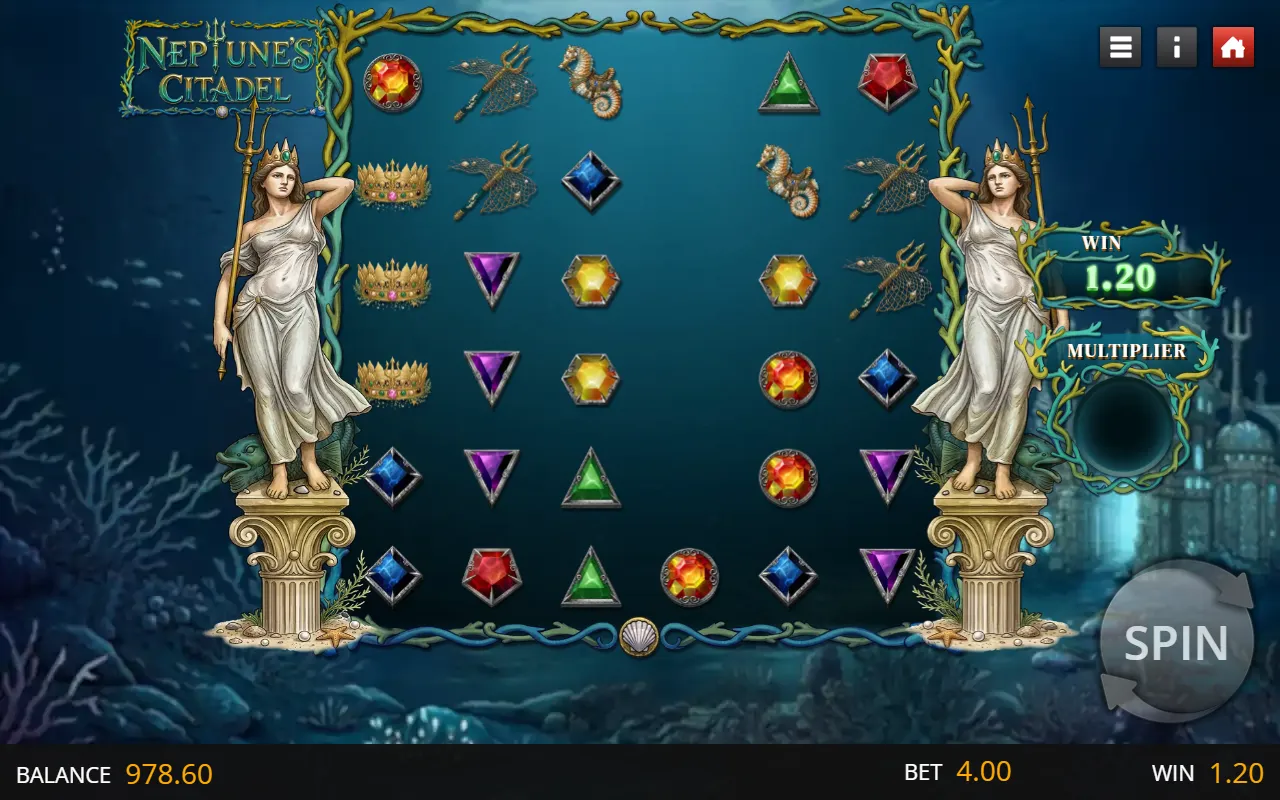
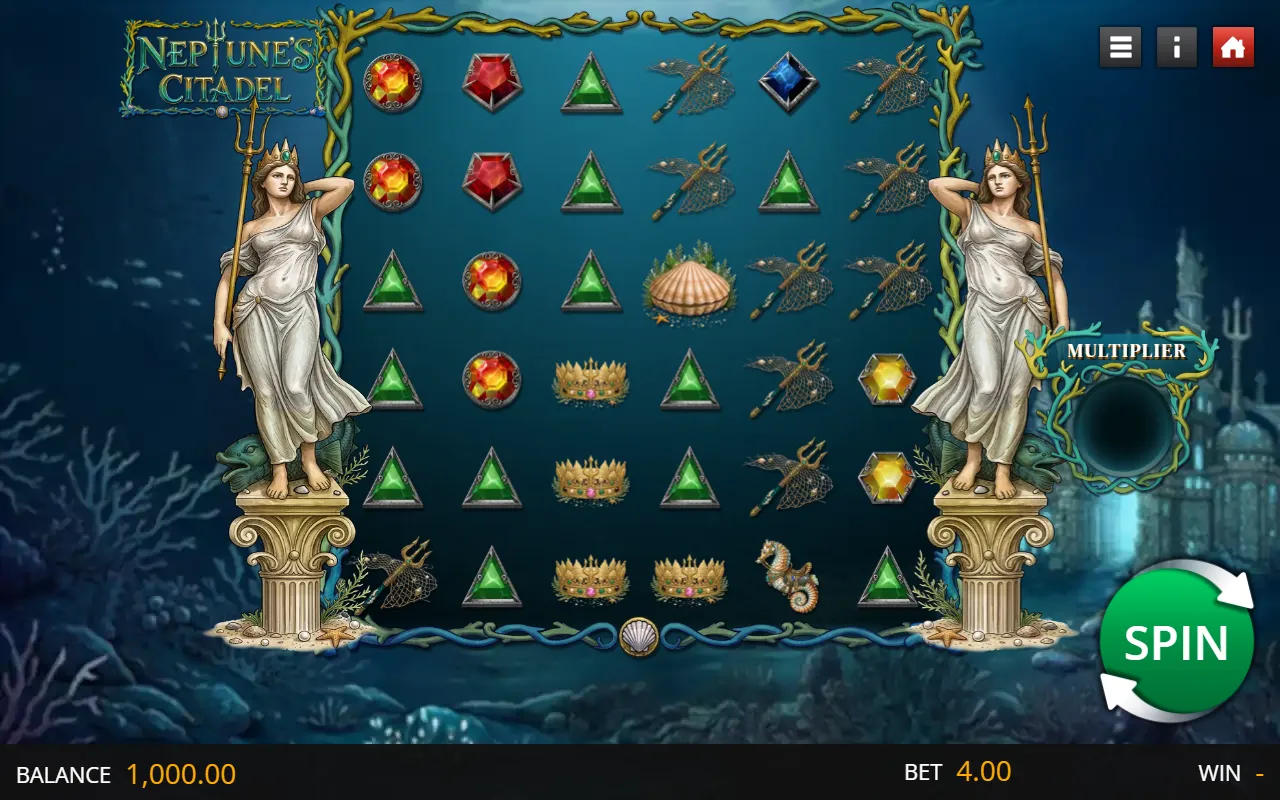
The cluster rules here are strict. Symbols have to touch horizontally or vertically, never diagonally, and five is the absolute minimum group that pays. Position doesn’t matter at all; you can land a straight vertical run of five in the fourth column, completely detached from the edges, and it still counts. But don’t look for wilds to help you out, because there are none in this game to stretch a group of four into a paying five.
Any win kicks off a cascade. The winning symbols vanish, new ones tumble down, and the board is evaluated again until a drop produces nothing. The payouts scale up in single steps depending on your cluster size, but they hit a hard ceiling at eleven symbols. Everything from twelve upward pays exactly the same flat rate, meaning a monster twenty-cell crown cluster pays exactly what twelve would.
Across seventeen base spins at $4.00 a go, four rounds paid out. Three of those four returned less than the spin had cost. The best of them came off a single drop featuring two separate clusters, five crowns and a five-cell seahorse group. They paid independently, handing over $8.00 and $3.00 respectively. That $11.00 total off a four-dollar spin was the absolute peak of the session.
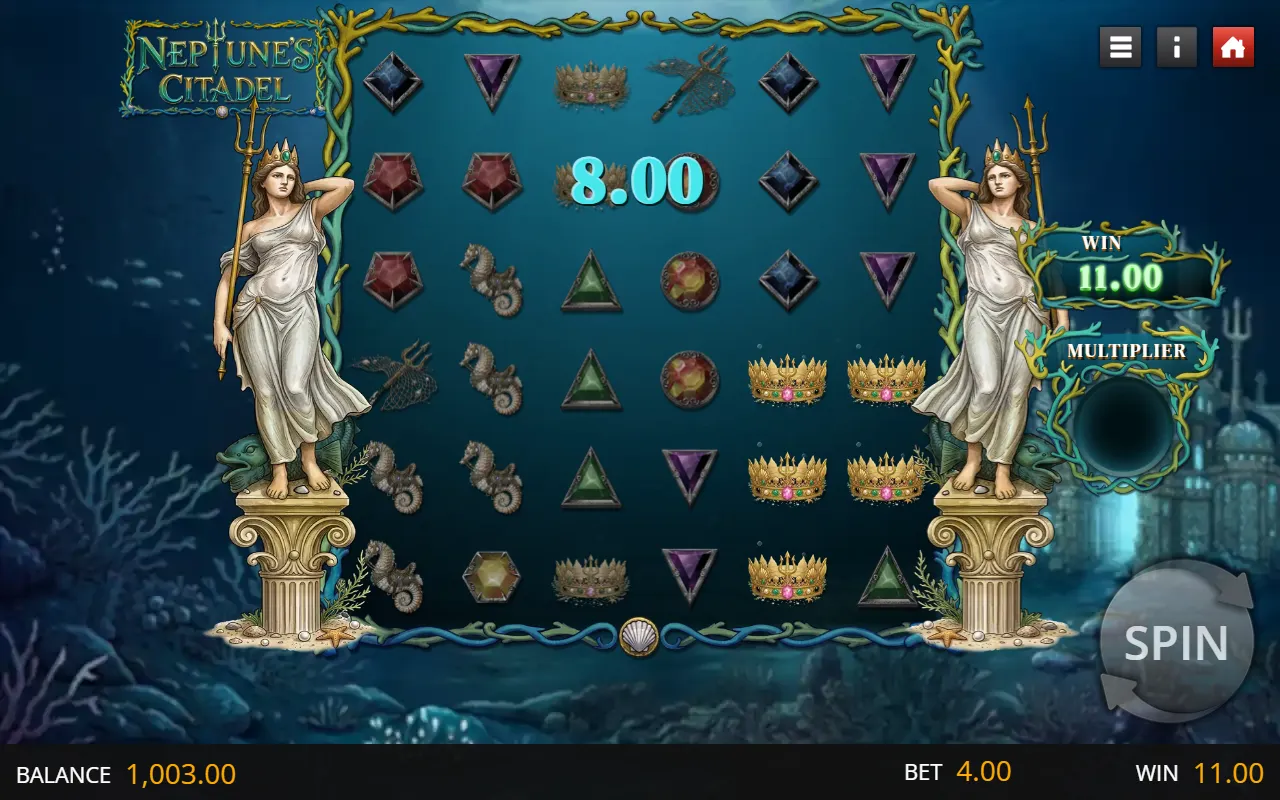
Cascades also feel a bit less generous in practice than they look. Two of my four paying rounds tumbled exactly once, produced nothing new, and ended immediately, adding zero to what the first cluster had already paid. The longest chain ran for three tumbles and finished at a flat $4.00, which was exactly what the spin had cost.
Stakes run from $0.20 to $50.00 in twenty-five steps built from a coin size and a coin count. A quick word of warning before you play: the Bet Max button does not actually max the bet. Pressing it at the $4.00 default only bumped the wager to $5.00 because it raises the coin count while leaving the coin size alone. Reaching the true top stake requires digging into a second control that the button ignores.
The clam only counts if you’re already winning
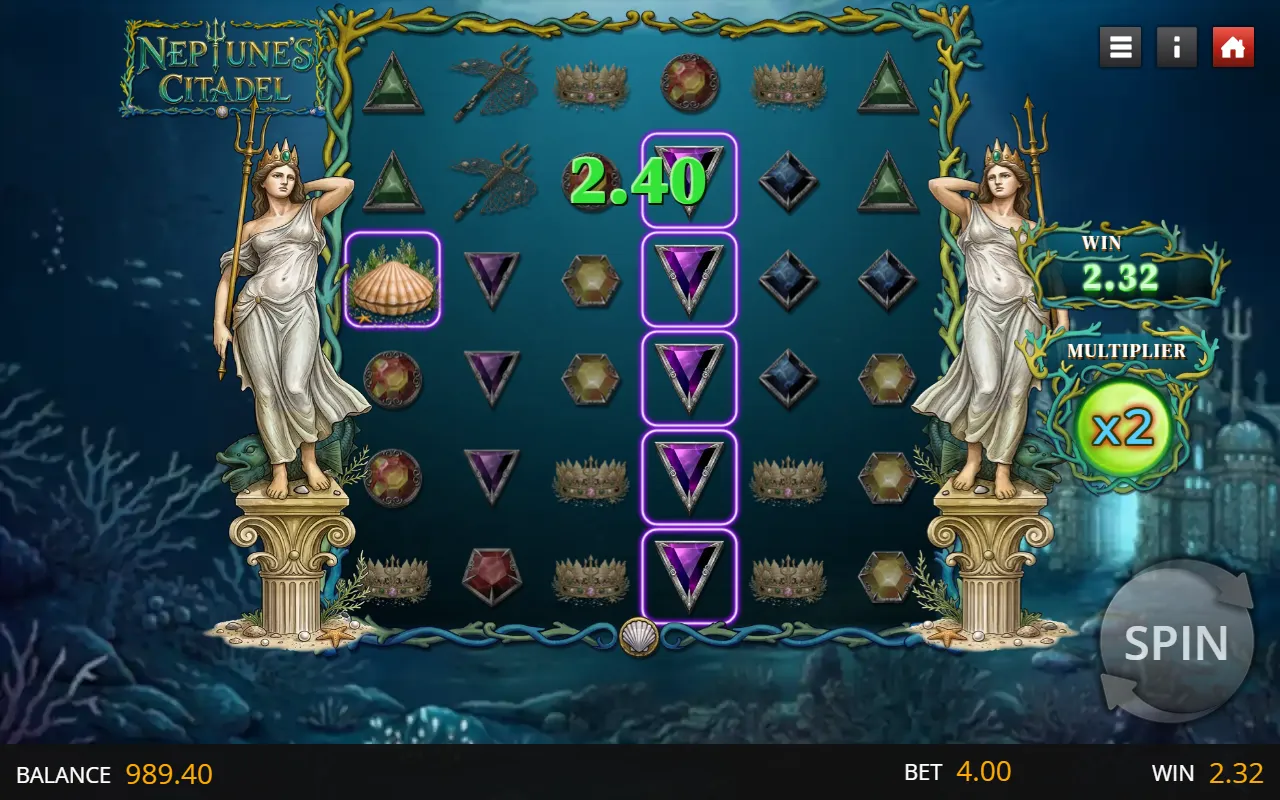
The multiplier symbol is an open clam that can land on any reel, carrying a fixed value rather than a printed number that changes. These values add up rather than compound, so landing a x2 and a x3 together makes the meter read 5, not 6. A single clam can carry as much as 500x, though the only ones that actually surfaced for me were x2, x3, and x5.
But there is a catch, and it is the single most important rule to understand about this symbol: a clam only pays into the meter if that exact same spin also forms a winning cluster. Land one on a board that does not win, and it is simply thrown away with everything else. I watched this happen twice, once with a x5 clam, and neither registered so much as a flicker on the meter. The clam looks identical whether it is about to count or about to be swept off. There is nothing on screen to tell you which one you are looking at until the board resolves.
In the base game, the meter wipes clean at the end of every cascade sequence. A big clam is therefore worth one round and then it is gone, no matter what number was on it.
Free Falls and the four medallions standing in the way
The bonus goes by the name Free Falls, a pun leaning into the tumbling reels rather than the underwater theme. You need four crowned Neptune medallions to open the doors, which awards eleven Free Falls. There is one tier and no more: four scatters get you eleven spins at the triggering stake, and the feature cannot be retriggered from inside.
One crucial rule separates the bonus from the base game, and it all comes down to the meter. During Free Falls, the multiplier total is never swept away, it accumulates across all eleven spins. That is where the 2000x maximum win actually lives, and there is no other route to it. The flip side, of course, is that a Free Falls round where no clam happens to land is just eleven ordinary spins at your own stake and nothing else.
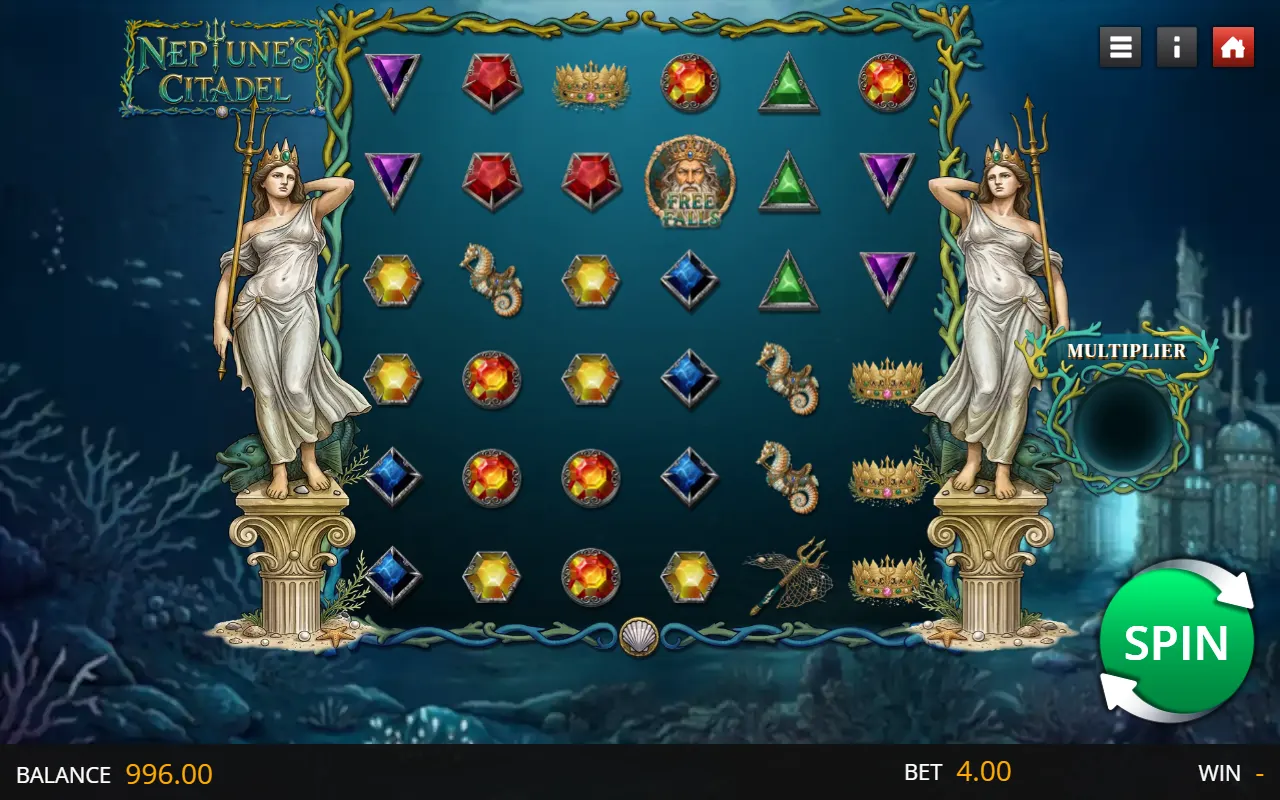
Getting into the bonus is the hard part, and the scatter symbols act as a nuisance while you wait. The medallion has no pay row of its own and no scatter ladder. Landing one, two, or three of them awards absolutely nothing and accumulates towards nothing. Worse, they only land on the middle four reels, which is exactly where clusters are most likely to form. Every medallion that turns up short of the required four is essentially a hole punched through the most productive part of the grid. While most slots let their scatters sit harmlessly, this one charges you a cell for it.
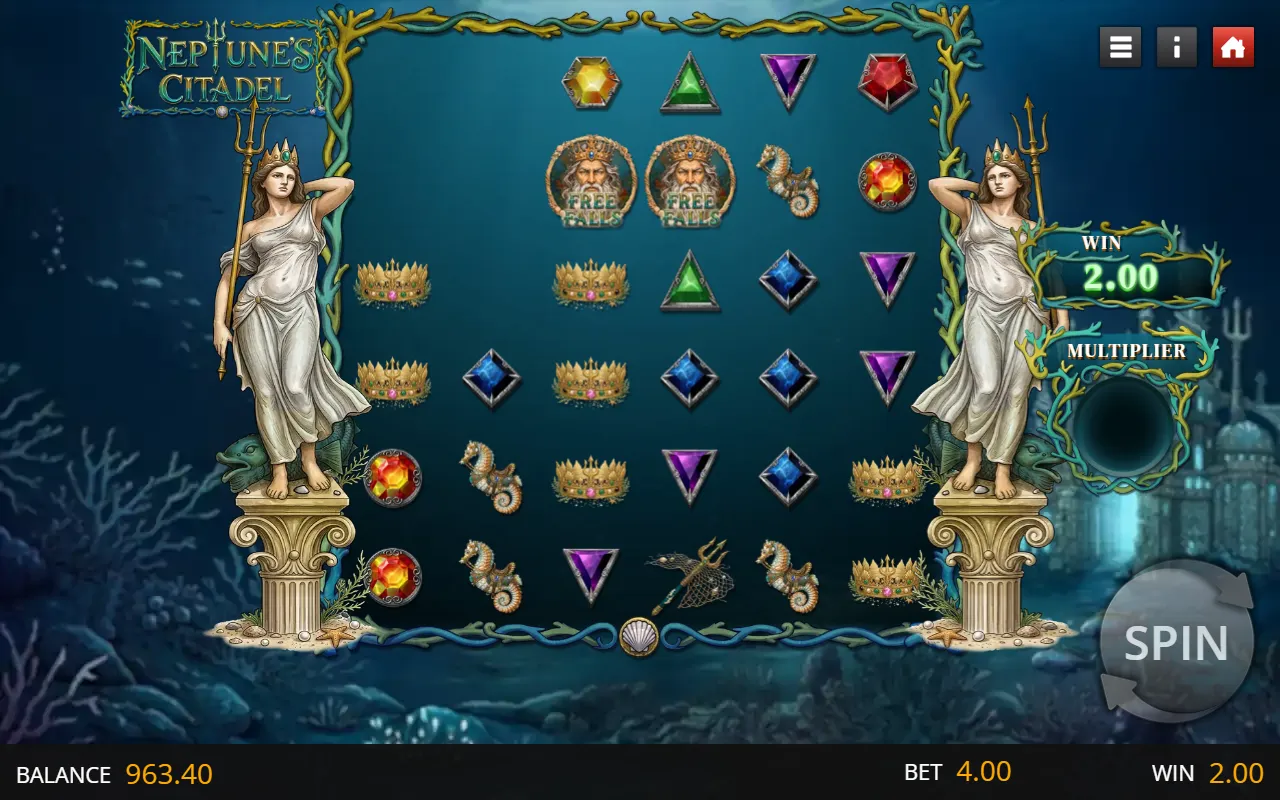
Unsurprisingly, breaking into the feature is a grind. My seventeen spins produced a single board with two medallions on it, and with no purchase option on offer, grinding for those four scatters is the only door in.
The symbols and what they actually pay
The grid is populated by nine symbols split into two families. Four cut gems in silver settings make up the bottom tier, a blue diamond, a green triangle, a purple triangle, and a yellow hexagon. Above them sits an orange-red gem, followed by three premium objects: a gold seahorse, a trident tangled in a fishing net, and a jewelled crown at the very top.
At the $4.00 default bet, a spin costs 20 coins, and exactly one symbol beats that cost on the minimum cluster. Five crowns pay 40 coins, doubling your stake. Five seahorses pay 15 coins, giving you three-quarters of your bet back. The two cheapest gems pay just 5 coins for the same achievement, returning a measly quarter of what the spin cost. This is a game that hands out a great many things it calls wins and means something much smaller by the word.
The biggest single number printed anywhere on the paytable is 600 coins for twelve or more crowns, which equates to 30x the bet. Set that against a 2000x ceiling, and the arrangement is clear enough: no cluster of any symbol, at any size, gets within a sixtieth of the maximum on its own. The 2000x is strictly a multiplier-meter number, and that meter only survives more than one round inside a bonus you need four medallions off four reels to reach.
There is one oddity in the paytable. Although there are nine symbols, they carry only seven prices. The yellow hexagon and the purple triangle share a pay row exactly, and so do the green triangle and the blue diamond. Somebody drew nine symbols for math that only needed seven.
How it looks
The art direction feels old-fashioned in the best possible way: hand-painted, cold, and restrained where a sea-god slot usually goes for thunder and spray. The palette relies on deep navy and teal, weathered marble, and gold as the only warm color in the frame. The drowned city glows faintly from inside its own arches, making the scene read like a place where somebody lives rather than a wreck. There is no splash screen and no intro sequence; it loads straight to the grid, which is a small mercy.
Neptune himself turns up exactly once in his own citadel, showing up only as a face on the scatter medallion. Everything else is temple statuary and heavy jewellery. The theme acts as decoration rather than a mechanism, and the one place it earns anything is the clam, a shell on the seabed that opens to hand you a number.
Pros and Cons
Good
- A clean cluster-and-cascade game with nothing bolted onto it, no ante, no gamble, no side bet, no meter to learn.
- Small wins arrive often enough to keep a session moving; four of our seventeen spins paid something.
- The artwork is genuinely well drawn and does not look like every other Poseidon slot on the shelf.
- Entry at $0.20 a spin, which is cheap for a 6×6.
Bad
- Almost every cluster in the game pays less than the spin that produced it.
- The clam is void on a board that does not win, and nothing on screen warns you.
- The scatter blocks the middle reels, pays nothing on its own and accumulates towards nothing.
- No bonus buy and no retrigger, so eleven Free Falls behind four medallions is the whole of the upside.
- A 2000x headline sitting on top of a paytable whose largest entry is 30x.
Verdict
Across eighteen spins, the multiplier meter lit exactly once, and it read x2. That is a small sample, and it is not the complaint, the complaint is that everything about the game points the same way. The cluster math pays under the stake nearly everywhere, the one symbol that could rescue a spin is quietly discarded on the spins that need it most, and the scatter that opens the only route to the ceiling spends the rest of its life taking up space in the middle of the board.
What is here is built properly. The cascades are quick, the adjacency rule is honest, the art is better than the game deserves, and the eleven-spin round with a meter that never resets is a real and well-judged payoff for anyone who reaches it. Someone who wants a cluster game with nothing bolted on can have one at 20 cents a spin, and will spend a long time collecting wins worth less than the spin before four medallions ever show up on the middle reels.