
 Powered by SlotsReach.com
ELK Studios invented the CollectR mechanic and has spent three years putting animals on it: parrots in the Pirots run, beavers in Dam Beavers, and pigs in Huff N’ Puff CollectR. Concrete Cowboys is the first one featuring people. Four builders work a grid on a city rooftop, and the game hands them a wrecking ball, a bundle of lit dynamite, and a woman from HR whose entire function is to fire them. It starts as a 5×5 grid and grows to an 8×8, arrives on 24 September, runs at a 96% return with high volatility, and tops out at 10,000x the bet.
What makes the game genuinely interesting is that nearly every disaster on the site is something you want to happen. What makes it frustrating is that the bonus round, the thing you are supposedly playing toward, feels like the least imaginative part of the shift.
How the builders get stuck
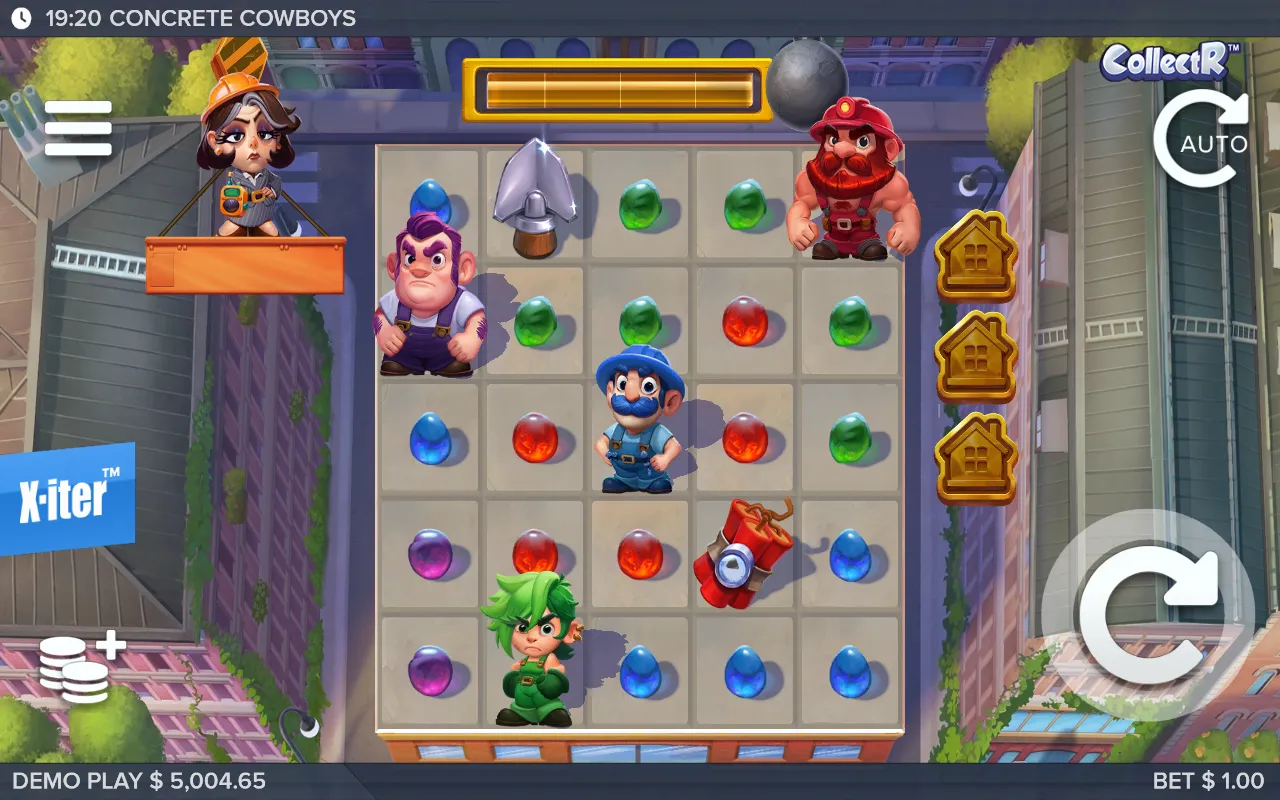
Nothing in Concrete Cowboys pays just for landing, and there are no paylines to memorize. Four Collectors stand on the grid, one for each gem colour (red, purple, green, and blue). Each moves once per refill to a cluster of its own colour sitting directly above, below, or beside it. Everything a worker reaches is collected and paid, old symbols fall, new ones drop in, and everyone moves again. The round keeps running until nobody can move.
The rule that dictates all of this is what counts as a wall. A worker crosses empty cells freely but cannot pass a gem of another colour. Because of this, a board packed with red isn’t a massive red win, it is a barricade. A worker can easily get boxed in by purple on one side, blue on the other, and red directly above, leaving twenty-five symbols on the board and not one of them reachable. A full grid can be worth absolutely nothing. It is a positional loss condition, which feels completely different from a standard slot.
Two features exist mainly to fix these traffic jams. Transform converts a cluster next to the collecting worker into their colour, turning a brick wall into a payday. Tunnel lets a worker jump to a cluster of their colour they could not otherwise walk to, or swap places with a colleague. There is also an automatic swap when a stuck worker can reach something from a neighbour’s square, which happens quietly in the background and is easy to miss.
Seven levels of gem, and six are pocket change
Red, purple, green, and blue are the only paying symbols, and each carries a payout level from 1 to 7. The level belongs to the gem on the board, not to how many you collect, meaning there is no three-of-a-kind ladder anywhere in this game. One collected gem pays its own level value exactly once, and the total is the sum of everything the four workers picked up.
The numbers are lopsided on purpose. Red at level 1 pays 0.10x. It then goes 0.25x, 0.40x, 0.75x, 2.00x, 6.25x, and finally hits 12.50x at level 7. Blue starts at a microscopic 0.05x. On the best symbol in the game, four of the seven levels pay less than a single unit of stake, yet the game still enthusiastically throws a big gold number over the grid when one lands. It is entirely normal to watch seven green gems come off the board at once, only for the floating figure to read 0.15, leaving the whole round finishing at 1.35 on a 1.00 stake. That is what an unupgraded board pays, and it is where the game spends most of its time.
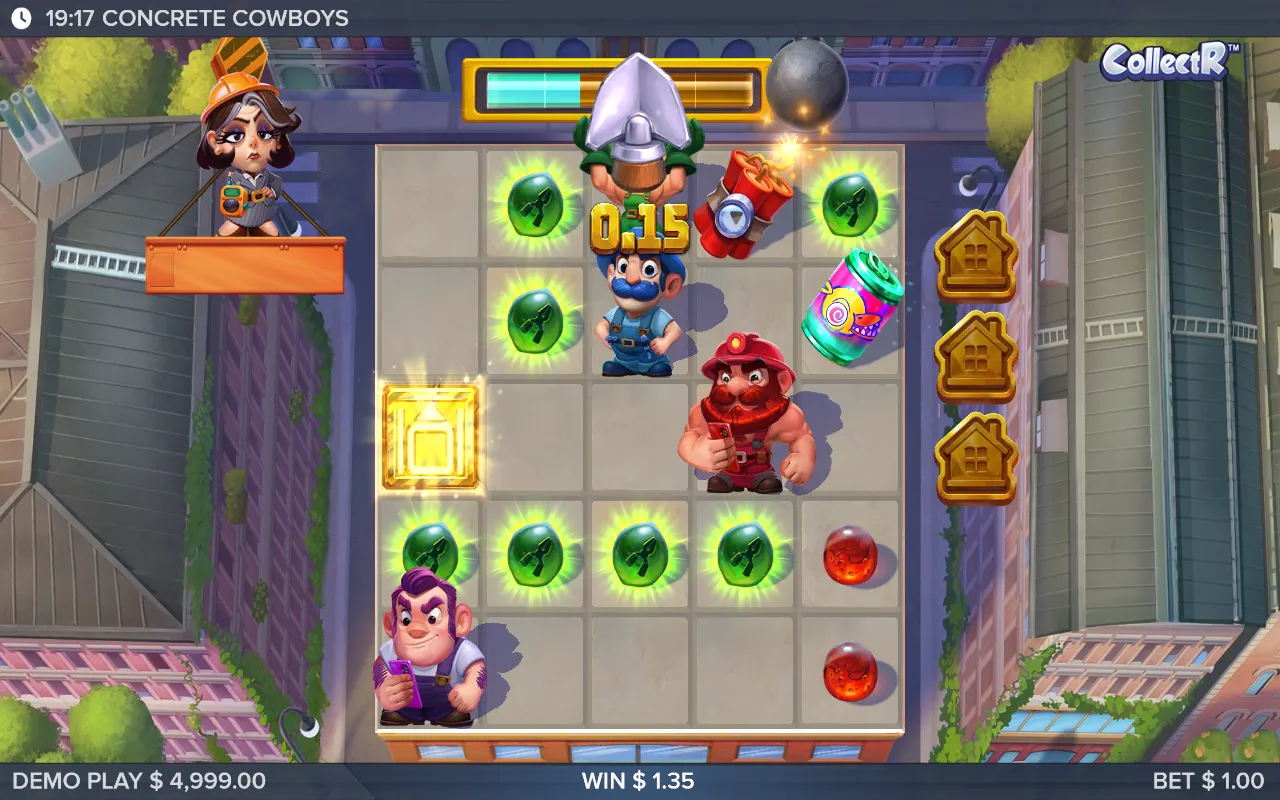
Every base drop resets all four colours back to level 1, which is why the Upgrade is the load-bearing symbol of the entire slot. A silver Upgrade lifts one colour by one, two, or three steps, and the beneficiary is decided by whichever worker happened to reach it rather than by you. The gold Upgrade All boosts all four at once. You can see when it has worked without reading a single number: upgraded gems put on hard hats, then ear defenders, and by the top of the ladder, they are carrying tools.
The hazards, and why you want them
Dynamite clears a line of the grid in a random direction and takes out any workers standing on it. Transform, when there is nothing adjacent to convert, does not just fizzle out, it becomes a live bomb instead, meaning the safest-looking symbol in the game can blow up the worker who picked it up. Above the grid sits a meter with a wrecking ball hanging off it, filling as gems and Wilds are collected. Twenty symbols charge it the first time, thirty the second, and forty the third, with up to three waiting at once. The blast zone gets outlined in hazard tape before the ball drops through it, and the ball does not distinguish between gems and staff. Feature symbols, coins, and Bonus symbols do nothing for this meter at all.
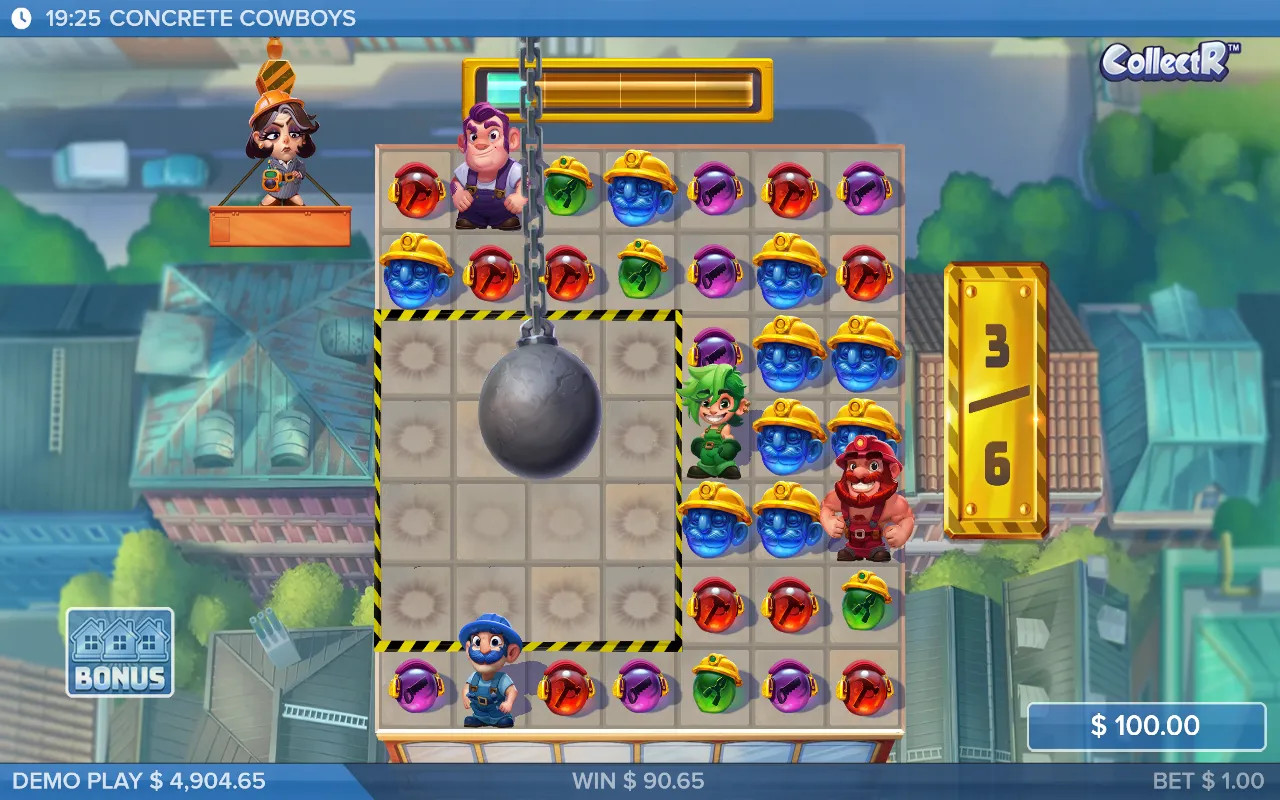
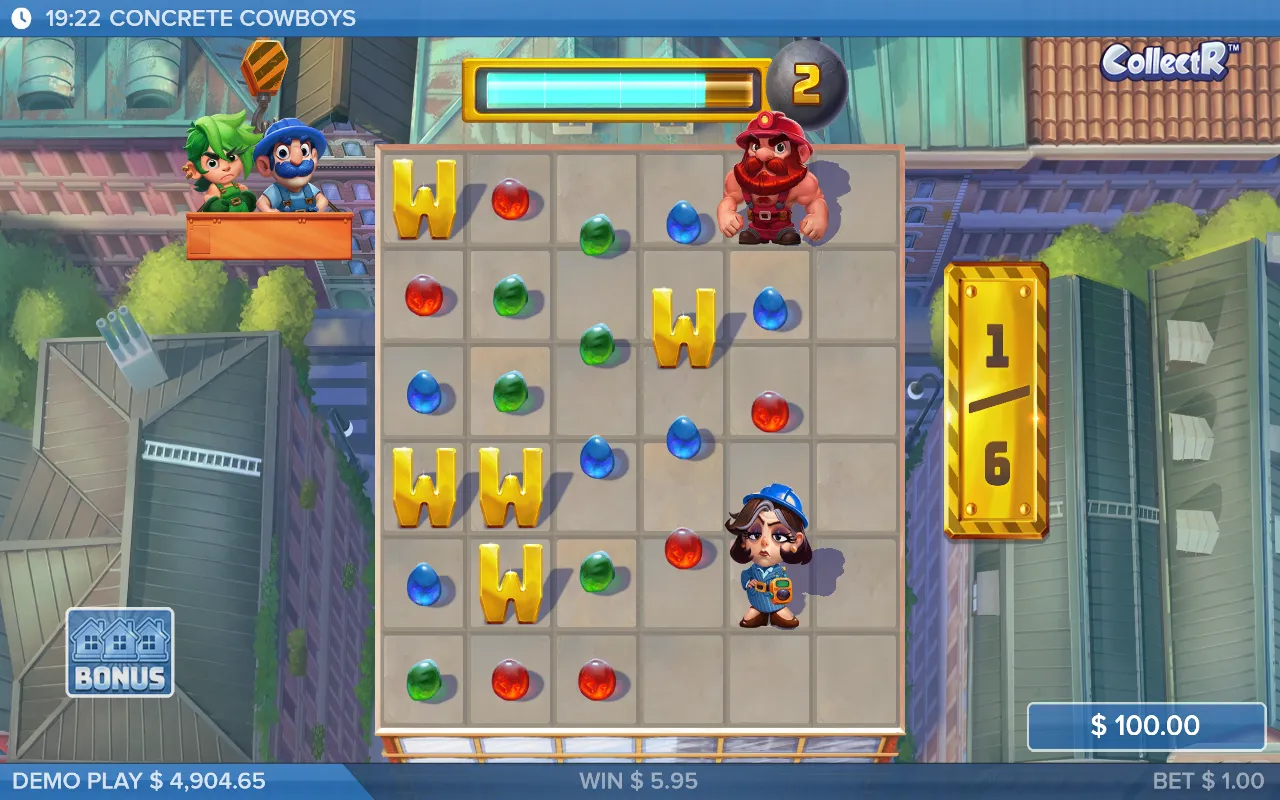
Crucially, losing a worker is the good outcome. Every remaining gem of that colour converts to a Wild, and a Wild substitutes at whatever level the gem it stands in for has reached. A crew death on an upgraded board simply hands you a screen full of high-value symbols. The walkie talkie is the deliberate route to this massacre. Collect one, and HR Karen walks onto the grid, removes a worker, takes over their colour, and if she finishes next to another one, she removes them too. She can clear out anywhere from one to four of them, acting as a lottery rather than a promise. Having two workers fired and sitting out on Karen’s platform while their gems turn into five gold Ws is exactly what you want to see.
Lose all four workers and the game promotes them to Heaven, an 8×8 board with every symbol at level 7 and haloed versions of the dead crew floating over it. It is the richest board in the game, but it comes with a catch: the wrecking ball meter and the Bonus inventory are both switched off in there, so you cannot bank any progress toward the bonus while you are enjoying it.
Three minigames, and one is a reward for emptying the board
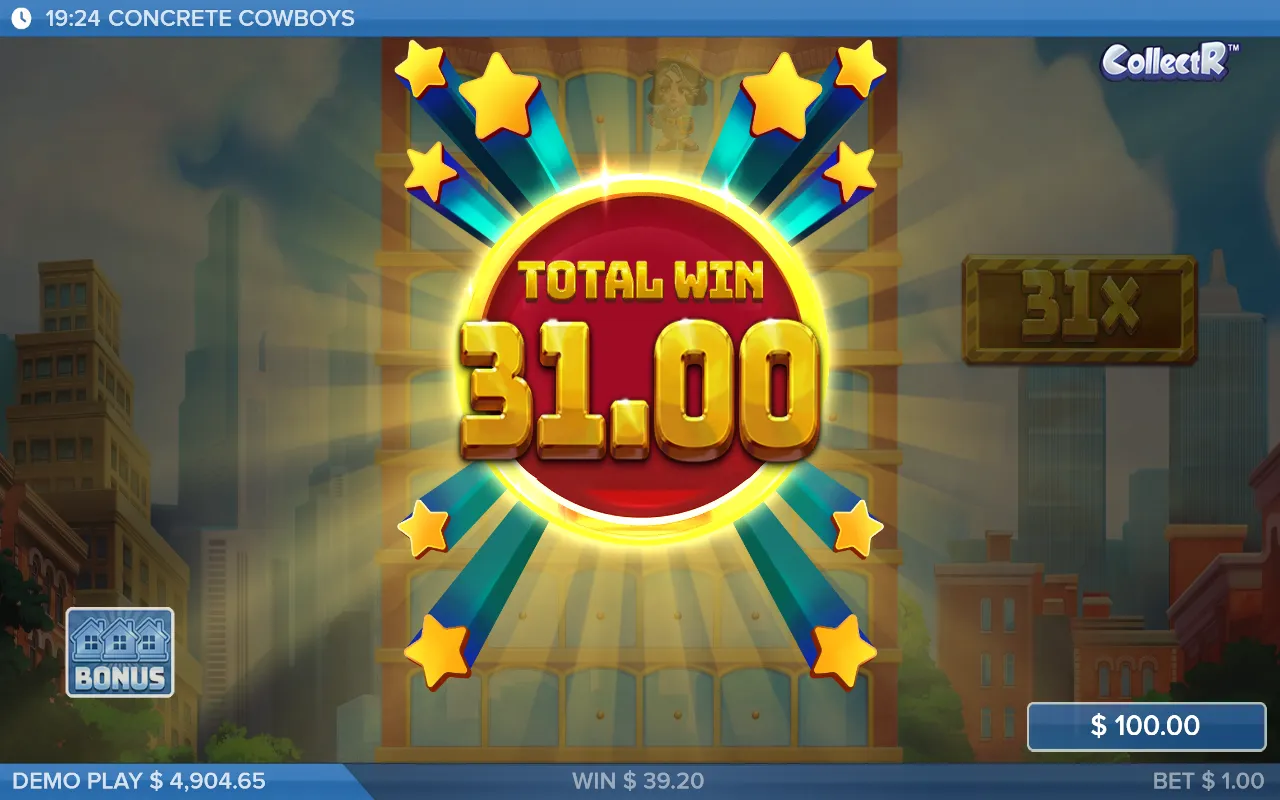
Clear every paying symbol off the grid and you get Employee of the Month, played on its own 6×7 board with a worker in the bottom corner. Coins, walkie talkies, ladders, and Accumulators keep awarding spins until nothing new lands, then the worker walks their row and collects it all. Ladders let them climb a floor and are used up. An Accumulator turns into a coin worth every other coin on screen. If Karen opened the minigame instead of a cleared board, it plays as a different game entirely: only coins, Accumulators, and duds land, and the ladders are already in place connecting every level. During our time playing, seeing the board empty completely on the third drop was a thrill, it’s both the best thing that can happen on a drop and the exact thing that ends it. One run of Employee of the Month closed at 31.00 on a 1.00 stake, carrying almost the entirety of a 39.20 round.
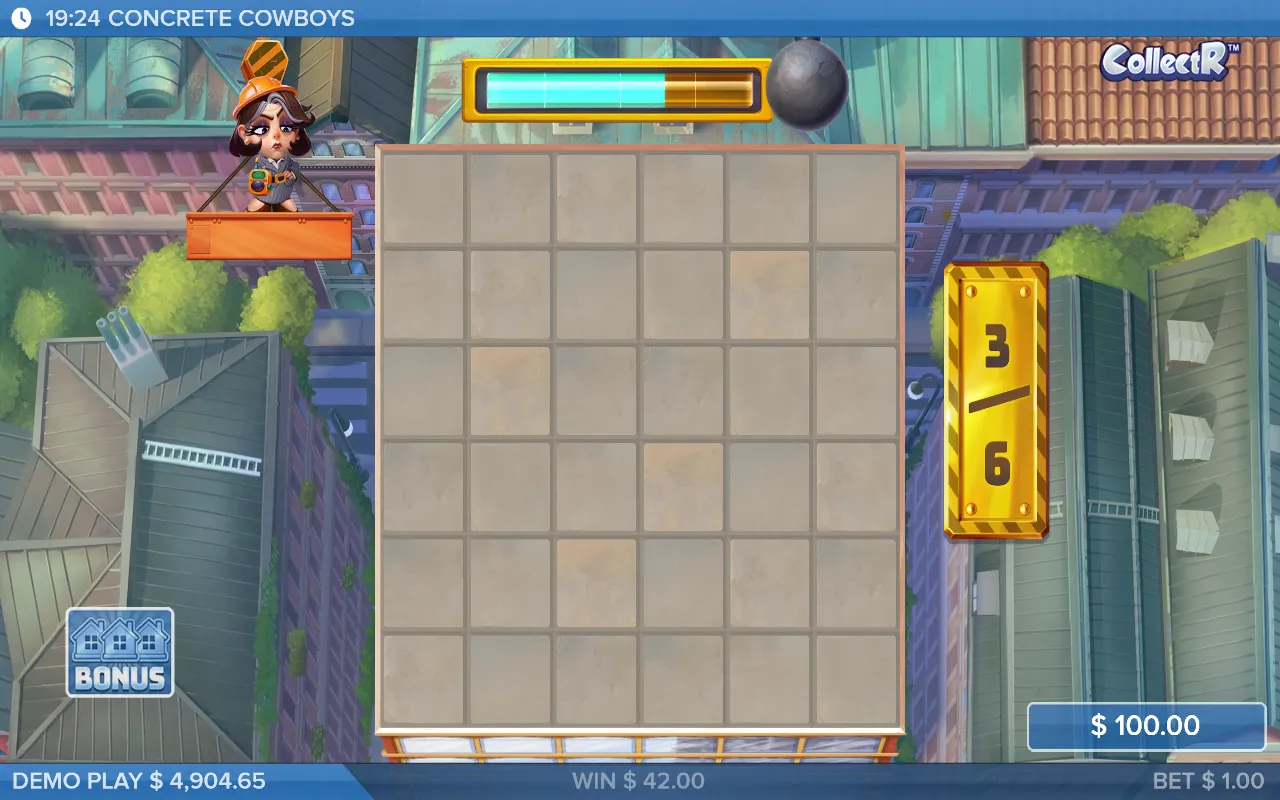
Building Time is the third minigame, played on a 5 by 6 board where gems and coins fill rows against a multiplier printed beside each one. Completing a row is what buys more drops. It is the one we never naturally triggered, as the 50x buy picks a minigame at random and consistently opened a different door for us.
The bonus is the base game with one rule switched off
Three Bonus symbols collected in a single round awards five bonus drops. Note the word collected, not landed. That distinction defines the whole base game experience: a gold house plaque sitting on the board is worth absolutely nothing until a worker walks to it. You will frequently see two Bonus symbols land, remain completely out of reach, and watch the round end with your inventory still sitting empty at 0 of 3.
Inside the bonus, nothing resets between drops. Grid size, gem payout levels, meter progress, and the Bonus inventory all carry over, and every further Bonus symbol collected adds another drop. That is the entire difference from the base game. There is no new symbol, no multiplier trail, and no separate board. The base game is simply the bonus with a handicap, and whether you find that elegant or thin depends entirely on how much you enjoyed watching your gems reset to level 1 on every standard drop.
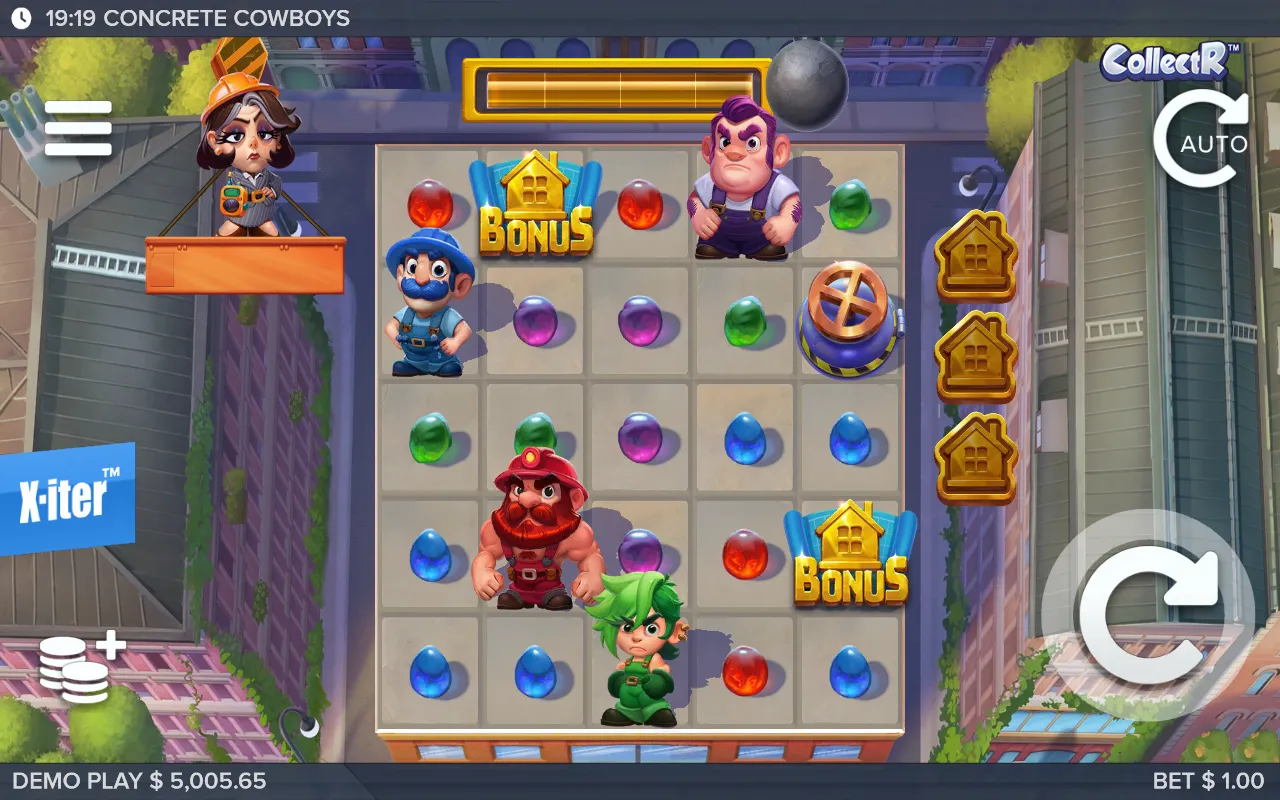
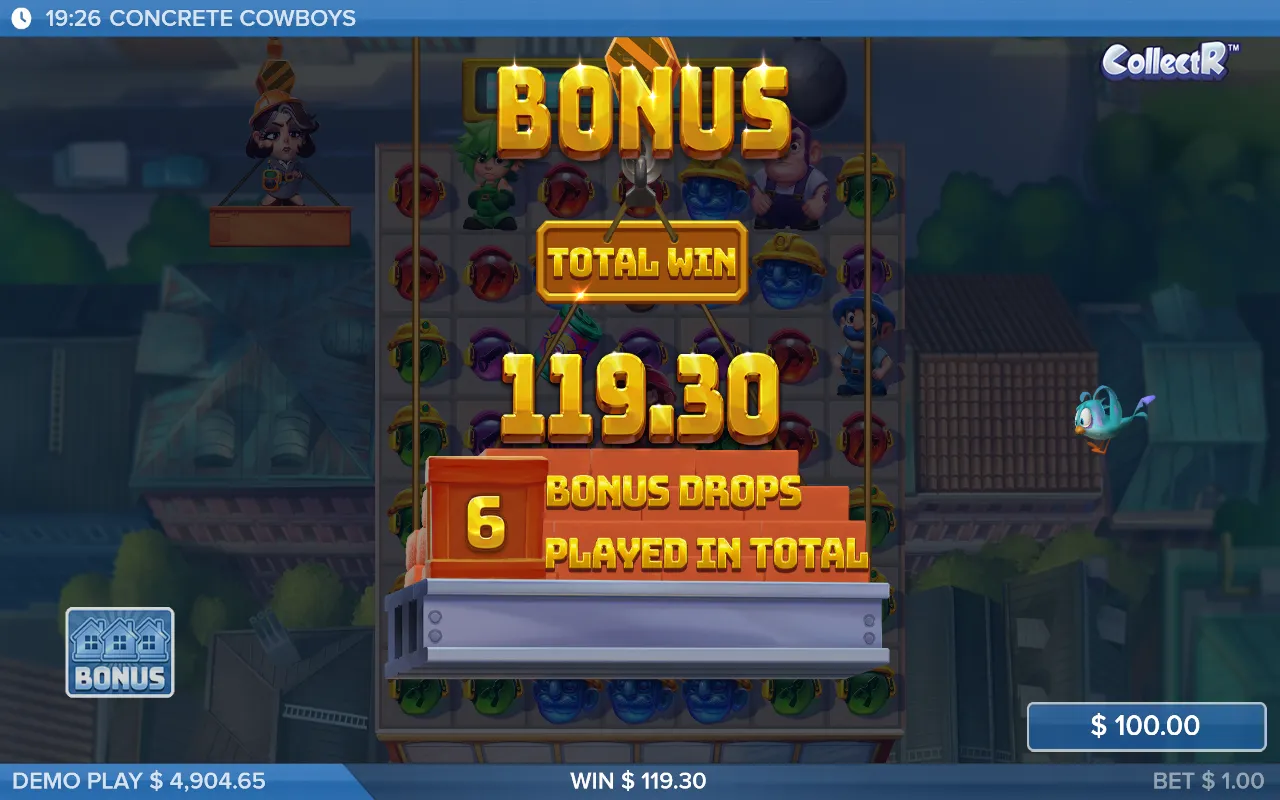
We bought the feature at 100x. Five drops were awarded, six were played because one more Bonus symbol was collected inside, and it closed at 119.30 on a 1.00 stake. Tellingly, thirty-one of those units came from an Employee of the Month trigger rather than from the bonus drops themselves.
There is a Super Bonus too, triggered when one of the three collected symbols is a Super Bonus version. It starts at the maximum 8×8 size and turns every Upgrade into an Upgrade All, which on paper is a substantially better round.
The buy menu
The buy menu offers five tiers, priced at 2.5x, 5x, 50x, 100x, and 250x the stake. The two cheap ones do not buy a trigger at all: Bonus Hunt gives more than three times the usual chance of getting there and Mega Hunt more than six, and either can end as an ordinary losing round. Fifty buys one of the three minigames, chosen for you. A hundred buys the bonus and 250 buys the Super Bonus. Stakes run from 0.20 to 100.
Two things about that menu are worth knowing before you use it. Every tier runs at the same theoretical return as the base game, so there is no buy tax here, which is rarer than it should be. And the cheapest tier is a weighted ordinary spin rather than a stripped-down mode, so Heaven, all three minigames, and both bonus games are reachable from 2.50 exactly as they are from 250. The only thing the expensive tiers actually sell is certainty.
One caveat matters more than any of it: 96% is the top rung of five. The same game ships at 94, 92, 90, and 87 as well, and the casino picks. Check which one you are sitting at before you settle in.
It is not a western
Half the internet has this filed under Wild West, and the title is why. “Concrete cowboys” is actually American slang for the ironworkers who put up skyscrapers, and the game takes it literally: four builders, a rooftop, a city running off in every direction, and a loading screen that is a straight parody of the famous 1932 photograph of workmen eating lunch on a girder. There is no desert in it and no saloon.
The tone is pure workplace sitcom, and the joke is carried through the maths rather than just painted on top of it. The hazards are site hazards. The villain is HR. The paytable files itself under Builders, Minigames, and Code Violations. Karen stands out on a suspended platform with a clipboard and an expression of enormous patience, waiting to be called in. Death is a promotion. It is genuinely funny in a way slot art almost never manages, and the chunky cartoon style holds up over an hour of spinning.
The one visual complaint is legibility. At the full 8×8 grid size, with every gem wearing a hard hat, a wrecking ball swinging, Karen on the board, and Wilds scattered around, it takes a beat to work out what just paid you. The game is dense and the screen shows it.
Pros & Cons
Pros
- The buys do not tax the return. Every tier runs at the base game’s RTP, and the 2.50 entry reaches everything the 250 one does.
- The hazard logic actually works. Losing workers turns their gems into Wilds, and wiping out the whole crew is the route to the best board in the game.
- Three minigames feature genuinely different boards, and Employee of the Month changes its deck depending on whether you cleared the board or Karen opened it.
- The theme is a real joke, sustained all the way into the protocol the game runs on, rather than just a cheap skin.
Cons
- Six of the seven payout levels are small change. A blue gem at level 1 returns 0.05x, and the game still plays a win animation for it.
- The bonus adds nothing except turning off the level reset. In a game bursting with ideas, that is the one place none of them landed.
- 96% is the best of five versions, and the worst is 87%. Where you play changes the game materially.
- The 10,000x ceiling is the same number Pirots 5 and Spark of Creation carry, at the same 96%. On the headline figures, this is not a step up from either.
Verdict
Our 100x buy came back at 119.30, and 31.00 of that was from Employee of the Month rather than the bonus drops we actually paid for. That is a perfectly fair summary of where the value sits in this game. The bonus feels like a formality. The minigames, the swinging wrecking ball, and the entire apparatus of getting your own staff killed are where the interesting money is, and all of them are completely live in the base game at 1.00 a spin.
The hit frequency is a shade under a quarter, so plenty of drops end with the crew standing in a full grid they cannot touch. You should fully expect the ones that do pay out to hand you tiny fractions of a stake until a solid Upgrade lands.
If you already play CollectR titles, spend the 2.50 on Bonus Hunt rather than the 250 on Super Bonus. It reaches Heaven, all three minigames, and both bonus rounds on exactly the same terms, and it lets you find out whether the joke is worth a hundred spins before you commit your bankroll to one.