
 Powered by SlotsReach.com
Everything in Pots of Power: Mummy’s Treasure happens after the wheel stops
AvatarUX has built its reputation on reel mechanics with names like PopWins, MultiPop, and StickyPop, but you won’t find any of those here. Released in 2026, Pots of Power: Mummy’s Treasure is a straightforward 25-line slot attached to a Hold & Win bonus. The real heart of the game lives entirely on the far side of a wheel you have no control over. It carries a 96.10% RTP, a ceiling of 10,000x your bet, and a volatility rating of two bars out of four.
Getting the bonus to start
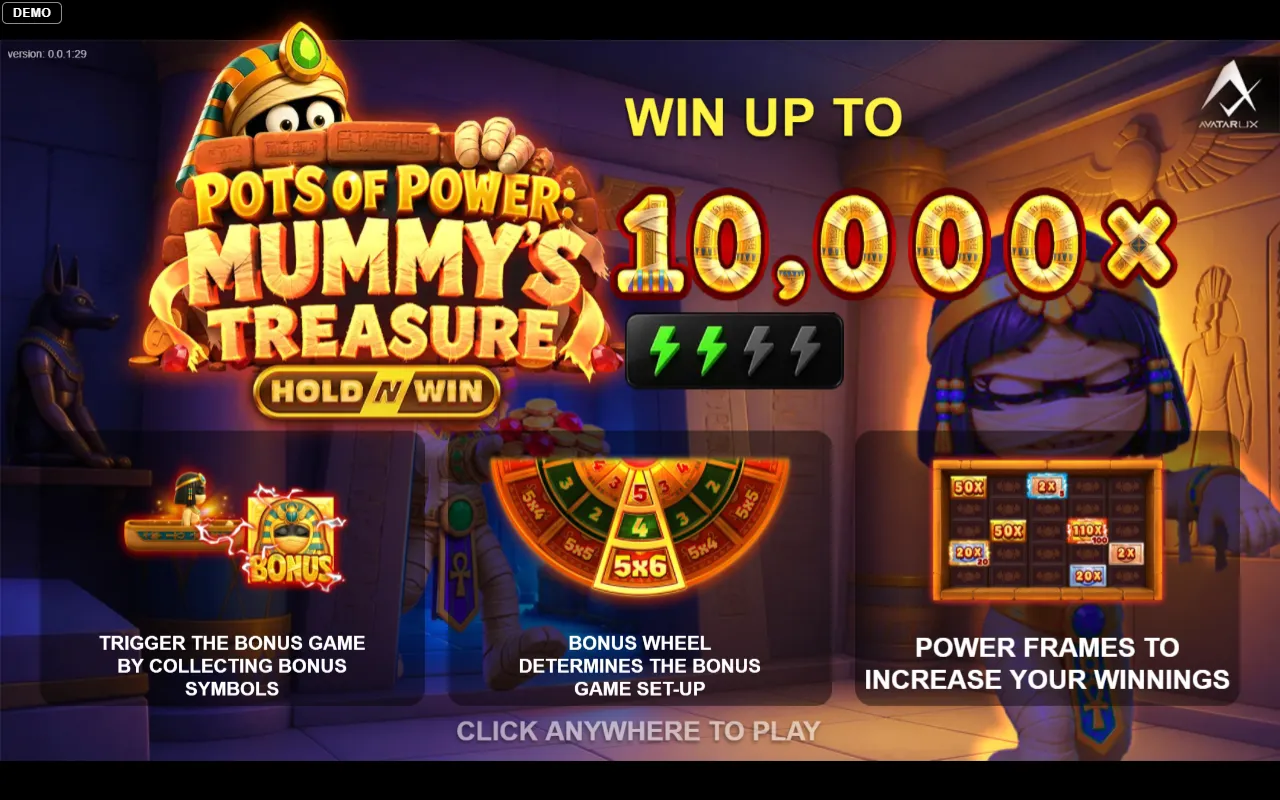
You only need one bonus symbol to drop. Not three, not two, just one, landing anywhere on the reels. There is no collection ladder above it, meaning landing two or three symbols on a single spin awards nothing more than a single tile would. What those extra symbols do buy you, however, are extra chances, because the trigger itself is entirely random. A bonus symbol landing does not guarantee the round opens; it simply acts as a ticket in a draw.
In practice, the ordinary outcome of seeing that gold tile drop into view is that the spin just carries on. You watch it land, wait for a reaction, and realize you just rolled a blank. It turns every bonus symbol into a small gamble of its own.
The wheel decides your round before you play it
Once the bonus does actually fire, a three-disc wheel takes over before a single respin is played. A mummified cat turns the contraption, and its three rings determine your fate. The outer disc sets the grid at 5×4, 5×5, or 5×6. The inner sets your respins at 3, 4, or 5. The middle sets the number of Power Frames at 2, 3, or 4. That creates 27 possible setups, and when the wheel stops, you are locked in.
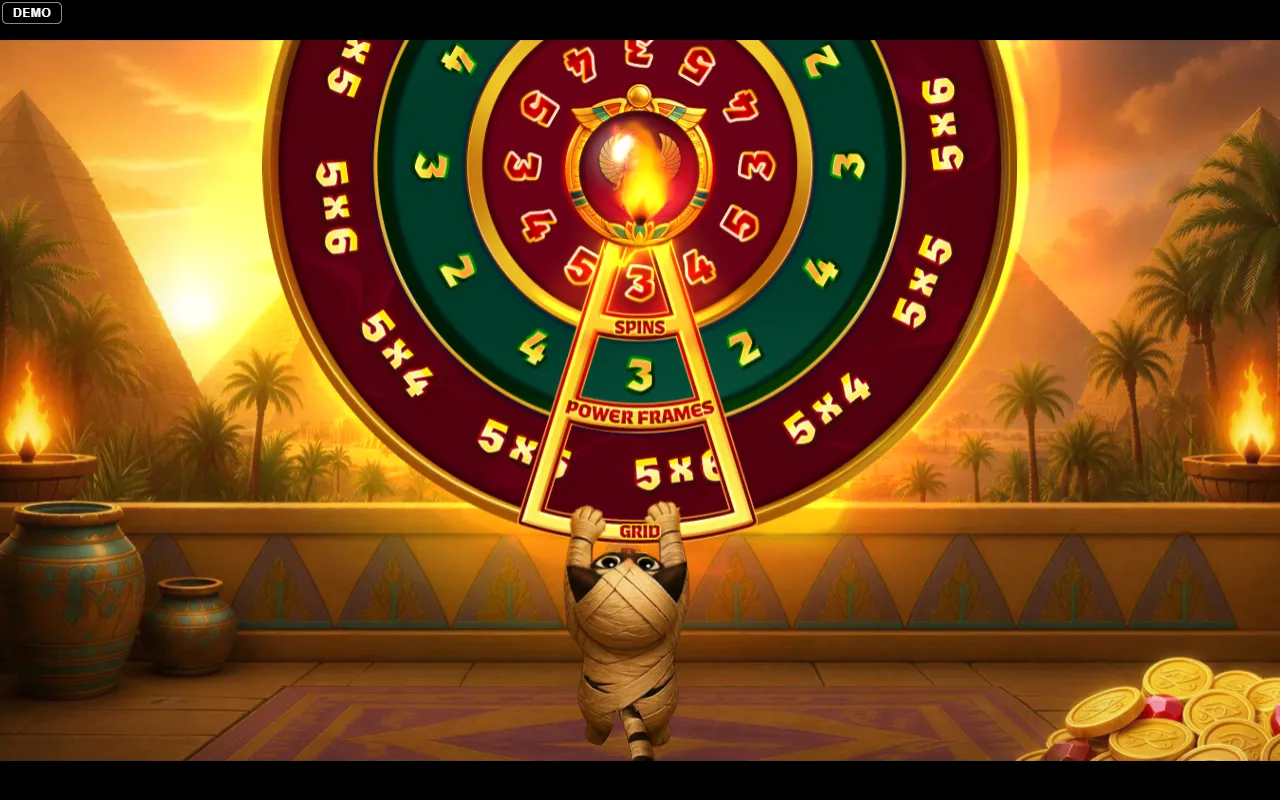
The grid size dictates more than just elbow room. If you manage to fill every cell with coins, your entire pot gets a multiplier at the end: x2 on a 5×4, x3 on a 5×5, and x4 on the massive 5×6 board. The wheel isn’t just handing out space; it is setting your ceiling before you have even seen a coin.
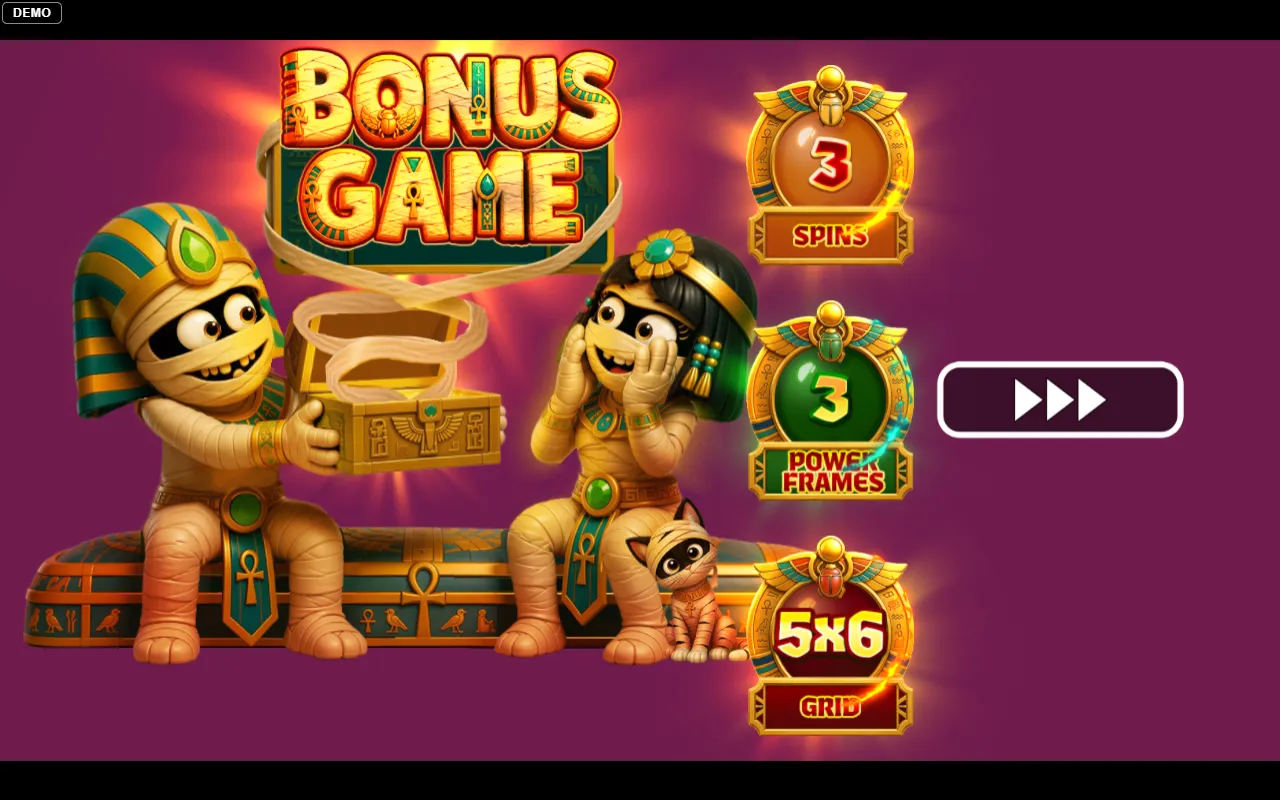
Drawing something like 3 spins and 3 frames on a 5×6 board, which is exactly what happened during our session, feels generous and stingy in the same breath. You get the biggest board, but the fewest respins to work with, forcing the math to argue with the empty space.
Power Frames, and what they do most of the time
Underneath the setup, this is a Hold & Win with no collector and no multiplier symbol. Coins land carrying flat values, ranging from 0.2x up to 3x, 5x, 7x, 10x, 25x, and 50x, and they stay put until the game adds them up at the end. Everything that makes a round bigger than the sum of what fell comes exclusively from the frames.
A frame is an empty rectangle with a small number in the corner. Before every respin, all the frames relocate. If a frame lands on a coin, it adds its number to that coin. If two frames finish next to each other, vertically or horizontally, they merge their values and both come away holding the total. As they grow, they change color from blue to yellow to red, though ours never managed to leave blue.
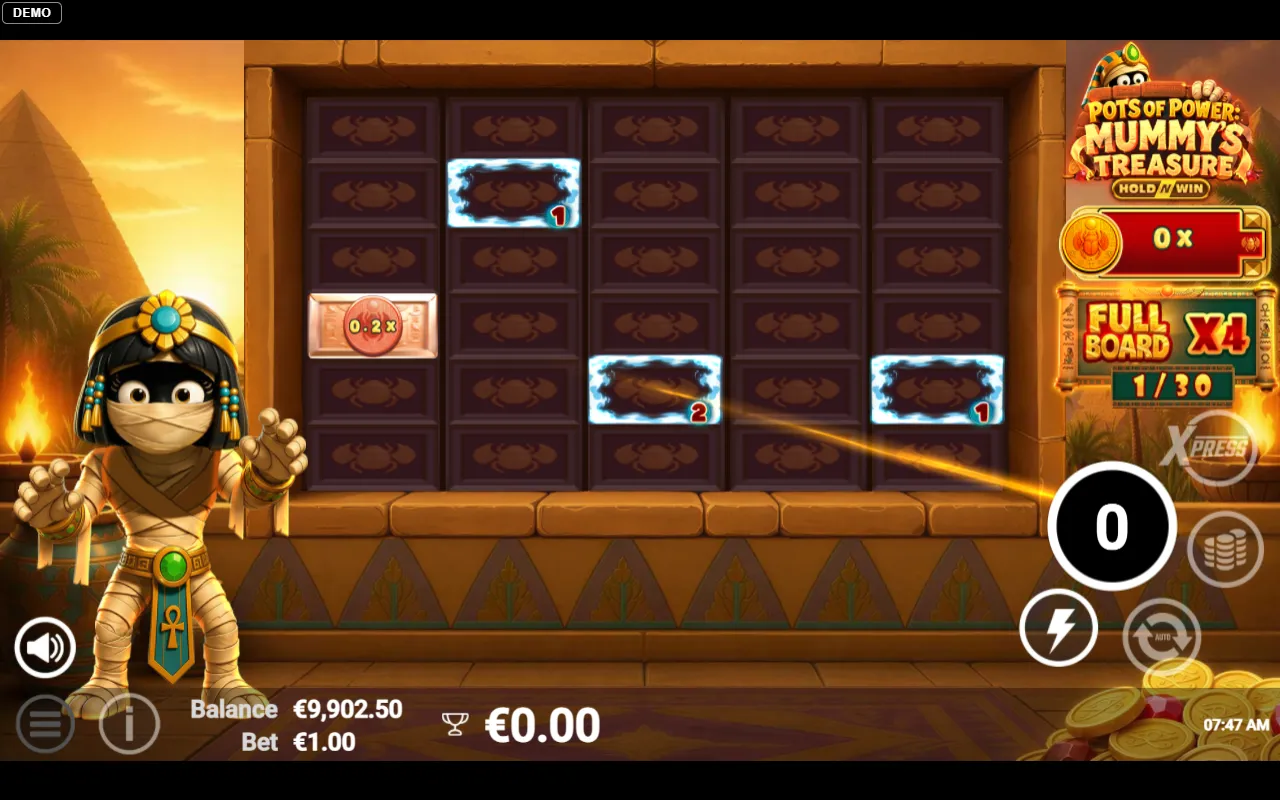
The operative word in all of this is “lands.” Three frames on a 5×6 board are just three tiles wandering thirty mostly empty cells. For the first few respins of a round, it is entirely normal to watch them connect with absolutely nothing, time and time again.
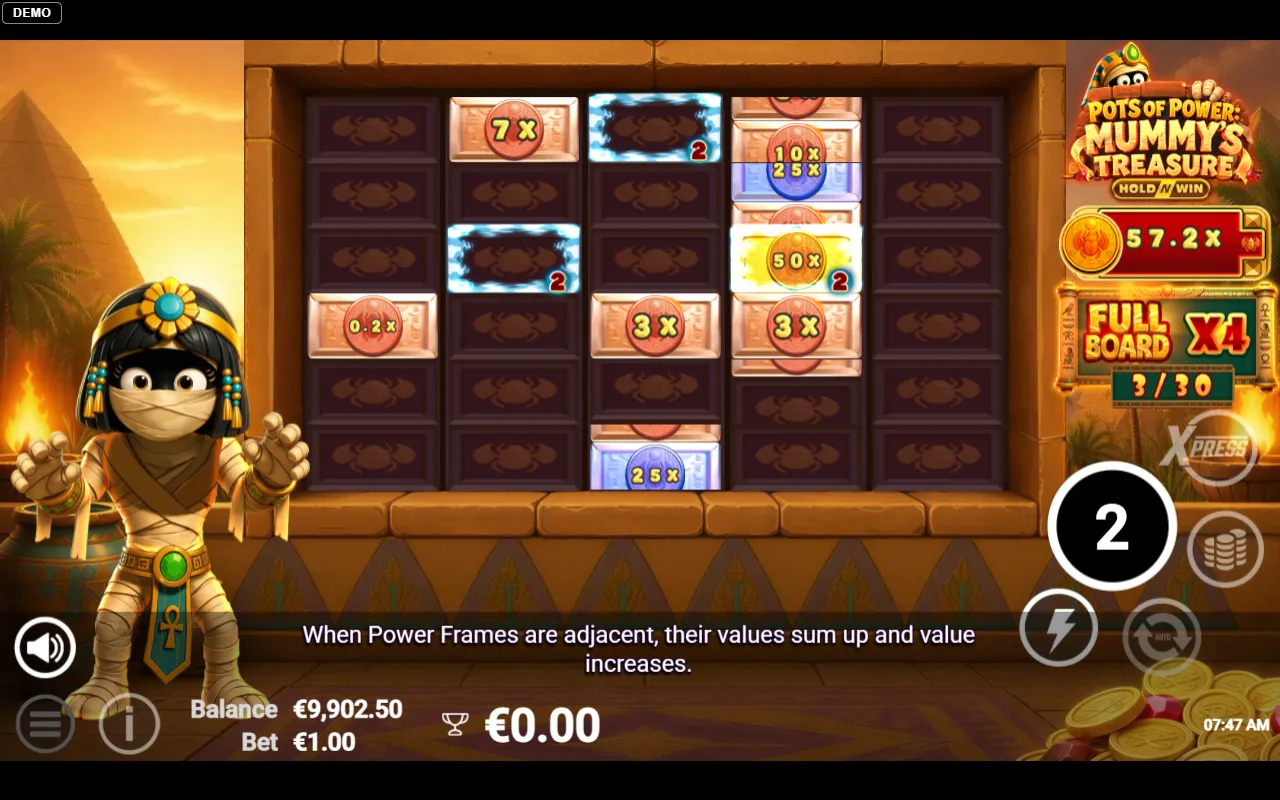
But when they do connect, the mechanic shines. Watching a frame double from 1 to 2 off another frame, then from 2 to 4, and finally coming down on a 50x coin to turn it into 52x is genuinely satisfying. A single good contact can make up the bulk of your round’s total all by itself.
Respins behave the standard way, with one wrinkle worth knowing: the counter resets to the wheel’s starting number rather than climbing by one. If you started with three, every collected coin puts the tally straight back to three. The round ends either when the counter empties or at the 10,000x cap, where the game stops everything mid-round and pays out.
What the buys cost
The game offers two buy buttons. For 100x your bet, you buy a wheel spin. Crucially, this is not the same thing as buying a guaranteed good bonus round: at a flat price, you might get 5 respins on a 5×6 with 4 frames, or you might get stuck with 3 respins on a 5×4 with 2 frames. For 500x, you can hit the maximum buy and skip the lottery entirely, securing 5 spins, a 5×6 grid, 4 frames, and access to that x4 full-board multiplier.
There is also an ante bet at 1.5x per spin. It doubles the chance that the random trigger fires, but it does not improve the wheel, the grid, the frame count, or the ceiling. You are paying half again per spin strictly for frequency.
The pricing runs backwards from most games, and pleasantly so. The base game is 96.10%, the ante is 96.12%, the 100x buy is 96.24%, and the 500x buy is 96.27%. Buying doesn’t cost you a slice of RTP here; it actually hands a sliver back to you.
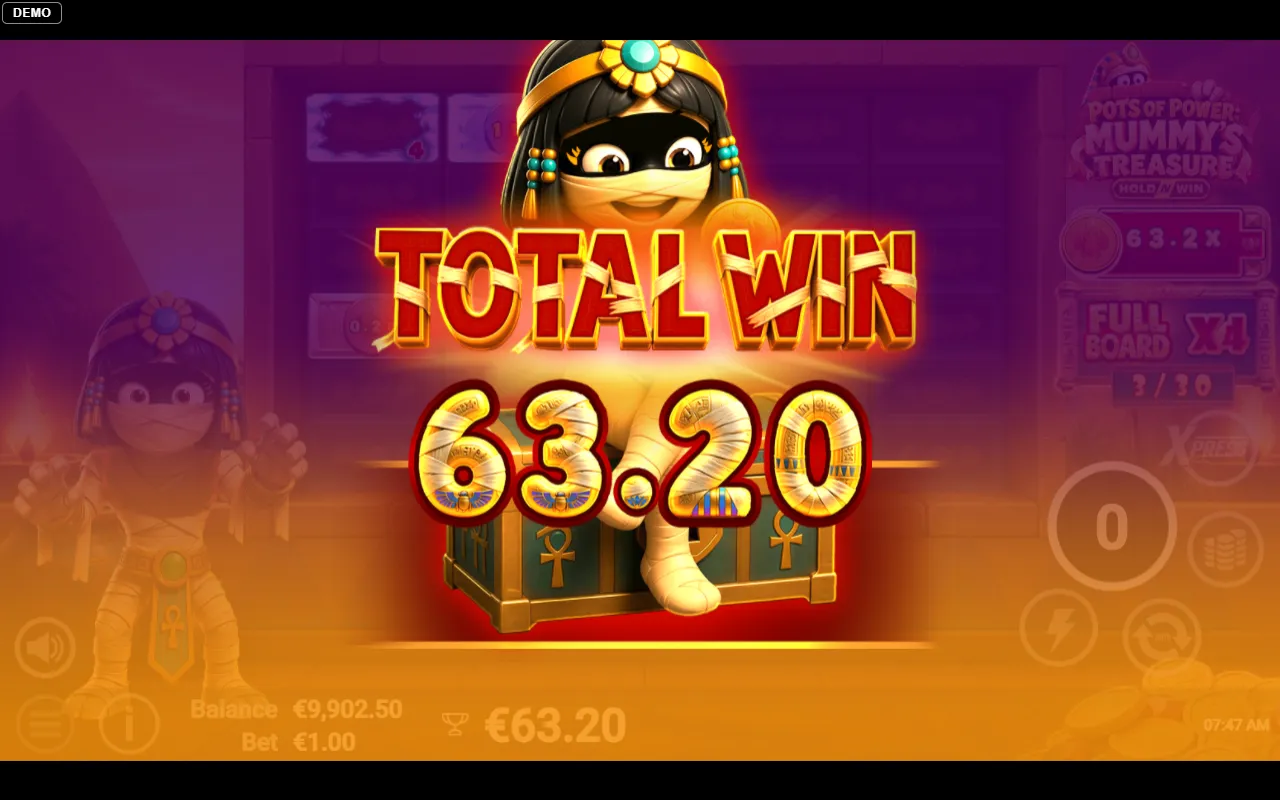
Even with the math in your favor, the cheap buy can be brutal. Paying 100x can easily result in a tough wheel draw, a mostly empty board, and a return like the 63.20 we walked away with after our frames spent most of the round missing their targets.
The base game tops out at 2x
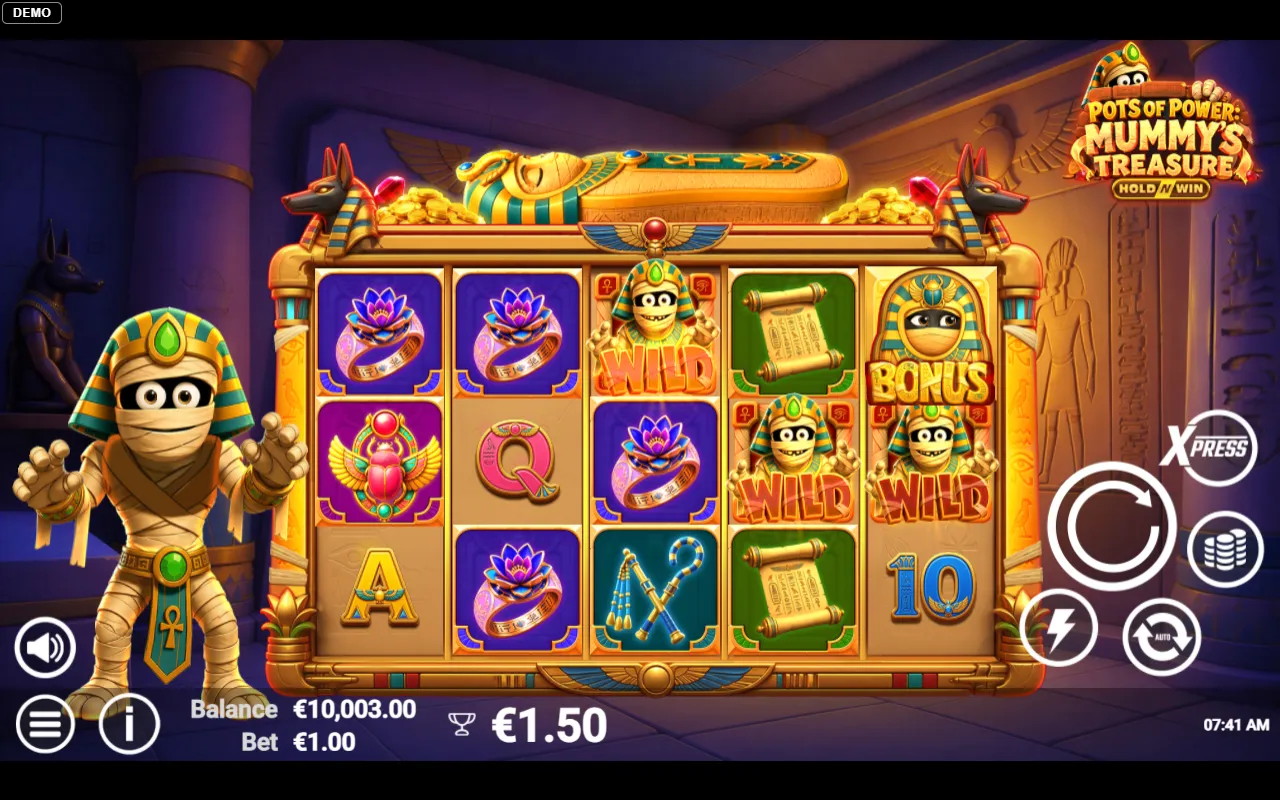
The base game plays across 25 fixed lines, paying left to right, and a run has to start on reel one. Because the symbols are large and the board is only three rows deep, near misses are constant and painfully obvious.
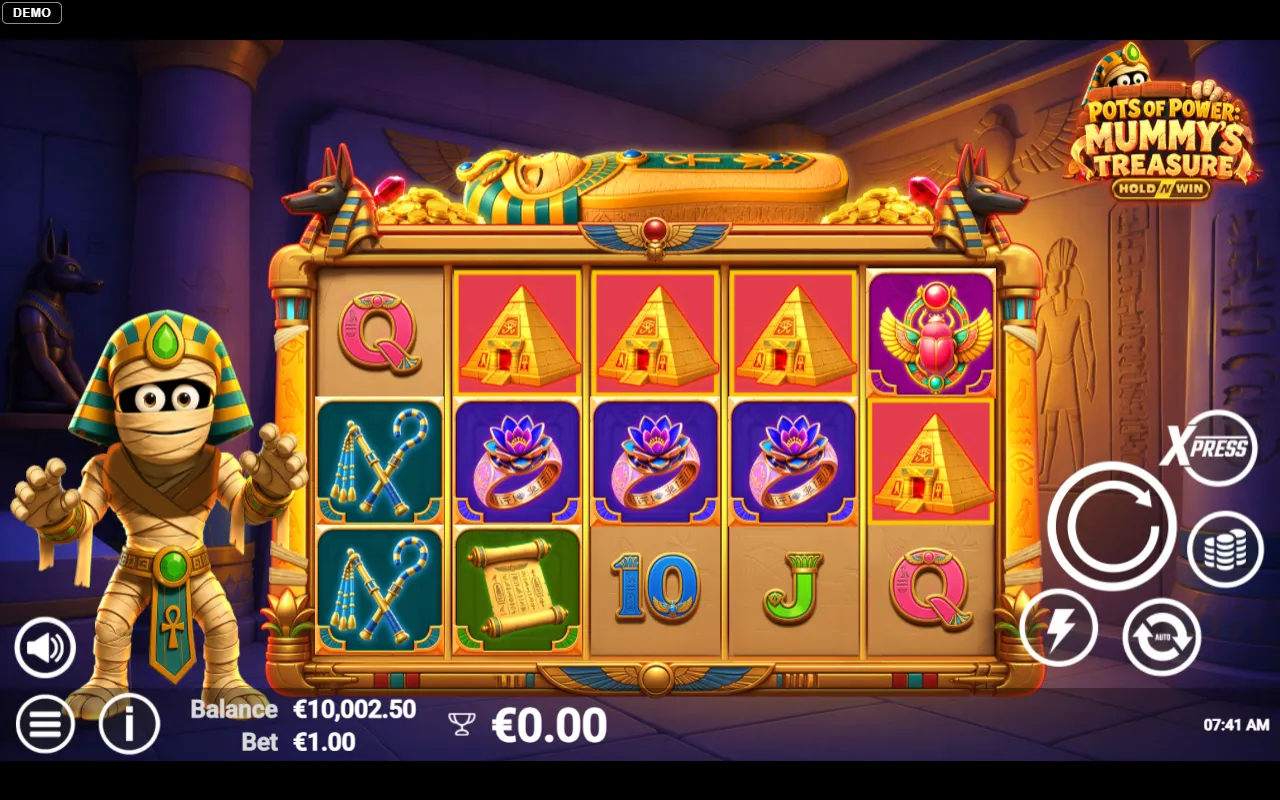
The paytable is the oddest part of the design. There are five high symbols, a pyramid, winged scarab, lotus ring, crossed crook and flail, and a papyrus scroll, and every single one of them pays exactly the same: 2x for five, 1x for four, and 0.5x for three. The five card royals underneath are identical to each other too, at 1.2x, 0.6x, and 0.3x. There is no premium symbol anywhere in the game. A full line of the best thing on the reels returns double your stake. The 10,000x is purely a bonus-round number; the base game cannot get anywhere near it.
The wild is the mummy’s own face. It substitutes for everything except the bonus symbol and does absolutely nothing else, no multipliers, no expanding, no sticking.
The tomb and the two mummies
Visually, the slot operates in two registers that deliberately clash. The tomb is painted straight, filled with deep blue-violet stone, Anubis jackals on plinths, and carved winged scarabs picked out in amber torchlight. Meanwhile, the mascot is a round-headed cartoon mummy with enormous eyes and a green jewel in his headdress. It shouldn’t hold together, but it does, mostly because the heavy sandstone and gold reel frame refuses to be cute about it.
The bonus throws the tomb away entirely, opening onto a sunset exterior of pyramids, palms, and braziers. Here, the Pharaoh is replaced by the Queen. This is the studio’s story paying off rather than just decoration: he is collecting treasure to persuade the gods to wake her, so she only appears once you make it into the round. The card royals are carved stone glyphs rather than flat letters, which rescues the aesthetic a little.
The same machine as Pots of Power: Zeus
If the mechanics feel familiar, it is because Pots of Power: Zeus arrived in May 2026 with the exact same 25 lines, the same Hold & Win, the same 10,000x ceiling, and the same 96.10%. Mummy’s Treasure is essentially that game with Olympus swapped for a tomb. The seam shows in exactly one place: the frames are still marketed as Lightning Frames and still crackle with blue electricity, despite this being a game with no lightning anywhere in it. On screen, the game calls them Power Frames and says nothing about storms.
Pros and Cons
What works
- The wheel makes bonus rounds genuinely different from one another. Twenty-seven setups is more variety than most Hold & Win games ever offer.
- Buying costs no RTP. Scaling from a 96.10% base up to 96.24% and 96.27% on the buys is the right way round, and it is rare.
- Frames merging into each other is a great mechanic that reads clearly. You can watch a 1 become a 2, and then a 4, without having to read a rulebook.
- A single bonus symbol can open the round, so no spin feels completely dead on arrival.
What does not
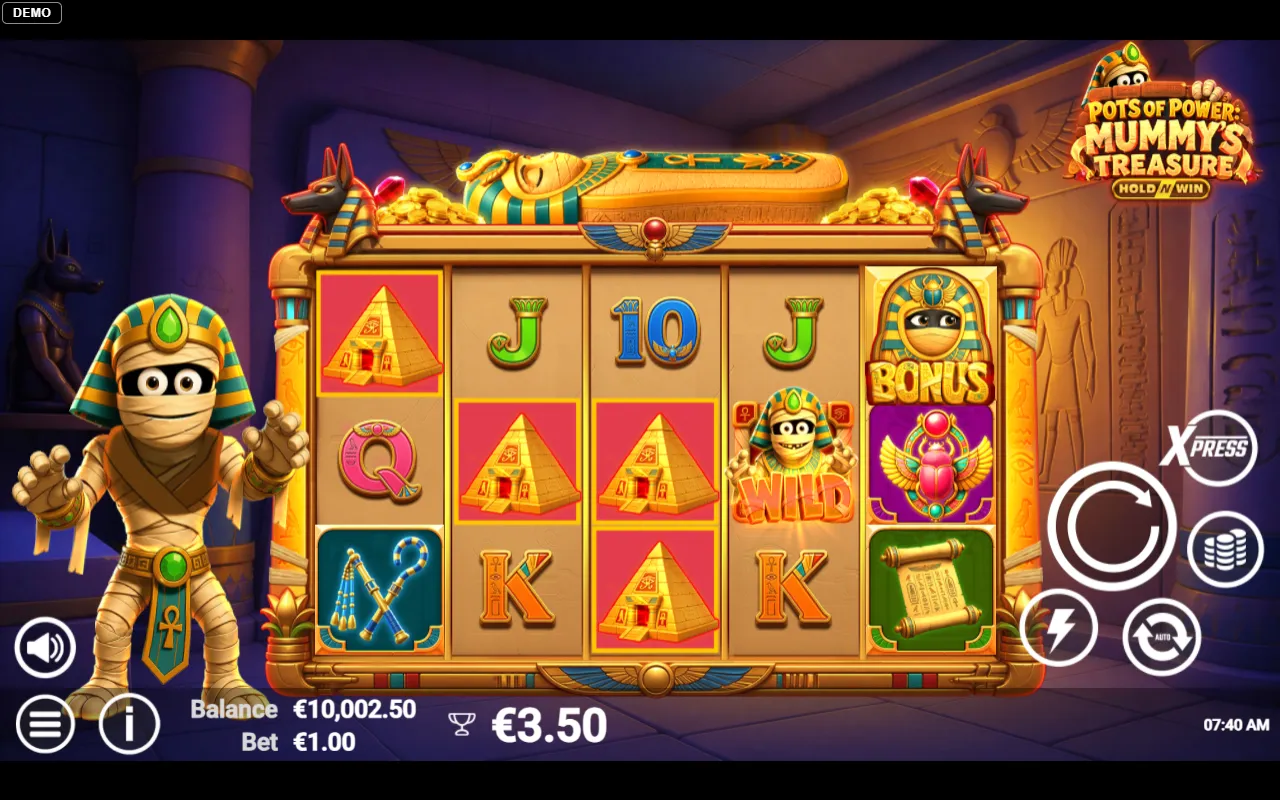
- The base game is pure filler. Five high symbols paying identically means there is nothing on the reels to hope for, and the best possible line pays just 2x.
- At 100x, you are buying a lottery ticket for a lottery. The worst wheel result is 3 respins on a 5×4 with 2 frames, and you pay the same for it as you would for the best.
- The random trigger turns every bonus symbol into a small disappointment, and they land often enough for that feeling to add up.
Verdict
When a 100x buy can easily return something like 63.20, and the base paytable hard-stops at 2x, it becomes clear that the buy button is the whole product. The reels are just a way of passing time until you press it. What saves the game from being ordinary is the wheel. It does something most Hold & Wins don’t bother with: it makes the shape of the round the thing at stake, not just the coins. Three frames on a small board with three respins is a fundamentally different game from four frames on a big one with five, and you feel the difference immediately.
The catch is that at 100x, the wheel decides which of those two games you just paid for. If you are going to spend your bankroll here, spend the 500x once and take the 5×6 board. Thirty cells is the only grid carrying the x4 multiplier, and the cheap button simply won’t reliably hand it to you.