
 Powered by SlotsReach.com
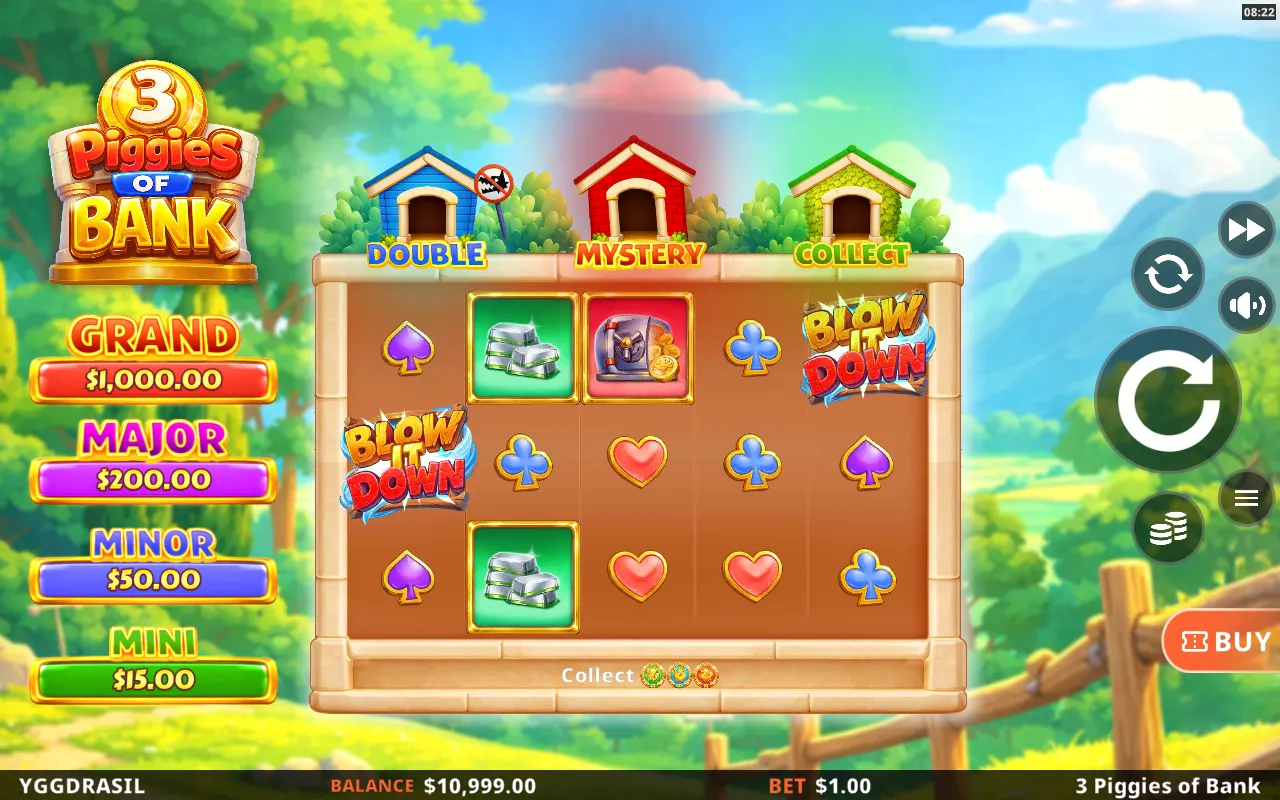
Yggdrasil has taken the classic Three Little Pigs fable and turned the big bad wolf into cold, hard cash. He isn’t blowing any houses down here; instead, his face is stamped on the gold coins you’re trying to collect. Running the show are three pigs overseeing three piggy banks labelled Double, Mystery, and Collect. The bank you land in dictates which of the three hold-and-win rounds you play, and that mechanic is the beating heart of the game.
It plays out on a 5×3 grid with 25 fixed paylines. The volatility sits on the low side, but the ceiling reaches a highly respectable 5,625x your stake. Yggdrasil advertises a 96% return, though casinos can dial that down, and the demo version runs at 94%.
The Three Banks
The main attraction is a hold-and-win bonus, and its underlying shape is comfortably familiar. Coins land, they lock in place, and you are granted five respins. Any new coin that hits resets the counter back to five, and once you are inside the feature, nothing but coins will appear on the reels. When the respins finally run dry, or if you manage to fill all fifteen cells, every value on the board is tallied up and paid out as one lump sum.
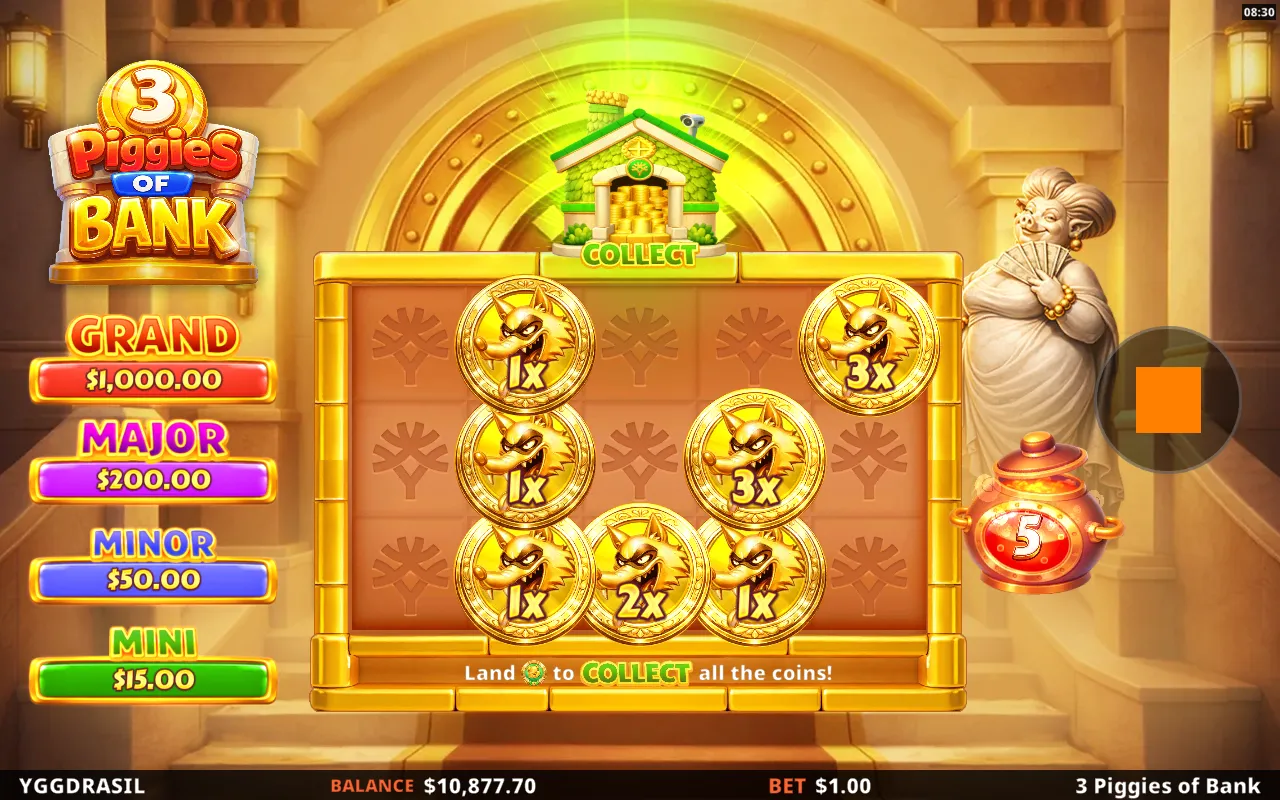
What gives this game its distinct personality is that there are three separate versions of this bonus. Three piggy banks sit above the reels, blue for Double, red for Mystery, and green for Collect. During normal play, every Piggie Coin that lands gets swept into the bank of its matching colour. When six or more Wolf Coins land alongside a Piggie Coin, that specific coin’s colour dictates the round you get.
The three variations differ purely in what the Piggie Coins do once the bonus begins, but the impact is massive. A Collect coin scoops up the total of everything else currently on the board. A Double coin multiplies every existing coin by two, then assumes a random value of its own somewhere between 1x and 150x. A Mystery coin simply takes a random figure from a fixed set, starting at 15x and capping at 150x. Wolf Coins behave identically across all three modes, carrying values between 1x and 10x each.
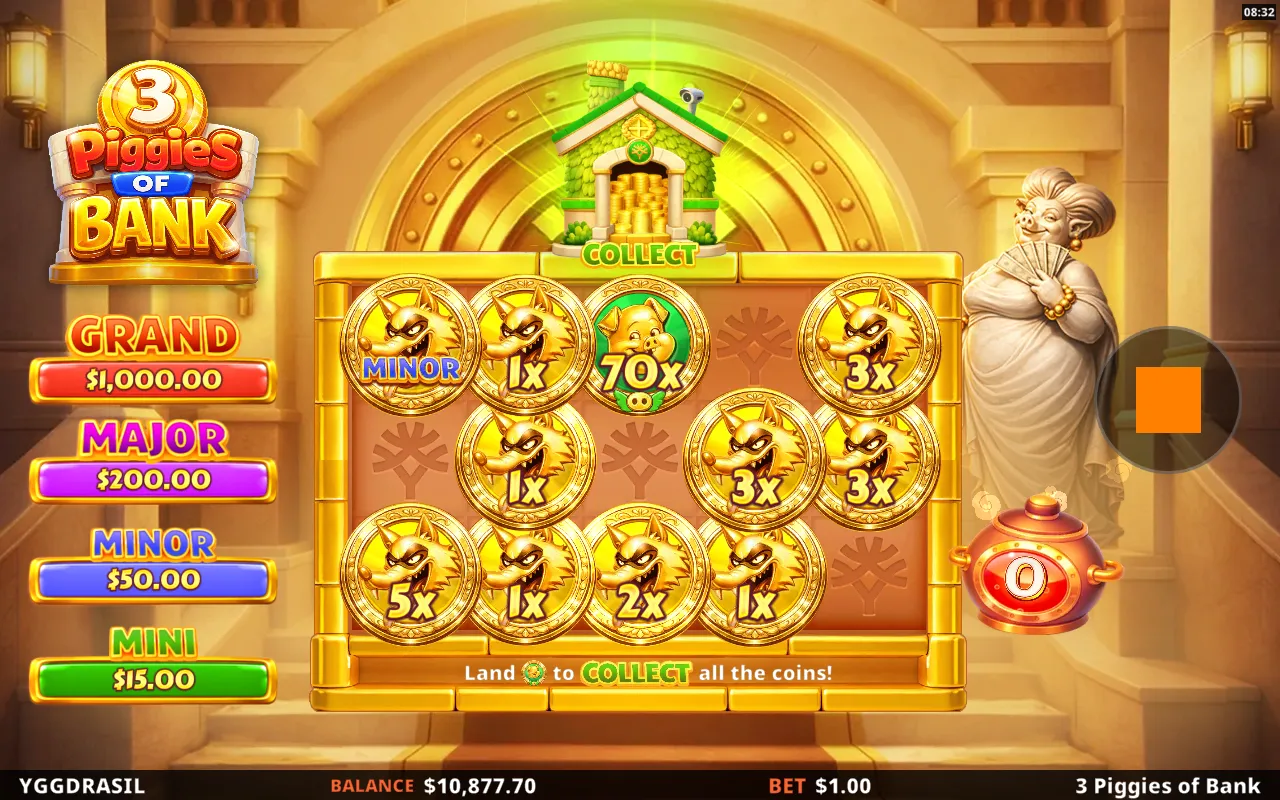
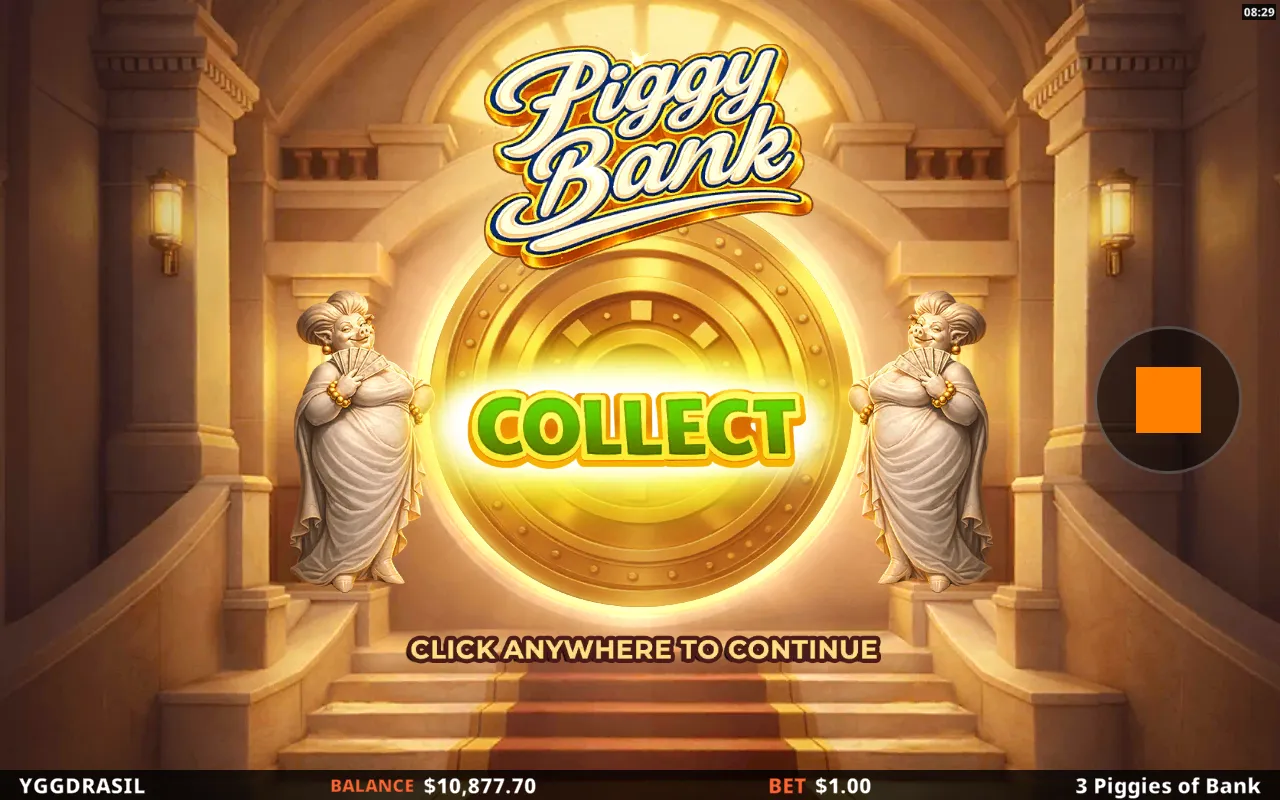
Buying into the Collect round for $120 at a $1 stake gives a great sense of how this math unfolds. During one session, nine Wolf Coins landed across the respins, chipping in 20x between them, before a Minor prize coin dropped in at 50x. The real kicker came when the green pig landed on the top row showing 70x, instantly mirroring the exact total that the rest of the board was holding. The round paid $140. It’s highly satisfying to watch: one Collect coin is effectively worth as much as everything your five respins just spent building. It makes the cheapest buy on the menu incredibly transparent, letting you follow the arithmetic in real-time as your payout swells.
The Four Prizes, and the Ceiling Above Them
Four fixed prizes sit down the left side of the screen, functioning as flat bet multiples rather than progressives: a Mini at 15x, a Minor at 50x, a Major at 200x, and a Grand at 1,000x. The first three show up as special coins landing directly on the bonus board, which is exactly how that Minor turns up during play. The Grand, however, has only one route to trigger: you have to fill every single one of the fifteen cells with a coin. Nothing else awards it.
Crucially, the Grand is not the absolute limit of what this game can pay. The hard ceiling is 5,625x, sitting well above the top plaque. The four prizes on the rail act as visible targets rather than the absolute peak of the game’s potential. It’s worth keeping that in mind so you don’t mistakenly treat the Grand as the finish line.
Five Ways to Buy
The buy menu offers five different entries, effectively ranking the three features by price. Collect is the cheapest at 120x. Mystery costs 150x, tying with the Random option, which drops you into one of the three rounds without revealing which one beforehand. Double is the most expensive of the single features at 180x. Finally, All Banks costs 250x and runs all three features in a single round.
A couple of things stand out here. Double costing the most and Collect the least is a clear indicator of how the studio values its own mechanics. Furthermore, Random is priced exactly at Mystery’s rate, even though it draws from a pool that includes the pricier 180x Double. Notably, all five options run at the exact same return as the base game, a welcome detail that isn’t always a given in modern buy menus.
The Wild, the Free Spins and a Very Flat Paytable
Outside the bonus, the base game offers one main feature. Mamma Pig, a coiffed sow in a gold gown fanning a hand of banknotes, acts as the wild. She substitutes for everything and can stretch upward after the reels settle. Expanding one row pays the win as normal, two rows doubles it, and stretching across the full three rows trebles it. She won’t, however, expand across a scatter.
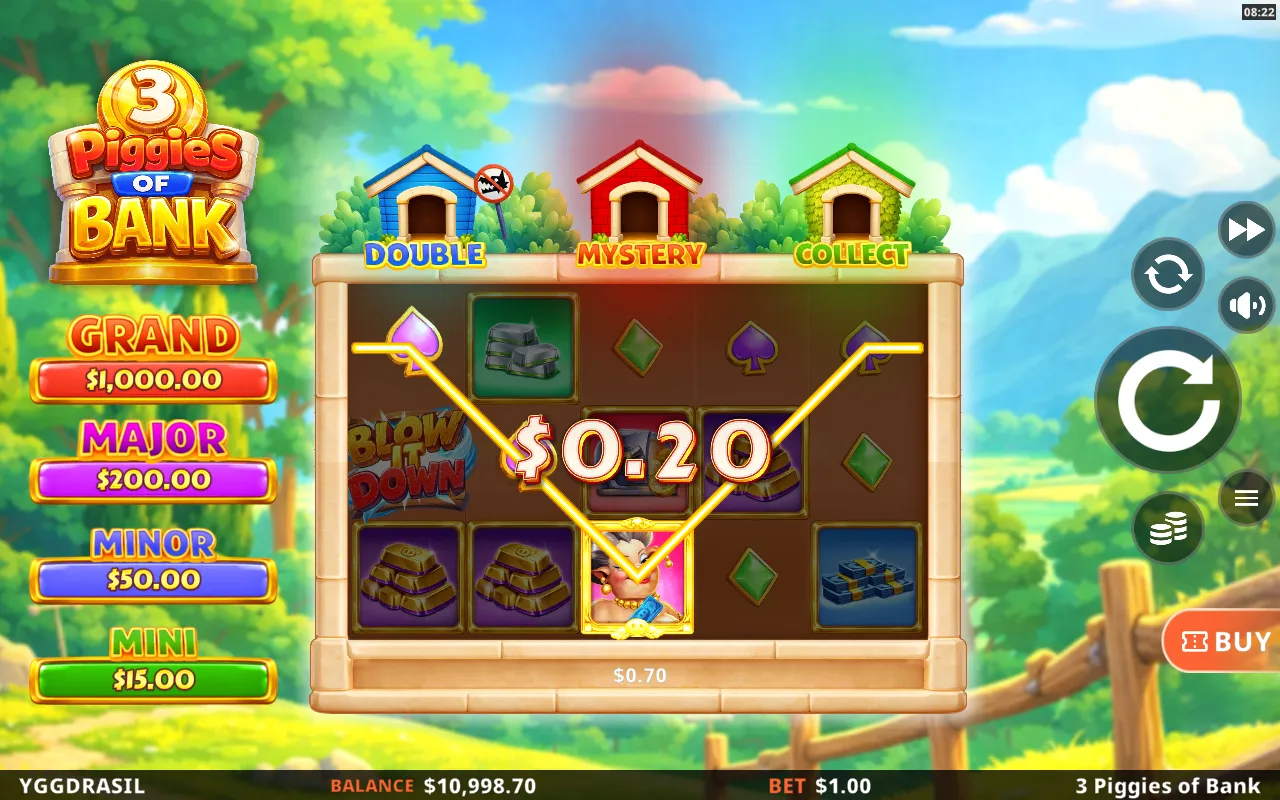
The paytable itself is surprisingly flat, which explains why base game wins often feel quite light. Landing a wild to complete a line of spades might net you a mere $0.20, leaving a whole spin worth just $0.70 on a $1 stake, a very fair sample of what the base game hands out. Landing five of the top symbol, the vault, pays 15x. Five gold bars pay 10x. The four low symbols, the card suits, all pay identically to one another: 0.2x for three, 0.4x for four, and 2x for five. It’s essentially four different pictures carrying the exact same value. Card suits are standard filler on most slots, but they usually manage to at least differ among themselves.
Free spins make up the other half of the game, and they are arguably its weakest element. Landing three scatters awards ten spins on the exact same grid at the same stake. There is no multiplier ladder, no extra reel, and nothing new added to the mix. Coins do continue collecting into the banks, meaning the round can drop you straight into the hold-and-win, and honestly, that is the only real reason to want the free spins. Finding three more scatters during the round simply adds another ten spins.
Storybook Pigs and a Marble Bank
The art style feels like a children’s picture book that’s been allowed to crack one good joke. Everything is highly saturated: grass green, sky blue, and a massive amount of gold. Mamma Pig rocks a bouffant and heavy eyeshadow, while the scatter symbol is a comic wind blast captioned with BLOW IT DOWN. The wolf, traditionally the villain of the story, has been humiliatingly demoted to loose change, just a face stamped on a coin. It’s a clever visual gag that holds up much longer than the base game spins do.
When you win a bonus, the game completely abandons the countryside. The round opens inside a marble bank hall, complete with a massive vault door, statues of Mamma Pig, and a board that turns entirely gold. It’s a proper change of scenery rather than a lazy filter slapped over the same background, and after a stretch of quiet base spins, it does a fantastic job of shifting the mood.
Pros and Cons
Good
- Three genuinely different bonus rounds, not just three names for the exact same mechanic.
- The buy menu lets you choose exactly which of the three rounds you want instead of leaving it to chance, and all five options run at the base game’s return.
- The Collect rule is highly readable while it happens, allowing you to see exactly what the green pig will be worth before it even lands.
- The theme carries its joke all the way through, and the bonus changes the room entirely rather than just recolouring it.
Bad
- Free spins add nothing of their own. You get ten spins on the same grid at the same stake, and their only real value is the chance to trigger the hold-and-win from inside them.
- All four low symbols pay identically, meaning the bottom of the paytable is essentially one value wearing four different costumes.
- Base game payouts are thin. Fifteen times your stake for five vaults is a very small top line on a game that boasts a 5,625x ceiling.
- The Grand prize demands all fifteen cells be filled, which can be a frustratingly steep climb even when you have a full set of respins behind you.
Verdict
Watching a $120 Collect buy return $140, with 70x of that coming from a single green pig at the very end, perfectly encapsulates what this game is all about. The three banks are the entire product. The base game is simply a way of reaching them, and the free spins are just a slightly cheaper vehicle for doing the same. It is competent, it is highly likeable, and it isn’t trying to be anything more than that. The three bonus flavours are a great idea executed properly, and pricing them separately treats the player as someone who might actually have a preference, which is far more thought than most buy menus ever show. Anyone looking for a solid hold-and-win with arithmetic they can easily follow while it’s running should spend the 120x on Collect, where the pig’s value is nothing more complicated than the rest of the board added up.